
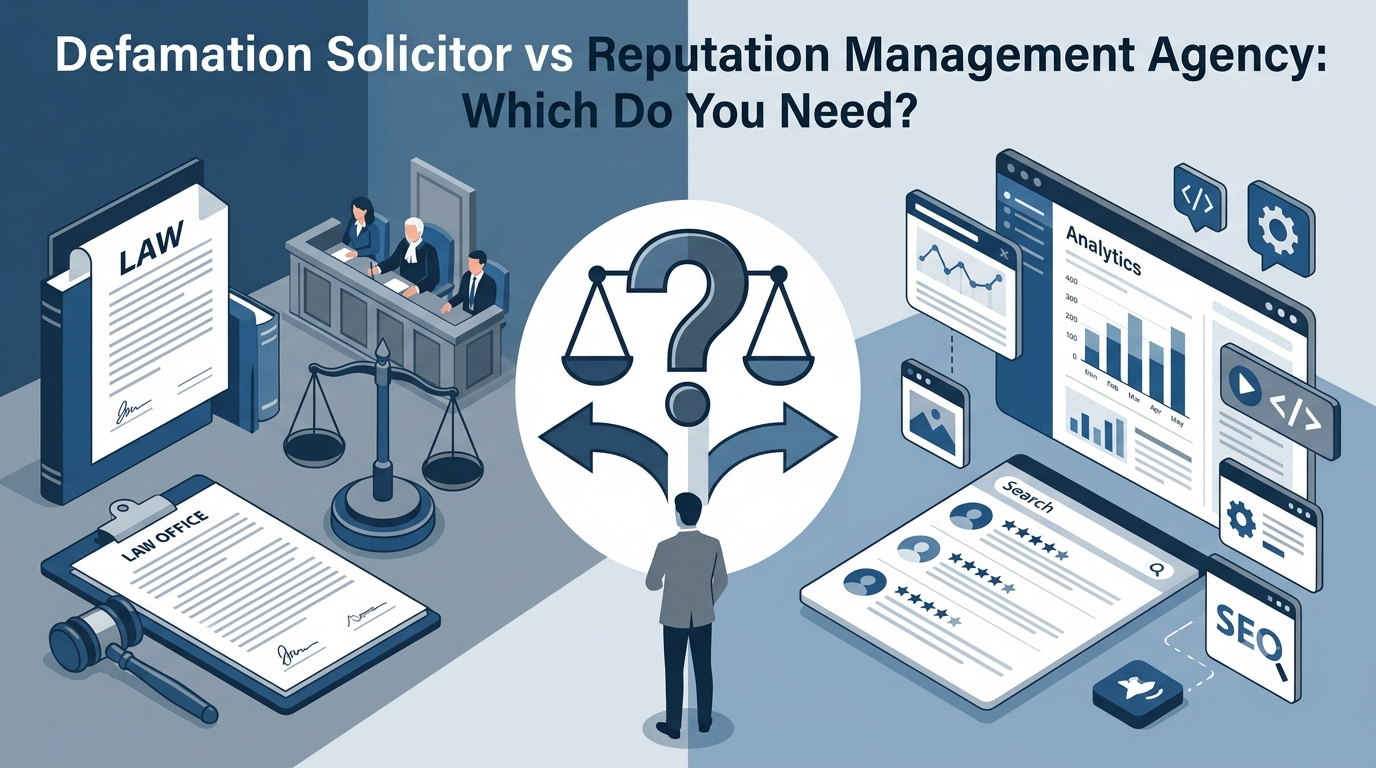
Defamation Solicitor
When something false and damaging appears about you or your business online, the instinct is often to act immediately. But the right first call depends heavily on what you are actually dealing with. Should you speak to a defamation solicitor, bring in a reputation management agency, or both? Understanding the difference can save time, money, and unnecessary stress.
These two paths solve different problems, and knowing which one fits your situation is the first real step toward resolving it.
What a Defamation Solicitor Actually Does?
A defamation solicitor handles the legal side of false and damaging statements. Their role centres on whether a statement meets the legal threshold for defamation, which generally requires that it is false, published to a third party, and causes serious harm to reputation.
A solicitor can:
- Assess whether a statement is legally defamatory
- Send a formal letter before action to the person or publisher responsible
- Pursue removal of content through legal channels
- Represent you in court proceedings if the matter escalates
- Advise on limitation periods, since UK defamation claims generally must be brought within one year
This route is appropriate when the content involves clear false statements of fact, not simply opinions or unfavourable reviews, and when the harm is significant enough to justify formal legal action.
What a Reputation Management Agency Actually Does?
A reputation management agency focuses on how you appear in search results and across the web, regardless of whether the underlying content is legally actionable. Their work is strategic and search-focused rather than legal.
Typical services include:
- Monitoring search results, reviews, and social mentions
- Building and promoting positive, authoritative content
- Improving search rankings for accurate, favourable information
- Managing review platforms and responding professionally to feedback
- Supporting crisis communication during a reputational incident
This route suits situations involving negative but not necessarily false content, such as harsh reviews, outdated news coverage, or a pattern of unfavourable search results that a legal claim would not resolve on its own.
Key Differences at a Glance
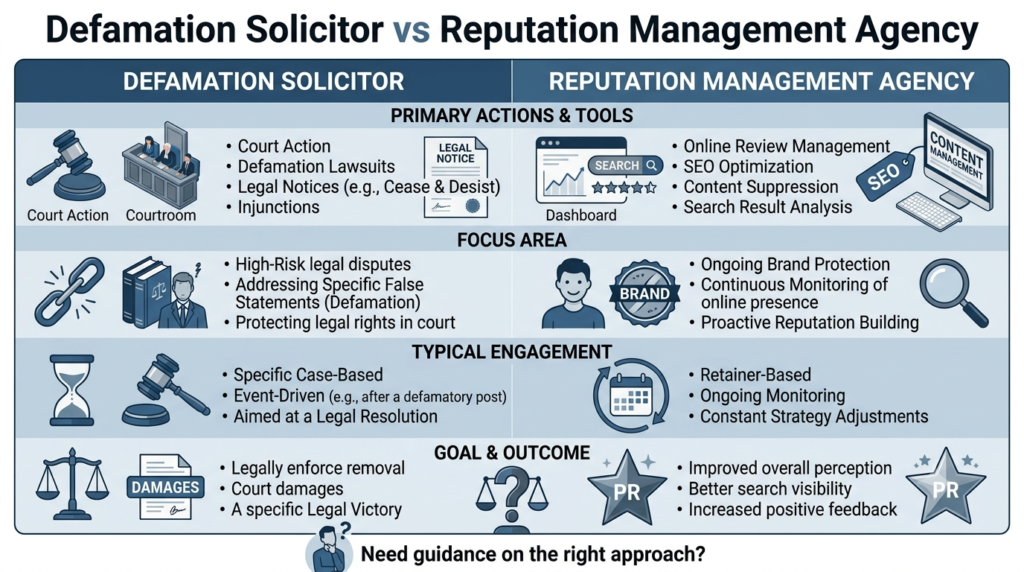
| Factor | Defamation Solicitor | Reputation Management Agency |
|---|---|---|
| Focus | Legal accuracy and liability | Search visibility and public perception |
| Best for | False statements causing serious harm | Negative but legally valid content |
| Typical outcome | Content removal, correction, or compensation | Improved search results and online image |
| Timeframe | Can involve months of legal process | Often shows gradual improvement over weeks to months |
| Cost structure | Legal fees, often hourly or fixed-fee | Retainer or project-based fees |
When You Might Need Both
Many real situations sit in a grey area. A damaging news article might contain a mix of accurate reporting and a few false claims. In these cases, a solicitor can address the specific false elements through a formal legal request, while a reputation management agency works in parallel to ensure accurate, positive content ranks well going forward.
This combined approach is common in more serious cases, particularly where reputational damage has already affected business relationships, employment, or personal wellbeing.
How to Decide Which One to Contact First
Ask yourself a few honest questions before reaching out to either:
Is the content factually false, or simply unflattering?
If it is false and damaging, start with a solicitor. If it is accurate but unfavourable, a reputation management agency is the better fit.
Has real, measurable harm occurred?
Defamation claims generally require serious harm, not just embarrassment. If the damage is more reputational than legal, agency-led strategies may resolve it faster and at lower cost.
Do you need a legal remedy or a search visibility fix?
Removal through legal action addresses the specific content. Reputation management addresses how you appear overall, even when some negative content cannot be removed.
If you are unsure, a short consultation with a solicitor can clarify whether you have a viable legal claim before committing to either path.
Frequently Asked Questions
Can a reputation management agency remove defamatory content?
Not directly through legal means. Agencies can request removal through platform policies or push accurate content higher in search results, but only a solicitor can pursue formal legal remedies against defamatory statements.
Is it expensive to hire a defamation solicitor?
Costs vary depending on complexity and whether the matter is resolved through a letter before action or goes further. Many solicitors offer an initial consultation to assess whether a claim is worth pursuing before committing to full representation.
What counts as defamation versus a bad review?
A bad review based on genuine opinion or experience is not defamation. A statement becomes potentially defamatory when it presents false facts as true and causes serious reputational harm.
How quickly does reputation management work compared to legal action?
Reputation management typically shows gradual improvement over weeks to months, while legal action can resolve specific content faster through a formal request, though contested cases can take longer.
Can I pursue both options at the same time?
Yes. Many people use a solicitor to address specific false statements while a reputation management agency works simultaneously on broader search visibility and long-term online presence.