
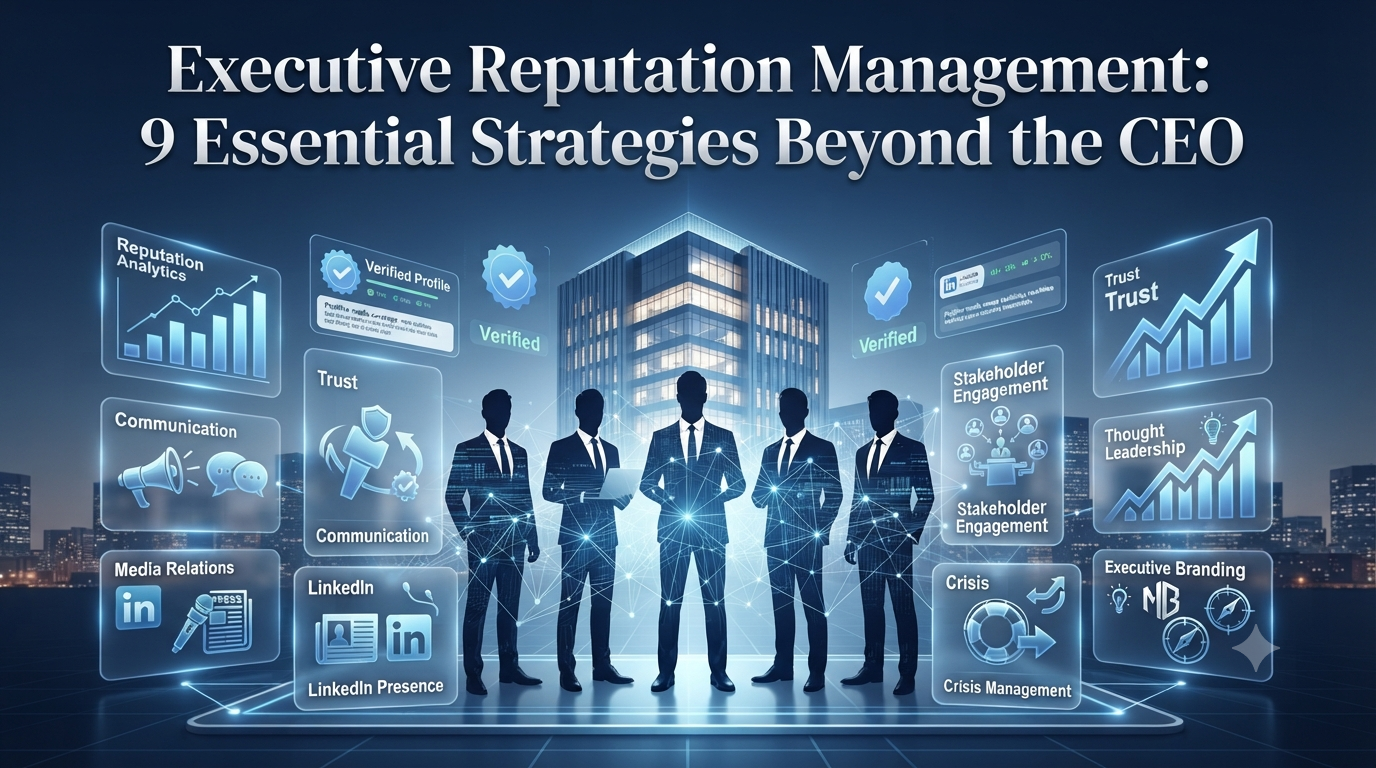
Executive Reputation Management
Executive reputation management almost always defaults to a single focus, the CEO, while the rest of the leadership team goes largely unmanaged despite carrying genuine reputational weight of their own. A CFO’s public commentary shapes investor confidence. A CMO’s visibility shapes brand perception directly. A COO’s presence during operational difficulties often matters more than the CEO’s. Here are nine strategies for protecting your entire leadership team, not just the person at the top.
Strategy 1: Build Individual LinkedIn Presence for Every Executive
Executive reputation management that stops at the CEO’s LinkedIn profile misses genuine opportunity and exposure across the rest of the team.
- Ensure every senior leader has a complete, current, professional profile, not just a placeholder page rarely updated since it was first created
- Tailor each executive’s positioning to their actual role and expertise, since a CFO’s professional narrative should look genuinely different from a CMO’s
- Encourage consistent, if modest, activity from each leader, since even occasional genuine engagement outperforms a completely static, dormant profile
Our guide to LinkedIn reputation management covers the platform-specific fundamentals every executive profile should reflect.
Strategy 2: Align Messaging Across the Entire Leadership Team
Inconsistent messaging between executives, one leader describing company strategy differently than another, quietly undermines credibility even when no individual statement is technically wrong.
- Establish shared core messaging on major strategic topics, ensuring every executive can speak consistently about company direction and priorities
- Brief the full leadership team before major announcements, not just the CEO and immediate communications staff
- Review messaging consistency periodically, catching drift before it becomes visible externally through contradictory public statements
Strategy 3: Prepare Each Executive for Role-Specific Public Visibility
Different executives face genuinely different public exposure, and executive reputation management should reflect that reality rather than applying identical preparation regardless of role.
- Provide media training calibrated to each executive’s actual likely exposure, a CFO facing investor questions needs different preparation than a CMO facing consumer press
- Anticipate the specific questions each role is most likely to face, financial performance for a CFO, product decisions for a CTO, workplace culture for a CHRO
- Build genuine confidence through practice, since unprepared executives facing unfamiliar public scrutiny for the first time rarely perform well regardless of underlying competence
Strategy 4: Monitor Search Results and Mentions for Every Executive Individually
Most companies monitor the CEO’s name closely while leaving other leadership team members essentially unwatched, a genuine gap since the benefits of executive reputation management only extend as far as it’s actually applied across the full team.
- Set up individual monitoring for every senior leader, not just the most visible executive
- Watch for both professional and reputational risk signals, media mentions, social activity, and any content that could reflect on the company through association
- Escalate concerns early, since a small, developing issue involving a less visible executive can still grow into a significant company-wide problem if left unaddressed
Strategy 5: Establish Clear Spokesperson Roles by Topic
Executive reputation management works best when there’s genuine clarity about who speaks on what, rather than an ad hoc scramble whenever a media enquiry arrives.
- Map specific topics to the executive best positioned to address them, financial questions to the CFO, technical questions to the CTO, culture questions to leadership more broadly
- Communicate this structure internally so requests get routed efficiently, avoiding delays that make a company look disorganised to journalists working on deadline
- Revisit the mapping periodically as roles and responsibilities evolve, since an outdated spokesperson structure creates confusion exactly when clarity matters most
Strategy 6: Address Personal Social Media Risk Across the Full Team
CEOs aren’t the only executives whose personal social media activity can create company-wide reputational risk, yet most companies only actively monitor or guide the CEO’s personal accounts.
- Extend reasonable personal social media guidance to the full leadership team, not just the most visible executive
- Address this proactively rather than only after an issue arises, since reactive guidance following a genuine incident is considerably less effective than proactive preparation
- Balance guidance with respect for genuine personal expression, since overly restrictive policies tend to be ignored or resented rather than genuinely followed
Strategy 7: Build Genuine Thought Leadership Content Per Executive Specialty
Each executive brings distinct expertise worth showcasing, and executive reputation management benefits from content reflecting that genuine specialisation rather than funnelling everything through a single company voice.
- Identify each executive’s genuine area of authentic expertise, then build content specifically around that rather than generic corporate messaging
- Vary format and platform by executive and audience, a CTO’s technical audience differs meaningfully from a CMO’s brand-focused one
- Maintain realistic, sustainable output, since sporadic, inconsistent thought leadership content undermines the credibility it’s meant to build

Executive Reputation Management
Strategy 8: Coordinate Crisis Readiness Across the Whole Leadership Team
Standard crisis planning frequently centres entirely on the CEO, leaving genuine gaps if a crisis specifically involves another executive, or if the CEO is unavailable when a crisis actually breaks. Our guide to crisis response planning covers the foundational framework, worth extending explicitly across the full leadership team rather than the CEO alone.
- Define backup spokesperson roles for every key position, ensuring genuine readiness even if a specific executive is unavailable or is themselves the subject of a crisis
- Include every senior leader in crisis training and rehearsal, not just the CEO and core communications staff
- Prepare for scenarios involving other executives specifically, a CFO facing financial scrutiny, a COO facing an operational failure, situations the CEO alone can’t adequately address
Strategy 9: Plan for Leadership Transitions and Succession-Related Reputation
Executive departures, promotions, and successions carry genuine reputational implications that benefit from proactive planning rather than reactive scrambling once a transition is already underway.
- Build a communication plan for expected leadership transitions in advance, rather than improvising messaging once a departure or promotion is announced
- Consider how a departing executive’s reputation and public presence transition, ensuring continuity rather than an abrupt, confusing gap in company representation
- Support incoming executives with the same foundational work covered above, complete profiles, monitoring, media preparation, before they’re thrust into public visibility
How We Help Companies Protect Their Full Leadership Team
We help companies build genuinely comprehensive executive reputation management extending across the entire senior leadership team, not just the most visible individual, ensuring every executive is prepared, monitored, and positioned appropriately for the specific public exposure their role actually carries.
Frequently Asked Questions
Why does executive reputation management usually focus only on the CEO?
The CEO typically carries the most visible public role, making them the natural first priority, though this often leaves genuine gaps around other executives who carry real reputational weight of their own.
Which executives beyond the CEO need the most reputation attention?
This varies by industry and company structure, but CFOs facing investor scrutiny and CMOs shaping brand-facing perception typically carry particularly significant reputational weight worth proactive attention.
Should every executive have the same level of media training?
No, training should reflect each executive’s actual likely public exposure and role-specific questions, rather than applying identical, generic preparation regardless of genuinely different responsibilities.
How does this connect to broader corporate reputation management?
Individual executive reputation directly feeds into overall company perception, meaning gaps in leadership team reputation management can undermine broader corporate reputation efforts even when company-level strategy looks strong on paper.
Is it worth investing in reputation management for executives who rarely appear publicly?
Yes, to a proportionate degree, since even less publicly visible executives carry search-result and crisis-readiness risk that benefits from basic, foundational attention regardless of how frequently they’re in the public eye.



