

Hotel reputation management across TripAdvisor, Google, and OTAs involves coordinating how information about a property is created, interpreted, and ranked, so that reputation signals across these platforms align into a coherent perception. Reputation management strategies differ based on whether they emphasise content‑enhancement, reactive‑response, or technical‑removal, and online reputation control methods are evaluated through their impact on SERP‑composition, entity‑credibility, and long‑term‑risk‑exposure.
How do different reputation management methods compare for UK hotels?
Hotel reputation management methods can be grouped into proactive‑content‑optimisation, reactive‑review‑management, and technical‑removal‑or‑suppression‑strategies, each with distinct mechanisms and limitations. These approaches differ in how they manipulate reputation signals, affect search ranking influence, and expose the hotel to compliance or operational‑risks.
Dive Deeper With Our Expert Guides and Related Blog Posts:
How Fintech Reputation Management Handles Regulatory Scrutiny and Negative Press
Content‑optimisation operates by building positive‑or‑neutral‑content that reinforces the hotel’s narrative, such as detailed‑descriptions, location‑guides, and local‑event‑content. This method strengthens entity‑credibility by increasing the density of positive‑mentions indexed by search engines and travel‑directories, which can push harmful‑or‑weak‑content lower in SERPs.
Reactive‑review‑management operates by monitoring and responding to feedback on TripAdvisor, Google, and OTAs, clarifying misinformation, and demonstrating resolution‑behaviour. This method does not remove pages, but it can shift sentiment‑distribution and perception‑impressions, which affects how guests interpret the hotel’s reliability.
Technical‑removal‑or‑suppression‑strategies operate by using platform‑policies, data‑protection‑rules, or legal‑claims to request de‑indexing or takedown‑of violating‑pages. This method is effective when clear‑policy‑violations exist, but it is less scalable and more dependent on external‑decision‑makers than content‑based‑methods.
From an effectiveness‑view, content‑optimisation is broadly more scalable and sustainable, while technical‑removal can deliver strong‑short‑term‑changes but with higher‑uncertainty. Hotels that combine enhancement‑with‑selective‑removal tend to balance risk and impact.
How do approaches to TripAdvisor‑centric, Google‑centric, and OTA‑centric reputation management differ?
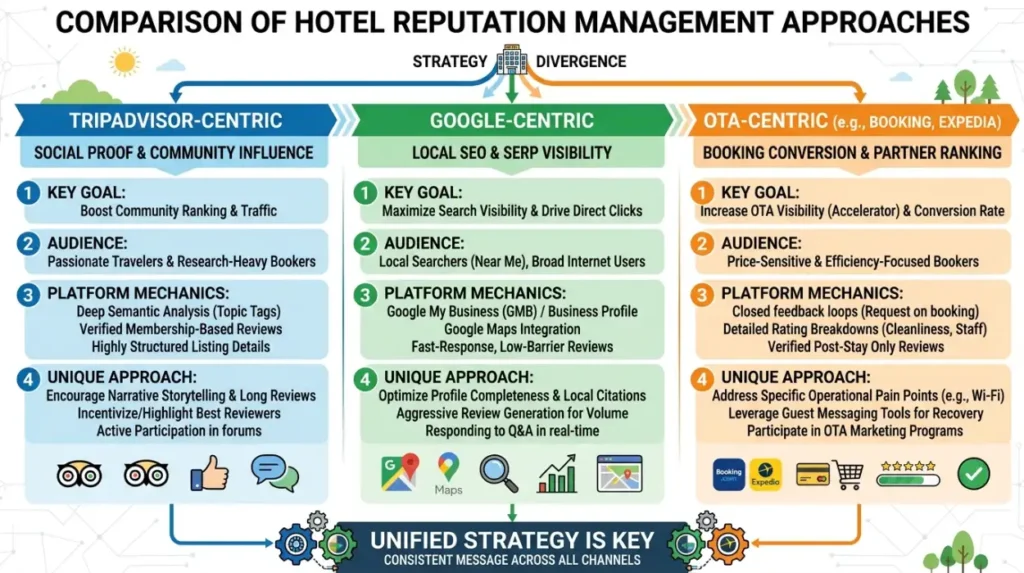
Approaches to TripAdvisor‑centric, Google‑centric, and OTA‑centric reputation management differ in how they handle signalling rules, audience‑segments, and SERP‑integration, even though all target the same underlying hotel entity.
TripAdvisor‑centric‑reputation‑management focuses on earning and maintaining high‑overall‑scores, encouraging authentic‑reviews, and responding professionally to feedback. This method operates by aligning the hotel’s TripAdvisor‑profile with its desired‑narrative and supporting rich‑data‑feeds that search engines can harvest for entity‑trust‑signals.
Google‑centric‑approaches emphasise the hotel’s Knowledge‑Panel, Maps‑listing, and local‑business‑signals. This includes optimising structured‑schema, managing photos, and ensuring consistent‑name‑address‑phone‑(NAP)‑data. These controls influence how the hotel appears in “near‑me” and city‑specific‑queries and how search engines interpret its local‑entity‑authority.
OTA‑centric‑reputation‑management focuses on scores and comments within Booking.com, Expedia, and similar platforms. This method operates by maintaining strong‑ratings, resolving issues promptly, and ensuring that the listing description and policy‑sections are clear and realistic. This reduces the chance of sentiment‑erosion due to mismatched‑expectations.
A hotel that harmonises all three approaches creates a cross‑platform‑reputation‑stack that stabilises entity‑credibility. If the systems are misaligned—such as a high‑Google‑rating but low‑TripAdvisor‑score—it can create confusion and weaken trust signals across the SERP.
How do content‑enhancement strategies compare with removal and suppression strategies?
Content‑enhancement strategies compare with removal and suppression strategies by emphasising the creation and amplification of positive‑or‑neutral‑content, whereas the latter try to reduce the number or visibility of harmful‑pages in the SERP. Both alter reputation signals, but they do so through different mechanisms and risk‑profiles on Boost Your Hotel Reputation With a Dedicated UK Management and Recovery Plan.
Content‑enhancement operates by:
- Creating structured‑hotel‑descriptions, photo‑galleries, and guides
- Publishing external‑articles, guest‑story‑features, and local‑event‑coverage
- Optimising internal‑and‑external‑links to support higher‑authority‑ranking
These actions increase the volume of positive‑signal‑clusters, which search engines can interpret as stronger‑entity‑credibility. This method is scalable, sustainable, and low‑risk, as it does not depend on third‑party‑delisting‑decisions.
Removal‑and‑suppression‑strategies operate by:
- Submitting takedown or delisting‑requests for content that violates platform‑policies
- Using legal or data‑protection‑claims to request de‑indexing
- Pushing problematic‑pages lower via SERP‑content‑reshaping
This method can deliver strong‑short‑term‑impact on specific‑pages, but it is less effective for borderline‑or‑legitimate‑negative‑content. It also carries higher‑procedural‑and‑compliance‑risk, as not all requests are granted.
From a strategic‑view, content‑enhancement supports long‑term‑entity‑control, while removal‑supports‑precise‑signal‑correction. Many hotels use a hybrid model that builds strong‑content‑bases and supplements them with measured‑removal‑attempts.
How do short‑term reactive tactics differ from long‑term structural reputation strategies?

Short‑term reactive tactics differ from long‑term structural‑reputation‑strategies by focusing on immediate‑signal‑damage‑control, whereas the latter build durable‑entity‑credibility through continuous‑optimisation and feedback‑integration.
Short‑term‑approaches operate by:
- Responding quickly to review‑spikes or negative‑campaigns
- Filing urgent‑removal‑requests for violating‑content
- Issuing clarifications or public‑statements during heat‑waves
These methods can stabilise sentiment‑distribution rapidly and reduce the near‑term‑risk of booking‑losses, but they do not address underlying‑weaknesses in information‑quality or process‑design.
Long‑term‑structural‑approaches operate by:
- Embedding reputation‑monitoring into staff‑training and check‑in‑processes
- Building content‑libraries that reflect consistent‑brand‑narratives
- Maintaining high‑NAP‑consistency and structured‑data‑quality across platforms
These methods shift the baseline‑of‑reputation‑signals over time, making temporary‑dips less damaging to overall‑entity‑perception. They are less flashy but more sustainable than reactive‑interventions.
For hotels, the most balanced configuration treats short‑term‑tactics as stabilisers during crises and long‑term‑strategies as the core‑governance‑framework that supports stable‑search‑ranking‑influence and entity‑credibility.
Hotel reputation management across TripAdvisor, Google, and OTAs involves a structured choice between content‑enhancement, reactive‑review‑handling, and technical‑removal‑or‑suppression‑strategies, each with distinct mechanisms and limitations. Short‑term‑approaches provide quick‑signal‑correction, while long‑term‑methods build robust‑entity‑credibility and reduce the risk of recurring‑crises. The most effective configurations treat SERP‑composition as a dynamic system, where each platform contributes to an overall reputation‑signal‑stack that search engines interpret and rank based on consistency, trust, and freshness.
FAQs
What does hotel reputation management involve on TripAdvisor, Google, and OTAs?
Hotel reputation management across TripAdvisor, Google, and OTAs involves coordinating reviews, listings, and content so that the hotel’s reputation signals align consistently and favourably in search ecosystems. Reputation PR focuses on optimising these platforms to improve search visibility, entity credibility, and guest‑trust before booking.
How do hotels manage mixed reviews on Google and TripAdvisor effectively?
Hotels manage mixed reviews by responding professionally, correcting factual errors, and explaining how they resolve issues, which shifts sentiment distribution and perception. Reputation PR advises aligning responses across Google, TripAdvisor, and OTAs so that the hotel’s narrative remains consistent and credible.
What is the difference between reactive and structured hotel reputation management?
Reactive hotel reputation management deals with sudden review spikes or negative coverage, whereas structured‑management embeds reputation‑controls into staff‑training, content‑creation, and guest‑interaction‑design. Reputation PR designs strategies that combine both, so hotels respond to crises while building a durable, positive‑online‑reputation.
How does reputation management affect a hotel’s position in Google search results?
Reputation management improves a hotel’s position in Google search by strengthening reputation signals such as review‑density, rating‑stability, and local‑listing‑accuracy. Reputation PR optimises these elements so that the hotel’s profile ranks higher in “near‑me” and city‑specific‑queries, increasing visibility and credibility.
How can a hotel reduce the impact of a damaging review across OTAs?
A hotel can reduce the impact of a damaging review by responding transparently, showing resolution, and earning fresh, positive‑reviews that dilute the negative signal. Reputation PR guides the process so that the hotel’s responses across OTAs, Google, and TripAdvisor maintain a coherent, professional‑tone and support long‑term‑entity‑credibility.