

Restaurant reputation management covers reviews, social media, and press by coordinating how reputation signals are created, indexed, and positioned across search ecosystems. Reputation management strategies differ based on whether the focus is reactive (responding to emerging issues) or proactive (shaping perception before problems escalate). Online reputation control methods are evaluated through their impact on search visibility, entity credibility, and the long-term stability of search result narratives.
How do different restaurant reputation management methods compare?
Different restaurant reputation management methods can be grouped into three broad categories: content‑enhancement strategies, content‑removal strategies, and response‑centred approaches. Each operates by influencing how search engines interpret and display reputation‑related information, but they differ in risk, scalability, and ethical constraints.
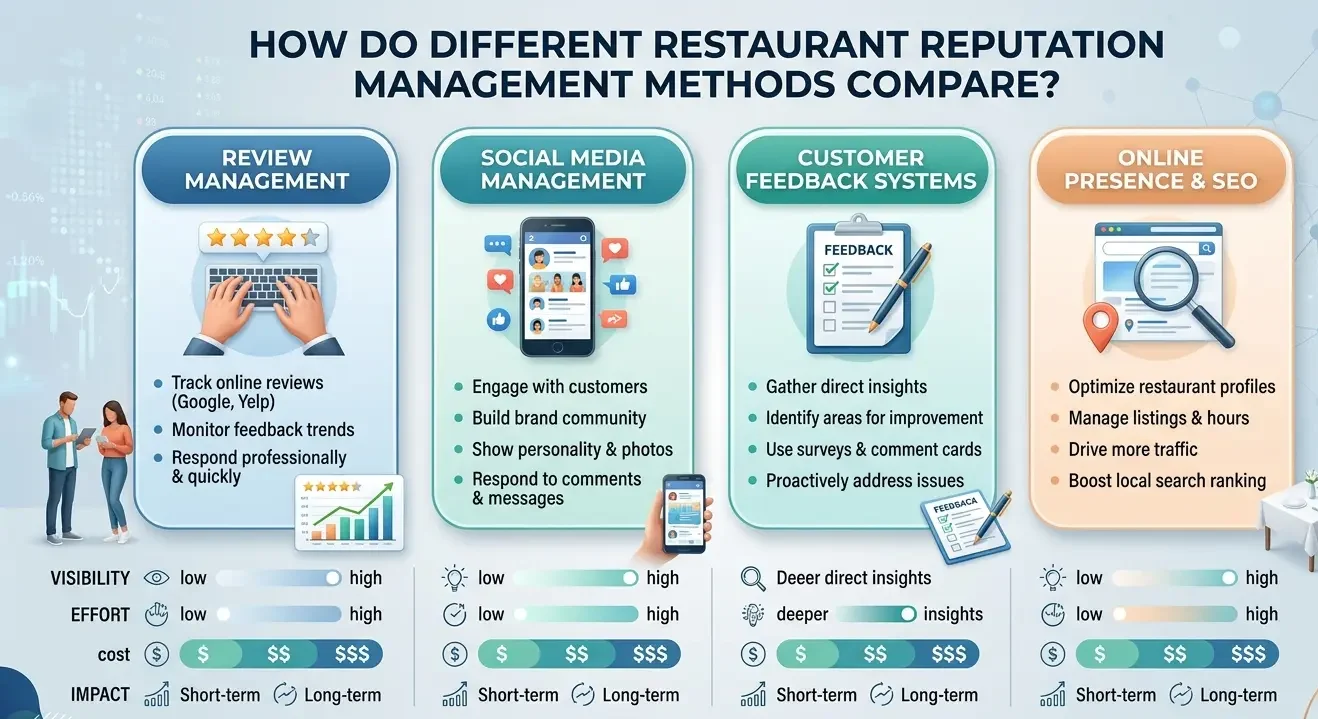
Content‑enhancement strategies work by creating and optimising high‑quality content that aligns with the restaurant’s desired reputation. This includes publishing detailed profiles, press releases, and third‑party features that reinforce positive attributes and improve SERP composition. These methods positively influence entity credibility because search engines prefer authoritative, consistent, and user‑valuable content.
Dive Deeper With Our Expert Guides and Related Blog Posts:
How Hospitality Reputation Management Works Across Multiple Booking Platforms
What TripAdvisor Review Management Involves Beyond Replying to Guest Feedback
Content‑removal strategies attempt to reduce the visibility of negative or damaging information by requesting takedowns, delisting, or legal escalation. These approaches operate by targeting specific pages or domains that host harmful content, often through formal processes or technical de‑indexing. While they can temporarily suppress reputation risk, they are limited in scope, often high‑cost, and cannot guarantee long‑term removal.
Response‑centred methods focus on how a restaurant engages with reviews, comments, and media coverage rather than on directly altering content. This approach operates by implementing structured response workflows, templated replies, and crisis‑response protocols that shape how sentiment is perceived in public channels. Compared to removal‑based tactics, response‑centred strategies are more scalable and less legally risky, but they require consistent internal discipline and resource allocation.
How well do organic reputation strategies work versus reactive ones?
Organic reputation strategies focus on building entity credibility over time through consistent, search‑optimised content and engagement, whereas reactive strategies respond to specific incidents or negative coverage. Both influence search ranking influence, but they differ in speed, control, and long‑term impact on reputation signals.
Organic reputation strategies operate by aligning a restaurant’s public content with its core attributes—such as cuisine type, service standards, and location. By publishing structured profiles, blog posts, and media interviews, these methods create a stable reputation footprint that search engines can index and rank. This approach strengthens SERP narratives gradually, making them more resilient to short‑term fluctuations in sentiment.
Reactive strategies kick in when a negative review, social media post, or press article alters how a restaurant appears in search. These methods operate by deploying rapid response teams, escalation protocols, and, where applicable, legal or compliance channels. While they can mitigate immediate damage, they rarely change the underlying reputation signals and may not address root causes of recurring negative patterns.
From a risk‑management perspective, organic strategies lower long‑term exposure because they diversify and reinforce the reputation content that appears in SERPs. Reactive strategies, however, increase operational risk if they rely heavily on takedowns or legal pressures, especially when applied inconsistently or without clear documentation. In practice, a balanced approach that combines ongoing organic development with targeted reactive responses tends to produce the most stable reputation profile.
How do reputation strategies for reviews differ from those for social media and press?
Reputation strategies for reviews, social media, and press differ in how they handle sentiment distribution, platform governance, and search indexing mechanisms. Each channel contributes to entity credibility, but the levers available to influence reputation are not interchangeable.
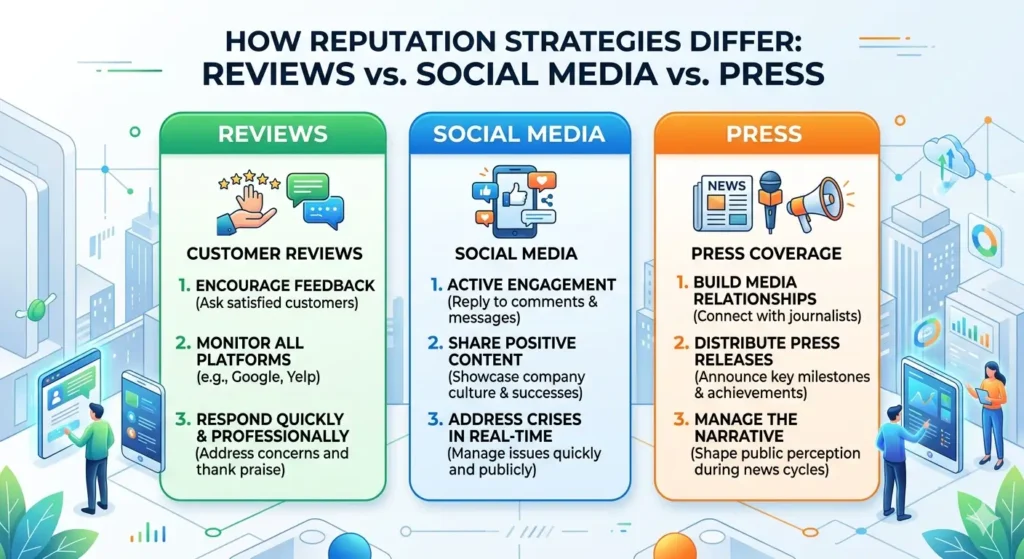
Review‑focused strategies operate by managing how star ratings and written feedback are generated, displayed, and interpreted. These methods typically include structured review‑request workflows, response templates, and sentiment‑analysis monitoring to ensure negative patterns are flagged early. Reviews have a strong direct impact on search ranking influence because Google treats review scores as explicit reputation signals embedded in listings.
Social media‑centred strategies operate by curating how users share, comment on, and tag a restaurant’s presence across platforms. These methods focus on community guidelines, moderation protocols, and engagement cadence to maintain a consistent tone and reduce the spread of misinformation. Social content indirectly influences reputation signals by generating content that can be indexed, linked, and referenced in search results.
Press‑oriented strategies operate by shaping how traditional and digital media cover the restaurant through editorial positioning, press releases, and media‑relations workflows. They rely on source credibility and external validation, because reputable outlets are treated as high‑trust reputation signals by search engines. Media coverage can significantly alter SERP narratives, especially when it appears in featured snippets or local news clusters.
When compared, review strategies are the most tightly controlled, since they occur within predefined platforms and structured formats. Social media strategies are more volatile because user behaviour is less predictable and platform policies vary. Press‑oriented strategies are the most resource‑intensive but offer the highest potential authority impact when they align with established outlets.
What are the strengths and limitations of removing negative content versus promoting positive content?
Removal‑based and promotion‑based reputation strategies both aim to influence how a restaurant appears in search, but they differ in mechanism, risk profile, and long‑term sustainability. Each approach modifies reputation signals, but not all modifications are equally stable or scalable.
Removal‑oriented strategies operate by targeting pages, posts, or listings that host negative or inaccurate information and requesting their removal or de‑indexing. This approach can be effective in specific cases—such as demonstrably false reviews, defamatory posts, or content that violates platform policies—but it is constrained by legal jurisdiction, platform rules, and index dynamics. Search engines may re‑index or re‑rank content if the underlying signal remains, so removal is rarely permanent.
Promotion‑centred strategies operate by manufacturing and amplifying positive reputation signals so they dominate the SERP landscape. This includes publishing guest articles, local guide features, and detailed business profiles that reinforce the restaurant’s desired attributes. These methods are more sustainable because they build entity credibility over time rather than depending on the absence of specific pages.
In comparative terms, content removal is faster in some cases but highly dependent on external approval and can escalate reputational risk if disputes are public. Content promotion is slower to show impact but reduces the proportional weight of negative content by increasing the density of positive signals. For most restaurants, a mixed approach—minimising illegitimate or harmful content while actively expanding positive coverage—is the most balanced from a risk and effectiveness perspective.
How do short‑term and long‑term reputation approaches affect search visibility and trust?
Short‑term reputation approaches prioritise immediate perception fixes, whereas long‑term approaches focus on building and maintaining entity credibility across multiple search touchpoints. Both influence search visibility and trust signals, but they differ substantially in scalability and resistance to fluctuation Consistent Reputation Management Plan.
Short‑term strategies operate by concentrating resources on specific incidents or SERP positions. This can involve rapid response triage, targeted removal requests, or temporary suppression campaigns aimed at altering how a restaurant appears in search for a limited period. These methods can produce visible changes quickly, but they often fail to address underlying drivers of negative sentiment or content patterns.
Long‑term strategies operate by implementing consistent, multi‑channel reputation management frameworks that align content, engagement, and governance over months and years. These approaches treat the SERP as part of a broader digital footprint and seek to optimise the balance of signals rather than a single listing. Long‑term strategies tend to produce more stable trust signals because they reduce the randomness of what appears in search results.
From an evaluation perspective, short‑term approaches are more suitable for acute crises but are less scalable across multiple locations or brands. Long‑term approaches are more complex to design and maintain, but they provide greater resilience against volatile sentiment spikes and help maintain a stable SERP narrative. A balanced configuration that combines crisis‑response protocols with sustained reputation‑building activities is typically the most effective architecture for restaurant‑sector reputation management.
What are the key strategic differences between reputation management options?
Restaurant reputation management options differ primarily in scope, time horizon, and risk exposure. Some approaches focus narrowly on individual incidents or listings, while others seek to reconfigure the overall reputation landscape across reviews, social media, and press.
Organic, content‑enhancement methods are generally more sustainable and scalable, because they rely on expanding the positive footprint rather than on removing specific pages. Reactive, removal‑based methods are more targeted and can be effective in defined cases, but they are less scalable and often introduce legal or reputational risk.
Approaches centred on review management are highly controllable, as they occur within standardised platforms, whereas social and press‑oriented strategies are more dependent on external actors and platform policies. Each configuration reshapes the SERP differently: review signals affect star ratings, social signals influence behavioural patterns, and press signals alter authoritative narratives.
The strategic choice, therefore, is not about selecting a single “best” method, but about aligning a mix of approaches with the restaurant’s operational capacity, risk tolerance, and long‑term visibility goals.