

TripAdvisor review management goes beyond responding to individual reviews and includes systematic monitoring, review generation, content optimisation, and competitive‑positioning strategies that shape a property’s online visibility and guest perception. Reputation management strategies differ based on whether they are reactive or proactive, and online reputation control methods are evaluated through their impact on search visibility, sentiment distribution, and competitive positioning.
How does proactive review management differ from reactive response‑only strategies?
Proactive review management differs from response‑only strategies by creating a continuous pipeline of fresh, structured feedback instead of waiting for guest comments to appear organically.
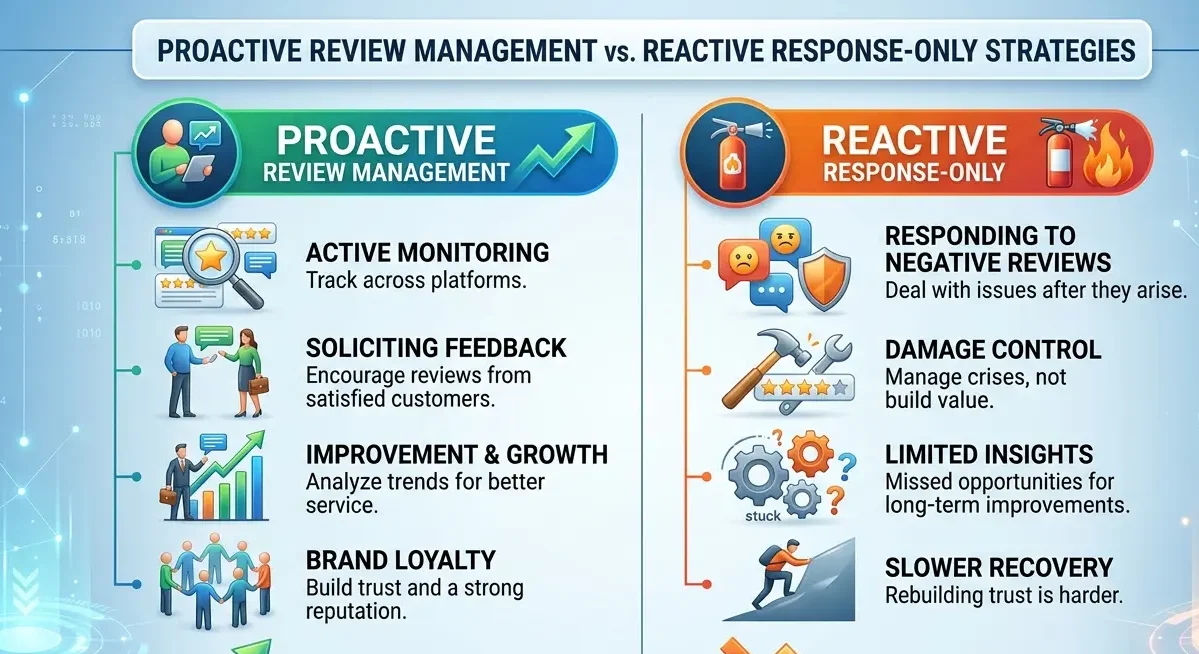
Reactive‑only strategies focus on:
- Replying to negative reviews to mitigate damage.
- Occasionally thanking guests for positive feedback.
- Waiting for new reviews to appear without influencing volume.
Dive Deeper With Our Expert Guides and Related Blog Posts:
What Hotel Reputation Management Involves Across TripAdvisor Google and OTAs
How Hospitality Reputation Management Works Across Multiple Booking Platforms
Proactive‑management strategies operate by:
- Triggering post‑stay review requests at specific points in the guest journey.
- Segmenting guests by stay‑type (leisure, business, groups) and property‑tier.
- Using structured templates that guide sentiment‑rich, keyword‑friendly language.
Search‑ranking systems respond to review quantity, recency, and sentiment skew, so properties that consistently generate 10–15 new reviews per month see stronger TripAdvisor‑and‑search‑visibility than those that rely on sporadic‑organic‑feedback.
Response‑only models can manage short‑term‑sentiment but usually fail to shift long‑term‑ranking dynamics, while proactive‑programs alter the overall sentiment distribution and review‑velocity across the property profile.
How do content‑creation and suppression methods compare in reputation control?
Content‑creation and suppression methods compare as opposite‑sides of the same‑reputation‑control‑spectrum, one expanding visible‑narrative and the other narrowing unwanted‑exposure.
Content‑creation‑strategies for hospitality‑and‑travel‑reputation management are:
- Producing owned‑property‑descriptions, meta‑descriptions, and FAQ‑sections that reinforce key‑service‑and‑location‑keywords.
- Building image‑galleries, virtual‑tours, and room‑experience‑narratives that provide context for guest reviews.
- Publishing blog‑content, press‑coverage, and owned‑news‑items that occupy SERP‑real‑estate around the property name.
Search engines and reputation‑signals treat this added‑content as credibility‑layers, which can push down or dilute negative‑mentions in the SERP.
Suppression‑methods, such as structured takedown‑or‑delisting processes, operate by:
- Requesting removal of clearly defamatory, inaccurate, or harassing reviews under platform‑policy and legal‑grounds.
- Highlighting duplicate or policy‑breaching‑reviews that violate TripAdvisor’s own moderation rules.
These mechanisms reduce the prominence of negative‑mentions in both TripAdvisor‑search and general‑search, but they do not erase the underlying‑experience.
Compared to content‑creation, suppression‑is more targeted and higher‑risk, because it depends on clear‑policy‑or‑legal‑grounds and can trigger reputational‑backlash if over‑used.
How do organic‑review‑growth and artificial‑review‑manipulation compare in effectiveness and risk?
Organic‑review‑growth and artificial‑review‑manipulation differ sharply in effectiveness over time and in their exposure to platform‑penalties and reputational‑blowback.
Organic‑growth‑models operate by:
- Aligning review‑generation with genuine‑guest‑experience improvements.
- Timing review requests after known‑high‑satisfaction‑points (e.g., checkout, post‑feedback surveys).
- Filtering out properties, segments, or service‑types where satisfaction is below a defined threshold.
This approach produces a natural‑sentiment‑distribution that search‑systems and TripAdvisor‑algorithms treat as credible, which supports steady‑improvement in ranking and perception.
Artificial‑manipulation‑tactics include:
- Paying third‑parties to leave five‑star reviews.
- Using staff‑accounts or affiliated‑guests to inflate volume.
- Sequentially‑refreshing bookings specifically to generate reviews.
Platforms detect these patterns through behavioural‑signals such as clustered‑posting‑times, identical‑review‑templates, or highly‑repetitive‑phrasing, and they can demote or delist properties caught in coordinated‑manipulation.
From a risk‑exposure standpoint, artificial‑methods may yield short‑term‑gains but carry long‑term‑reputation‑costs if discovered, while organic‑models are slower but far more sustainable and platform‑compliant.
How do short‑term crisis‑response strategies compare with long‑term reputation‑branding approaches?
Short‑term crisis‑response strategies compare with long‑term reputation‑branding approaches by prioritising speed and volume of intervention versus the depth and consistency of narrative construction.
Crisis‑response models in hospitality‑reputation management typically:
- Deploy rapid‑response‑teams to acknowledge every negative review within 24–48 hours.
- Issue templated‑apologies coupled with offers to move the conversation offline.
- Temporarily‑increase review‑volume via targeted‑post‑stay‑requests to dilute the share‑of‑negative‑comments.
These methods stabilise sentiment and prevent short‑term ranking drops triggered by sudden‑negative‑clusters, but they rarely change the underlying‑service‑quality‑signal.
Long‑term reputation‑branding approaches operate by:
- Aligning operational‑KPIs (staff‑training, room‑maintenance, check‑in‑speed) with guest‑perception‑targets.
- Embedding reputation‑goals into staff‑incentives, training‑modules, and manager‑performance‑reviews.
- Building multi‑year‑content‑and‑review‑strategies that normalise high‑average‑ratings and consistent‑positive‑volume.
Search‑systems increasingly reward properties that demonstrate sustained‑positive‑trajectories instead of isolated‑spikes, which makes long‑term‑branding approaches more effective for SERP‑representation and entity‑credibility over time.
How do different review‑management approaches scale across hotel chains and independent properties?
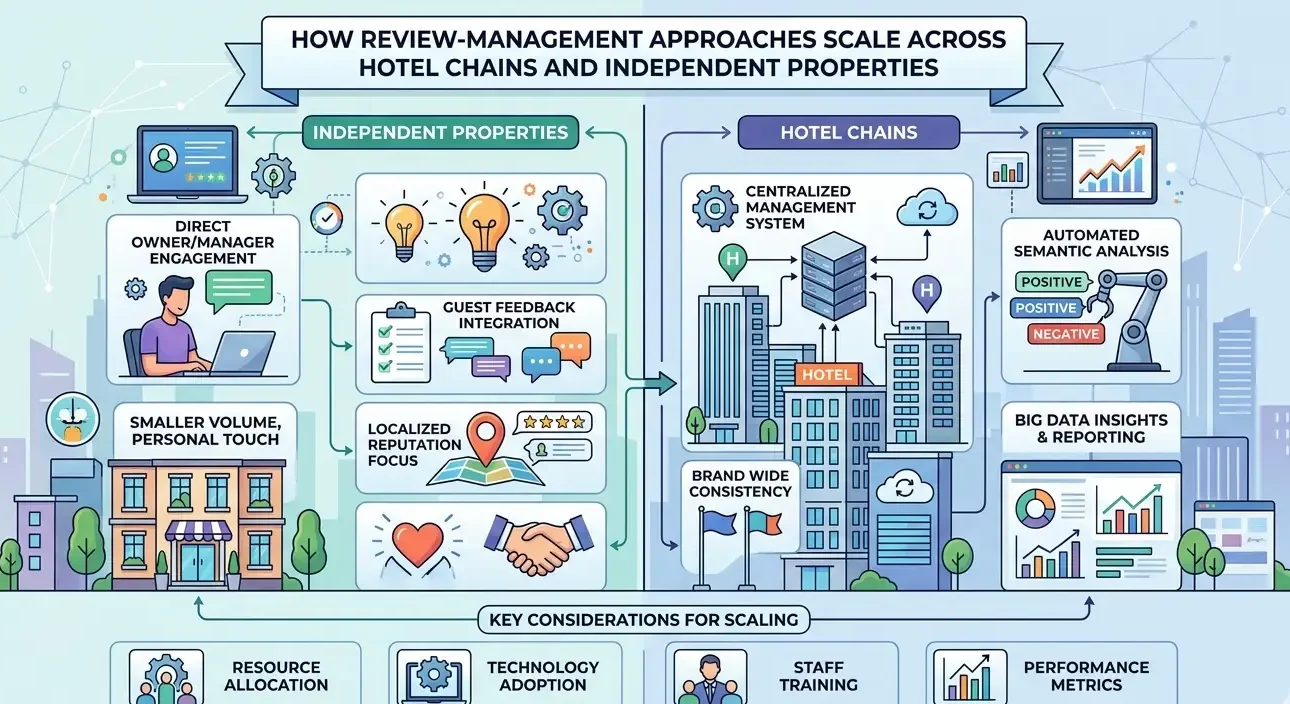
Different review‑management approaches scale more or less effectively depending on the size, structure, and platform‑behaviour of the property or chain for professional UK review strategy.
For large hotel chains, centralised‑review‑management‑systems can:
- Apply uniform‑response‑templates and escalation‑protocols across 100+ properties.
- Use aggregated‑sentiment‑dashboards to identify regional or brand‑level‑issues.
- Rotate high‑performing properties to highlight specific services and locations.
These systems integrate with existing PMS and CRM‑infrastructure, which makes them scalable but also highly dependent on data‑quality and staff‑compliance.
Independent properties usually adopt leaner‑models, such as:
- Owner‑triggered post‑stay emails with a simple review‑reminder workflow.
- A small‑in‑house‑review‑monitoring‑schedule (e.g., three‑times‑per‑week).
- Manual‑annual‑optimisations of descriptions and image‑metadata.
These approaches are easier to implement but harder to scale beyond a single‑property or small‑group, which can create competitive‑disadvantages against brands with institutional‑reputation‑management.
Search‑engines treat chain‑wide‑review‑consistency as a strong credibility‑signal, while independent properties must compensate with higher‑average‑scores and more frequent‑review‑generation at the local level.
How do review‑management strategies influence TripAdvisor‑search and general‑search ranking?
Review‑management strategies influence TripAdvisor‑search and general‑search ranking by altering the distribution, timing, and tone of review‑signals that search engines and platforms analyse.
TripAdvisor‑search‑ranking relies on:
- Average‑score and score‑distribution across recent‑months.
- Review‑volume and the proportion of reviews within the last 6–12 months.
- The presence of sentiment‑rich, keyword‑dense language about location, amenities, and service.
A strong‑review‑management strategy can shift a property from, for example, 3.6 to 4.2 over 18 months, move the recency‑profile from 50 percent‑reviews‑older‑than‑12‑months to 70 percent‑reviews‑within‑6‑months, and increase the share of mentions of key‑amenities by 20–30 percent.
General‑search ranking for the property name, address, and “near me” queries is similarly affected because:
- Review‑text and metadata are indexed by search engines.
- Link‑anchor‑texts from review‑pages and third‑party‑sites carry PageRank‑and‑trust‑signals.
- Rich‑chunks of sentiment‑and‑keyword‑data help search engines affirm entity‑relevance for local‑search.
TripAdvisor review management is not just about replying to individual guests; it is a multi‑channel, multi‑platform‑activity that shapes search visibility, sentiment skew, and competitive positioning. The most effective approaches combine organic‑review‑growth, content‑creation, and targeted‑risk‑management while avoiding artificial‑manipulation that can trigger penalties.
Strategic effectiveness depends on whether the chosen method is short‑term‑reactive, long‑term‑proactive, or platform‑suppression‑based, and on how well it scales across different property‑types and technological infrastructures.