

Hospitality reputation management across multiple booking platforms synchronises ratings, responses, and narratives so that search engines interpret the brand as a single, consistent, high‑credibility entity. Reputation management strategies differ based on whether they focus on review‑monitoring, content‑optimisation, or SERP‑reshaping, and online reputation control methods are evaluated through their impact on visibility, trust signals, and long‑term perception.
How do different reputation management approaches compare for hospitality brands?
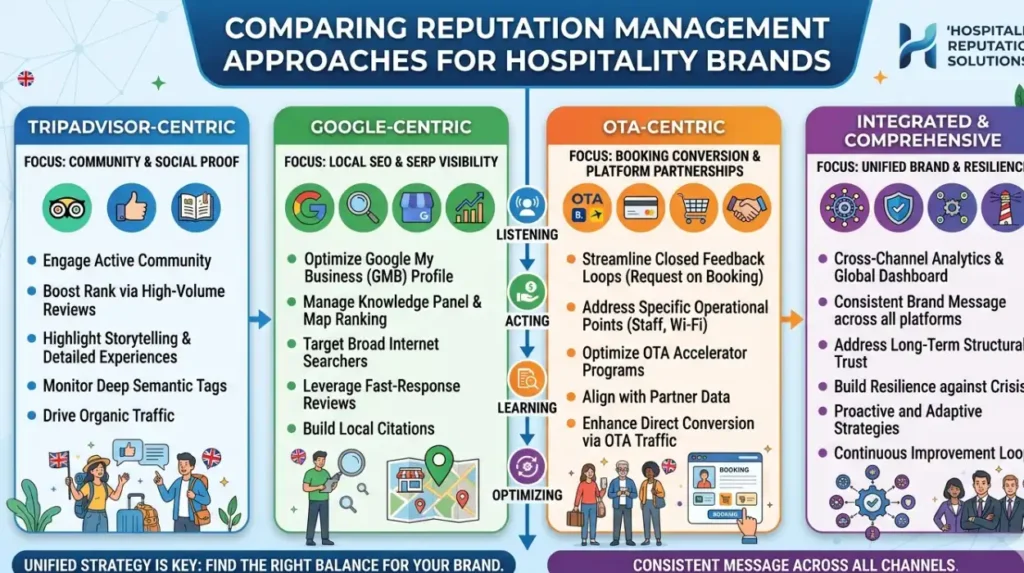
Reputation management for hospitality brands compares optimisation‑led, reactive‑response, and content‑enhancement‑based approaches in terms of SERP‑control, scalability, and risk exposure.
Review‑monitoring operates by tracking ratings, questions, and feedback across platforms such as Google, Tripadvisor, and global booking aggregators. It measures changes in star‑averages, review‑volume, and sentiment distribution, then feeds this data into response‑timelines and internal‑standards.
Content‑enhancement operates by building and optimising structured‑content that aligns with guest‑experience narratives, including descriptions, policies, and FAQs. This approach targets search‑ranking influence by embedding schema‑markup, clear‑headings, and consistent‑naming‑conventions across properties.
Proactive‑SERP‑control methods combine content‑enhancement with search‑signal‑targeting, such as inbound‑link‑building, citation‑cleanup, and technical‑SEO‑optimisation. This strategy aims to stabilise entity‑credibility over time, not just react to spikes in negative‑feedback.
From an effectiveness‑view, review‑monitoring produces short‑term‑risk‑reduction, content‑enhancement builds long‑term‑reputation, and SERP‑control‑methods address the technical‑basis of search‑perception.
Dive Deeper With Our Expert Guides and Related Blog Posts:
How Fintech Reputation Management Handles Regulatory Scrutiny and Negative Press
What Hotel Reputation Management Involves Across TripAdvisor Google and OTAs
How do organic and reactive reputation strategies differ in the hospitality sector?
Organic reputation strategies in hospitality operate before a crisis, whereas reactive‑methods respond after negative‑content has already impacted SERPs and review‑profiles.
Organic‑approaches operate by:
- Publishing clear, accurate property descriptions that match guest‑expectations.
- Encouraging genuine‑post‑stay reviews through standardised, policy‑aligned prompts.
- Optimising pages for branded‑and‑category‑queries to build a stable SERP‑cluster.
These methods prevent mismatched‑expectations and reduce the number of surprise‑negative‑reviews that can damage search visibility and credibility.
Reactive‑strategies activate when:
- A spike in negative‑reviews appears on a booking platform or listing.
- Misleading or inaccurate content ranks in branded‑search results.
- Guest‑complaints conflict with official‑descriptions, creating confusion.
Reactive‑actions include:
- Structured‑responses to each review that clarify standards, policies, and resolution‑steps.
- Technical‑content‑updates to correct misstatements and align narratives.
- Coordinated‑messaging‑alignments across platforms to reduce conflicting signals.
While reactive‑methods are necessary, they are less efficient than organic‑frameworks that build reputation‑signals in advance.
How does reputation management influence SERP composition for hotels and restaurants?
Reputation management influences SERP composition for hotels and restaurants by aligning review‑data, citations, and structured‑content into a coherent set of reputation signals that search engines prioritise.
Search engines interpret hospitality‑entity‑credibility through:
- Average star‑ratings and review‑count on major‑booking‑platforms.
- Freshness and volume of guest‑feedback.
- Consistency of ratings and descriptions across Google, Tripadvisor, and global‑aggregators.
When these signals cluster positively, the entity gains stronger ranking‑influence and is more likely to appear in local packs and organic‑top‑positions.
Reputation‑management‑methods that target SERP‑composition typically:
- Publish high‑quality, contextually‑relevant content that explains policies and services.
- Ensure schema‑markup accurately reflects name, address, rating, and review‑count.
- Encourage reputable‑third‑parties to reference the property or venue using consistent‑detail.
These steps do not change the SERP‑algorithm itself, but they ensure that the content‑set available for indexing supports a stable, credible‑narrative rather than fragmented or conflicting‑ones.
How do short‑term and long‑term reputation strategies differ in effectiveness?
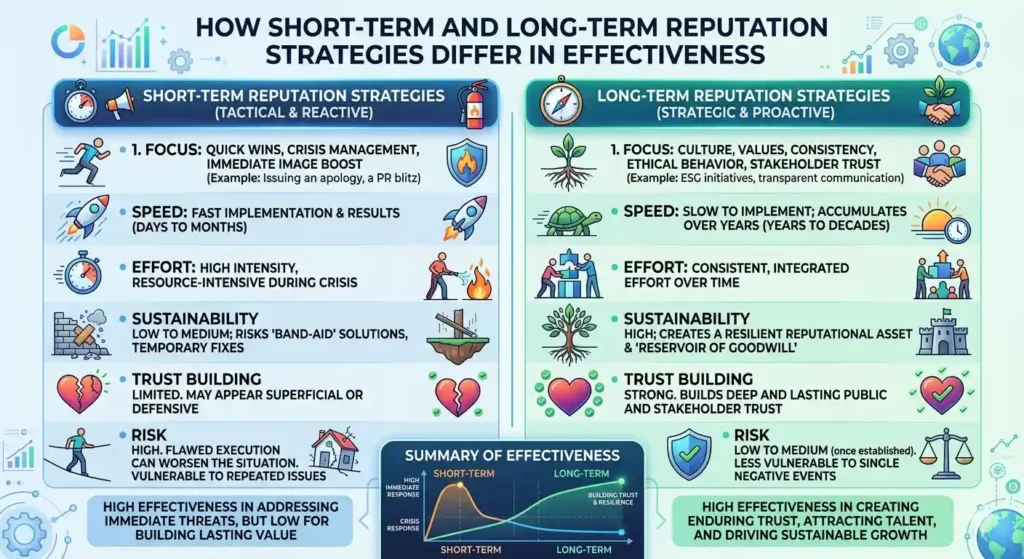
Short‑term reputation strategies in hospitality focus on stabilising immediate‑review‑spikes and SERP‑distortions, while long‑term‑methods establish predictable‑reputation‑signals and resilient‑search‑profiles on Let a UK specialist handle your hospitality reputation management end to end.
Short‑term‑strategies include:
- Rapid‑response‑protocols to negative‑reviews on booking platforms.
- Temporary‑content‑updates to address factual‑discrepancies or misstatements.
- Tactical‑link‑building to push negative‑or‑unverified‑pages down the SERP.
These methods control perception‑risk during crises but do not fundamentally alter the underlying‑reputation‑foundation.
Long‑term‑strategies emphasise:
- Continuous‑optimisation of property‑descriptions, FAQs, and policy‑pages.
- Regular‑review‑solicitation and structured‑response‑templates.
- Ongoing‑technical‑SEO‑maintenance, including canonicals, redirects, and structured‑data.
These approaches create a more durable SERP‑profile that is less vulnerable to temporary‑review‑spikes or misaligned‑narratives.
How do reputation signals from different booking platforms interact in search ecosystems?
Reputation signals from different booking platforms interact in search ecosystems by creating cross‑channel‑consistency checks that search engines use to measure entity‑credibility and reliability.
When a hotel or restaurant appears on multiple platforms, search engines compare:
- Star‑ratings and review‑averages across sites.
- Volume and age of guest‑feedback.
- Consistency of descriptions, amenities, and pricing.
Discrepancies raise risk‑signals; for example, a 4.5‑star‑average on one platform paired with a 2.8‑average on another suggests possible data‑bias or policy‑differences.
Reputation‑management‑methods that synchronise signals across platforms typically:
- Align naming‑conventions, address‑formats, and contact‑information.
- Use standard‑response‑templates for similar‑complaint‑types.
- Correct outdated or conflicting‑descriptions on each platform.
This coordination reduces the perception‑risk that arises from conflicting‑data and strengthens the entity’s SERP‑cluster.
Hospitality reputation management across multiple booking platforms operates through coordinated‑monitoring, response‑standardisation, and SERP‑optimisation that together reduce inconsistency‑risk and strengthen credibility. Different strategies vary in short‑term‑impact and long‑term‑stability, but the most balanced‑approaches combine proactive‑content‑frameworks with reactive‑review‑management. Understanding how search engines interpret these signals is essential for building a reputation‑system that is both responsive and resilient.
FAQs
How does hospitality reputation management work across multiple booking platforms?
Hospitality reputation management across multiple booking platforms synchronises ratings, responses, and descriptions so that search engines see a consistent, credible entity. Reputation signals from sites like Google, Tripadvisor, and global booking platforms are monitored and aligned to reduce conflicting narratives and improve SERP control.
Why is hospitality reputation more sensitive than other sectors?
Hospitality reputation is more sensitive because search engines rely heavily on guest reviews, star ratings, and booking‑platform data to rank hotels and restaurants. A single cluster of negative feedback across multiple sites can quickly shift search visibility and perceived trustworthiness.
How do review responses on booking platforms affect search rankings?
Review responses on booking platforms feed into reputation signals that search engines use to assess entity credibility and service quality. Prompt, transparent, and policy‑aligned replies improve sentiment distribution and help stabilise the SERP perception of a hotel or restaurant.
What role does content consistency play in hospitality reputation management?
Content consistency across booking platforms, maps listings, and the official website strengthens SERP evaluation by reducing conflicting information. Aligning property names, addresses, pricing, and amenities gives search engines clearer signals about entity reliability and reduces reputation‑risk exposure.
How do reputation signals from different platforms interact in search results?
Reputation signals from different platforms interact by creating a cross‑channel pattern of ratings, reviews, and descriptions that search engines compare for consistency. When those signals align, the entity gains stronger SERP control and higher perceived credibility than when the data is fragmented or contradictory.