

Hospitality reputation management is the most review‑sensitive sector because search engines and users treat booking‑site reviews, star ratings, and guest comments as primary reputation signals for hotels, restaurants, and travel services. Reputation management is the systematic observation and influencing of how entities are perceived across digital channels, and online reputation refers to how search engines and users interpret content, links, and feedback when forming judgments about an organisation or individual.
How does search build reputation for hospitality brands?
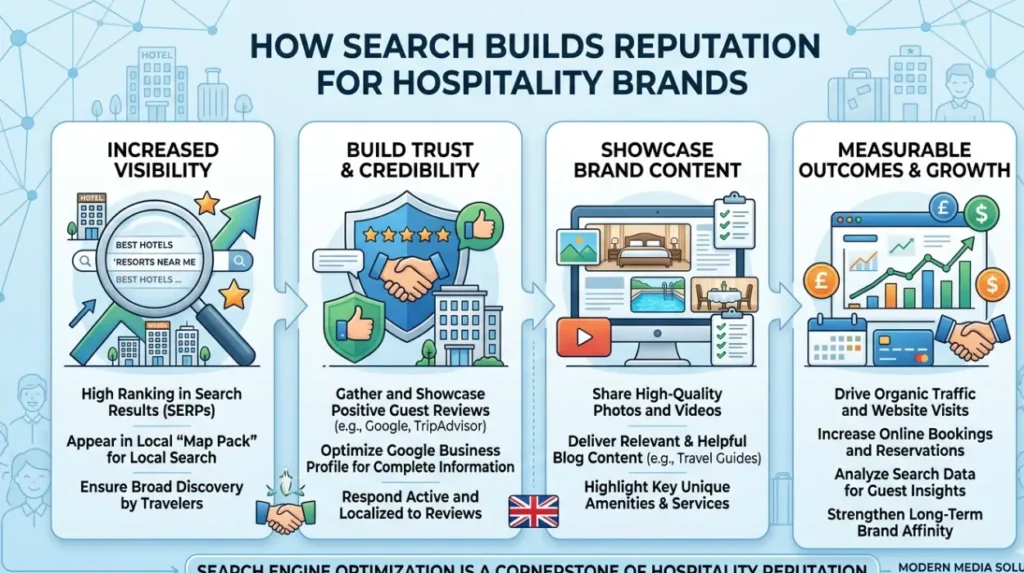
Search engines build reputation for hospitality brands by aggregating reviews, citations, and structured data into a composite of trust and relevance signals that shape SERP evaluation on How hospitality reputation management works across multiple booking platforms.
Reputation signals in hospitality include:
- Star ratings and written reviews on booking platforms and maps services.
- Number, age, and consistency of guest feedback across channels.
- Structured schema data such as aggregateRating, reviewCount, and priceRange.
These inputs feed into search‑ranking systems that treat hospitality brands as “experience‑products,” where prior‑guest‑experiences count more than generic‑promotional content. SERP evaluation for hotels, restaurants, or tours is therefore highly sensitive to review‑volume and sentiment, because they directly reflect real‑world‑use.
Dive Deeper With Our Expert Guides and Related Blog Posts:
Why Fintech Reputation Management Shapes User Adoption at Scale
How Hotel Reputation Management Affects Bookings Before Guests Even Visit
Search engines also look at how consistently reviews appear across multiple platforms, whether dates align with booking‑periods, and how many third‑party‑sites reference the same numerical‑scores. When those signals cluster positively, the entity gains a stronger SERP position; when reviews are sparse or negative, the entity’s visibility weakens.
How do review signals influence search visibility for hotels and restaurants?
Review signals influence search visibility for hotels and restaurants by acting as direct ranking and relevance factors that shape which entities appear in local and organic listings.
Search visibility in hospitality depends on how well reputation signals match the user’s intent. For example, queries such as “best hotel in Manchester” or “top restaurant near me” trigger search engines to prioritise entities with:
- High average star ratings and large review counts.
- Recent, verified‑guest‑reviews that describe check‑in experiences, room quality, and service.
- Consistent ratings across multiple booking platforms and maps services.
Entities that accumulate negative reviews or low‑average scores see reduced click‑through‑rates and lower position‑1 tenure, because the search ecosystem treats them as higher‑risk options.
Search engines also use review‑text to detect sentiment and semantic signals. Phrases indicating reliability, cleanliness, or genuine‑experience amplify positive‑reputation‑signals, while terms about cancellations, hidden fees, or unresolved complaints weaken perceived trust.
How does sentiment interpretation shape hospitality SERPs?
Sentiment interpretation shapes hospitality SERPs by converting free‑text reviews into machine‑readable indications of trust, risk, and quality that the search engine uses to rank and cluster entities.
Sentiment within reviews is not just “positive” or “negative”; it is broken down into granular signals such as:
- Polarity (positive vs negative tone)
- Intensity (strength of praise or complaint)
- Credibility markers (first‑hand vs generic statements)
Search engines analyse these signals using natural‑language‑processing and compare them across multiple inputs. A hotel with 200 reviews averaging 4.5 stars but including detailed complaints about cleanliness receives a weaker reputation signal than a hotel with 150 reviews averaging 4.7 stars and consistent‑positive‑descriptions of staff and hygiene.
The SERP evaluation then reflects this difference through:
- Placement in local packs
- Appearance in “top‑rated” snippets
- Highlighting or demotion of specific reputational‑keywords
How does content indexing affect hospitality reputation perception?
Content indexing affects hospitality reputation perception by determining which narratives, reviews, and descriptions are included in search results and how they are weighted against each other.
Search engines index anything publicly accessible, including:
- Hotel descriptions, photos, and press releases
- Booking‑platform listings and third‑party reviews
- Social‑media posts, blogs, and travel‑influencer articles
Entities that publish well‑structured, accurate, and consistent content about amenities, pricing, and policies receive stronger SERP signals than those with sparse, outdated, or conflicting information.
However, indexing does not guarantee prominence. Pages with high‑quality‑backlink profiles, fresh content, and strong user‑engagement rise faster than generic‑descriptions, even if both are technically “indexed.”
For hospitality brands, this means that reputation perception is shaped less by the existence of a website and more by the coherence of indexed content across platforms.
How do authority and trust signals work in hospitality SERPs?
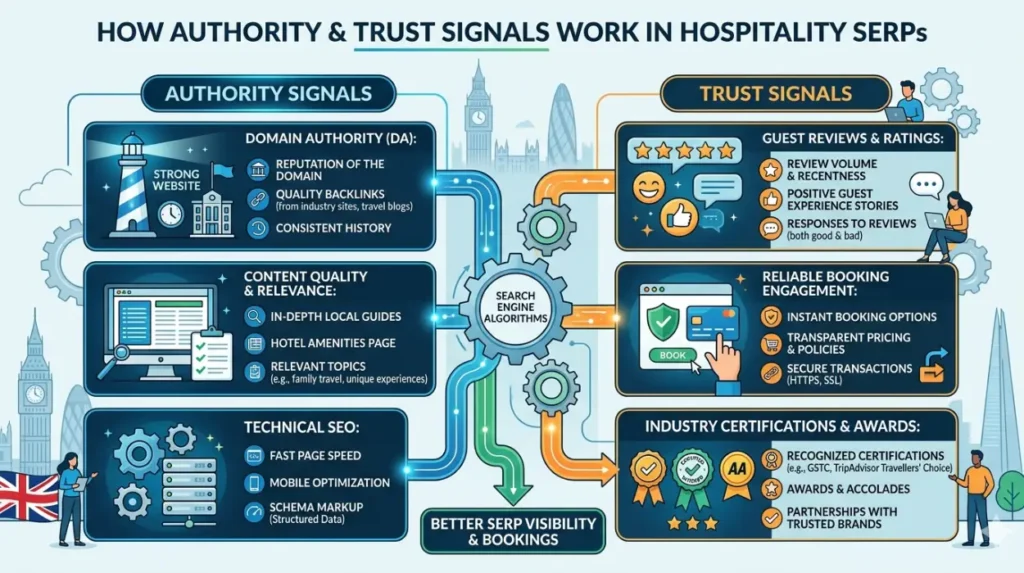
Authority and trust signals in hospitality SERPs work by measuring how reliably and consistently entities are represented across multiple independent sources, rather than relying on single‑source claims.
Trust signals include:
- Number of listings on reputable booking platforms
- Volume of guest reviews and their average rating
- Backlinks from travel‑guides, city‑websites, and respected media outlets
Search engines evaluate these signals to determine which entities are more credible and less likely to mislead users.
Authority, on the other hand, is built through:
- Repeated appearances in top‑10 listings for branded‑and‑category‑queries
- Frequent citations in travel‑guides and industry‑publications
- Structured‑data‑rich markup that clearly defines name, address, and services
The combination of high trust and strong authority leads to greater SERP control and higher‑click‑through‑rates.
How does search interpret hospitality‑specific reputation signals?
Search engines interpret hospitality‑specific reputation signals by combining structured data, text‑reviews, and behavioural‑signals into a holistic assessment of guest‑experience quality.
Structured‑data such as star‑rating, number‑of‑reviews, and price‑range sets the baseline. Text‑reviews flesh out that baseline with specific‑details about cleanliness, service, and value. Behavioural‑signals, such as click‑through‑rate, time‑on‑page, and repeat‑visits, provide feedback on whether the perceived reputation matches the actual‑experience.
When these signals align, the hospitality entity’s SERP profile becomes stronger.
Search engines treat hospitality reputation as a multi‑dimensional, constantly‑updated signal that depends on the consistency and quality of reviews, content, and citations. SERP evaluation is sensitive to both numerical and textual signals, which means hospitality brands must maintain coherent, accurate, and well‑documented digital footprints to shape how they are perceived in search.
FAQs
What is hospitality reputation management and why is it so review‑sensitive?
Hospitality reputation management is the process of monitoring and influencing how hotels, restaurants, and travel businesses are perceived in search results and on booking platforms. It is review‑sensitive because search engines and guests treat star ratings, written reviews, and guest feedback as primary reputation signals that directly affect search visibility and booking decisions.
How do online reviews influence hotel rankings in search results?
Online reviews influence hotel rankings by providing search engines with structured reputation signals such as average star rating, review count, and sentiment. Hotels with higher, consistent ratings and recent verified guest feedback tend to rank better in local packs and organic SERPs than those with low or mixed‑quality reviews.
How does reputation management work across multiple booking platforms?
Reputation management across multiple booking platforms involves aligning ratings, descriptions, and review responses so that the same brand appears consistently across sites like Google, Tripadvisor, and global booking aggregators. This coordination strengthens SERP evaluation by reducing conflicting signals and reinforcing a stable, credible reputation profile.
What role do sentiment and review text play in hospitality SEO?
Sentiment and review text shape hospitality SEO by giving search engines qualitative signals about cleanliness, service, and value beyond simple star ratings. Positive, detailed, and first‑hand reviews improve trust signals and search perception, while repeated complaints about cancellations, noise, or hidden fees weaken reputation.
How does content indexing affect a hotel’s online reputation in search engines?
Content indexing affects a hotel’s online reputation by determining which descriptions, photos, and guest reviews appear in search results and how they are weighted. Well‑structured, accurate, and consistent content across the website and third‑party platforms leads to stronger SERP control and higher perceived credibility in hospitality search ecosystems.