

Reputation management is the set of processes that govern how an entity’s information is created, structured and maintained across digital systems. Online reputation refers to the aggregate of indexed signals, content, and third-party evaluations that define an entity’s perceived credibility within search ecosystems.
A baseline review is a structured audit that identifies an entity’s digital footprint, including owned content, third-party references, review signals, and technical indexing status.
The agency executes crawling and index checks, extracts entity mentions from structured data and knowledge panels, analyses backlink provenance and anchor text patterns, and evaluates review metadata and sentiment tags. The agency quantifies trust using metrics such as domain authority proxies, entity co-occurrence frequency, and review signal weight in localised search results.
The baseline review clarifies which signals currently elevate or degrade search visibility. Removing low-quality references, correcting structured data, or amplifying authoritative content changes index priorities and reweights entity perception during SERP evaluation.
How does a reputation management agency assess content quality for trust-building?
A reputation management agency evaluates content quality by mapping content to reputation signals and entity intent. The assessment determines which assets support long-term trust.
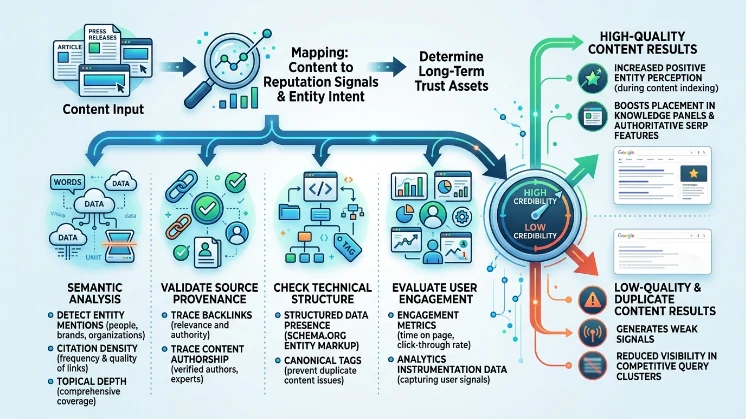
The agency applies semantic analysis to detect entity mentions, citation density, and topical depth; validates source provenance by tracing backlinks and content authorship; checks structured data presence (schema.org entity markup) and canonical tags; and evaluates user engagement metrics captured by analytics instrumentation. The agency rates each asset for its potential to signal credibility to indexing algorithms.
High-quality content increases positive entity perception during content indexing and boosts placement in knowledge panels and authoritative SERP features. Low-quality or duplicate content generates weak signals and reduces visibility in competitive query clusters.
How are review signals and sentiment interpreted by search algorithms?
Search algorithms interpret review signals and sentiment as quantifiable indicators of entity reliability and user satisfaction. Algorithms convert textual sentiment and review metadata into reputation signals.
The agency extracts review schema and API-provided rating data, performs sentiment analysis on review text, and maps temporal patterns in review volume. Algorithms aggregate rating averages, recency weightings, and sentiment polarity to create composite trust scores used in local packs, star snippets, and recommendation features.
Positive, consistent review signals increase the likelihood of enhanced SERP features and improve click-through estimations by ranking systems. Negative or inconsistent review signals reduce feature eligibility and lower perceived entity trust during SERP evaluation.
What role does structured data play in brand reputation?
Structured data defines an entity explicitly for indexing systems and strengthens entity perception by reducing ambiguity. It operates as a direct reputation signal.
The agency implements schema markup for organisation, product, review, and author entities, ensures JSON-LD is valid and served on canonical pages, and aligns markup with Knowledge Graph attributes. Search systems parse structured data to link disparate mentions, resolve entity ambiguity, and populate knowledge panels.
Correct structured data increases the probability of accurate entity representation in knowledge panels and rich results, thereby improving search visibility and stabilising entity perception across SERPs.
Enhance digital trust with professional Brand Reputation Management that leverages structured data, entity optimisation, and authoritative content to improve search visibility. Accurate schema implementation helps strengthen entity recognition, support knowledge panel accuracy, and reinforce a consistent brand reputation across SERPs.
How do backlink and provenance signals affect entity trust?
Backlink and provenance signals validate an entity’s authority by demonstrating third-party recognition and topical endorsement. These signals form a credibility graph around the entity.
The agency evaluates referring domains for topical relevance, editorial standards, and link placement context; assesses anchor text semantics for entity co-occurrence; and traces content lineage to detect syndicated or scraped copies. Algorithms use link quality, topical alignment, and citation frequency to weight authority.
High-provenance backlinks increase domain-level authority and improve content ranking for entity-related queries. Low-provenance or manipulative links trigger devaluation and reduce entity visibility during SERP evaluation.
How is entity perception modelled across multiple platforms?
Entity perception modelling synthesises signals from search engines, review platforms, social indexing, and content repositories into a unified representation. This model guides strategic interventions.
The agency aggregates signals indexed pages, review metrics, social mentions, structured data, and backlink profiles into a weighted model. The model uses entity resolution techniques, co-occurrence matrices, and temporal decay functions to identify persistent reputation signals and transient noise.
A precise entity model improves prediction of SERP outcomes and identifies which signals require remediation or amplification to shift entity perception in indexing pipelines.
How does content distribution influence content indexing and ranking?
Content distribution determines how quickly and widely content is indexed, and which contexts contribute to ranking authority. Distribution affects indexing priority and contextual relevance.
The agency sequences distribution to align with indexing patterns: publish canonical content on authoritative pages, push to syndicated channels with robust crawl rates, and generate contextual citations that reinforce topical entity connections. Distribution includes controlled refresh schedules and sitemap updates to prompt content indexing.
Strategic distribution increases crawl frequency for key assets, boosts contextual linkages that improve topical relevance, and elevates content into SERP features through concentrated indexing signals.
How are authority and trust signals operationalised in strategy?
Authority and trust signals convert qualitative reputation attributes into measurable optimisation tasks. Operationalisation creates persistent ranking benefits.
The agency implements authority-focused tasks: reinforce expert authorship with structured author markup; secure citations from high-provenance domains; correct technical issues that impede crawl or indexing; and normalise NAP (name, address, phone) data for local entity consistency. Each task attaches a measurable metric citation score, structured data coverage, crawl success rate that algorithms use indirectly during SERP evaluation.
Measurable authority improvements increase eligibility for high-visibility SERP features and reduce volatility in entity rankings during algorithm updates.
How does search engine evaluation treat conflicting or negative information?
Search engine evaluation balances relevance and trustworthiness when indexing conflicting or negative information. Algorithms rank content based on recency, provenance, and contextual relevance to query intent.
The agency analyses temporal patterns, source credibility, and context to prioritise higher-provenance, more recent, and more contextually relevant content. Search systems use entity-centric heuristics and manual quality raters’ guidelines to weigh conflicting items and determine which items surface for specific queries.
Correctly attributed, high-provenance content reduces dominance of negative items in SERPs. Conversely, persistent high-provenance negative content sustains lower entity perception until matched or exceeded by stronger countervailing signals.
Dive Deeper With Our Expert Guides and Related Blog Posts:
Why Brand Reputation Management Has Become Essential in the Digital Age
How does a long-term reputation strategy measure success?

A long-term reputation strategy measures success by tracking multidimensional reputation signals and SERP-specific outcomes rather than singular metrics.
The agency defines KPIs such as SERP feature share, knowledge panel accuracy, positive review share, citation provenance score, and content indexing coverage. The measurement system correlates these KPIs with traffic quality signals and entity impression metrics to evaluate strategy effectiveness.
Consistent improvements across these KPIs indicate enhanced entity perception and increased search visibility. Stable, positive trends reduce reputation risk and improve predictability of SERP evaluation.
How do technical SEO factors intersect with reputation systems?
Technical SEO factors ensure reliable content indexing and consistent signal transmission, forming the infrastructure upon which reputation signals operate.
The agency audits crawlability, robots directives, canonicalisation, structured data validity, and server response consistency. It corrects issues that lead to duplicate index entries, missing metadata, or broken structured data feeds that fragment entity signals.
Correct technical implementation prevents signal dilution and ensures authoritative content is properly indexed and surfaced, improving overall search visibility and entity credibility.
Read the Full Blog Here:
What a Brand Reputation Management Agency Reviews Before Creating Strategy
This analysis defines how reputation management functions within search ecosystems by mapping audits, content quality, review signals, structured data, provenance, distribution, authority operations, conflict resolution, measurement, and technical infrastructure to concrete effects on search visibility and entity perception. Long-term brand trust depends on coherent entity modelling, validated provenance, consistent structured metadata, and measurable improvements in SERP evaluation.
Answers to Key Questions
What does a Brand Reputation Management agency evaluate first?
A Brand Reputation Management agency evaluates the entity’s indexed footprint, review signals, backlink provenance, and structured data to establish baseline search visibility and credibility metrics.
How do review signals affect brand reputation in search results?
Review signals (ratings, review text, metadata) influence algorithms by supplying sentiment polarity and recency data, which search systems use to rank local packs, star snippets, and recommendation features.
Which technical fixes improve reputation-related indexing?
Fix crawlability, correct canonical tags, validate JSON-LD structured data, and ensure consistent NAP to prevent signal fragmentation and improve content indexing and SERP evaluation.
How long does it take to see search reputation improvements?
Search reputation improvements appear over months as indexing cycles, citation accrual, and authority signals consolidate; measurable KPI shifts often emerge within three to six months depending on content and backlink velocity.