

A reputation management strategy begins with an evaluation of search visibility, sentiment distribution, entity credibility, and reputation signals across digital channels. Strategic planning depends on identifying how search engines, users, and publishing platforms interpret and display information connected to a brand entity.
Reputation management strategies differ based on the source of reputational risk, the structure of search results, and the distribution of positive, neutral, and negative content. Online reputation control methods are evaluated through search ranking influence, content ownership, visibility persistence, authority signals, and long-term sustainability.
Which reputation signals receive the most strategic evaluation before planning?
Search visibility signals receive primary evaluation because they determine how a brand entity appears across search ecosystems. Reputation signals include branded search results, review sentiment, media coverage, social profiles, third-party mentions, knowledge panels, and authoritative content assets. Search engines analyse these signals collectively to form an understanding of entity credibility and relevance. A reputation assessment examines both the presence and prominence of each signal within search environments.
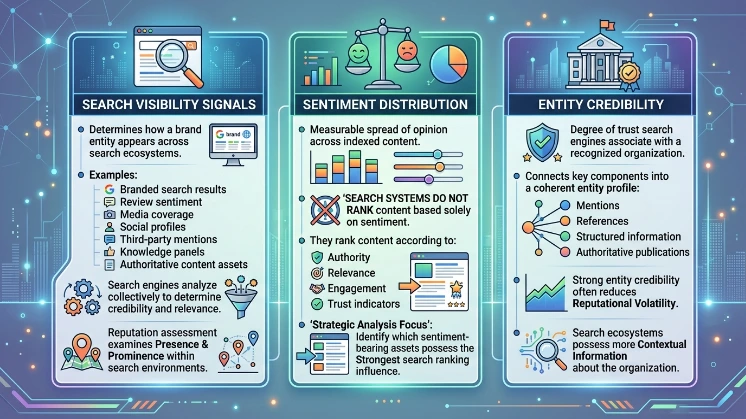
Sentiment distribution is another critical evaluation area because reputation outcomes depend on the balance between positive, neutral, and negative information. Sentiment distribution is the measurable spread of opinion across indexed content. Search systems do not rank content based solely on sentiment; they rank content according to authority, relevance, engagement, and trust indicators. Strategic analysis therefore focuses on identifying which sentiment-bearing assets possess the strongest search ranking influence.
Entity credibility is also reviewed before any strategic direction is defined. Entity credibility is the degree of trust search engines associate with a recognised organisation or brand entity. It operates by connecting mentions, references, structured information, and authoritative publications into a coherent entity profile. Strong entity credibility often reduces reputational volatility because search ecosystems possess more contextual information about the organisation.
How does content enhancement compare with content suppression strategies?
Content enhancement focuses on increasing the visibility and authority of positive or neutral assets. Content suppression focuses on reducing the prominence of unfavourable assets through competition within search results. Both approaches influence SERP composition, but they operate through different mechanisms and achieve different outcomes.
Content enhancement is the process of creating, improving, and promoting authoritative assets that reinforce favourable reputation signals. It operates by increasing the relevance, authority, and search ranking potential of owned or controllable content. Search engines interpret these assets as additional sources of entity information, allowing stronger content representation across result pages. This method contributes to entity credibility because it expands the quantity and quality of trusted references associated with a brand.
Content suppression operates by introducing stronger competing assets into search results. The objective is not removal but displacement. Search ranking influence becomes the primary mechanism because competing assets must outperform existing pages for visibility. This approach directly affects SERP composition when negative content occupies prominent ranking positions.
The comparative difference lies in sustainability and dependency. Content enhancement creates durable assets that remain useful beyond immediate reputation concerns. Content suppression depends on continuous competitive pressure because displaced content remains indexed and can regain visibility. From a risk evaluation perspective, content enhancement strengthens long-term reputation architecture, while content suppression addresses visibility concentration problems within specific search environments.
How do removal-focused methods compare with visibility-management approaches?
Removal-focused methods attempt to eliminate content from public visibility. Visibility-management approaches focus on influencing the prominence and discoverability of information without requiring deletion. The distinction affects scalability, feasibility, and strategic risk exposure.
Content removal is the process of eliminating information through legal rights, platform policies, publisher cooperation, or regulatory frameworks. It operates by removing the content source or restricting access to indexed material. Search engines respond by updating their indexes once content becomes unavailable. This approach produces immediate changes when successful because the underlying source ceases to contribute reputation signals.
Visibility management evaluates how information appears rather than whether it exists. It operates through search optimisation, authority building, content development, and reputation signal enhancement. Search ecosystems continue to recognise all indexed content, but ranking dynamics influence which assets users encounter first. The approach therefore concentrates on perception pathways rather than deletion outcomes.
Strengthen online credibility with professional Brand Reputation Management that combines strategic visibility management with reputation signal enhancement to improve search perception. By building authoritative content and strengthening trust signals, businesses can increase positive visibility and maintain greater control over how their brand appears in search results.
Why is review management evaluated differently from search result management?
Review management and search result management influence reputation through separate ecosystem mechanisms. Reviews operate within platform-specific trust environments, while search result management operates within broader information retrieval systems. Strategic evaluation therefore measures different performance indicators.
Review management is the monitoring, analysis, and optimisation of review-related reputation signals. It operates by influencing sentiment distribution across review platforms where users assess products, services, and experiences. Review ecosystems generate credibility indicators through ratings, review frequency, reviewer activity, and response patterns. Search engines often incorporate these indicators into broader assessments of trustworthiness.
Search result management focuses on the overall composition of branded search environments. It includes websites, news articles, social profiles, directories, reviews, and knowledge assets. SERP composition becomes the primary measurement because users frequently form impressions before visiting any individual platform. Search result management therefore evaluates how different content categories interact to shape perception.
The comparison reveals a difference in scope. Review management concentrates on opinion-based signals generated by users. Search result management evaluates all visible reputation signals regardless of source. Review sentiment directly affects trust indicators, while SERP composition affects information exposure. Together, these mechanisms influence both credibility assessment and user perception pathways.
How do reactive reputation strategies compare with organic reputation development?
Reactive strategies respond to existing reputation challenges. Organic reputation development establishes credibility before significant reputation pressure emerges. The timing difference influences effectiveness, cost of intervention, and strategic resilience.
Reactive reputation management is the process of addressing identified reputation threats after they become visible. It operates through monitoring, response planning, visibility management, content creation, and risk mitigation. Search ecosystems already contain influential signals requiring intervention. Strategic resources therefore focus on correcting imbalances within sentiment distribution and SERP composition.
Organic reputation development is the continuous cultivation of authoritative reputation signals before reputational issues gain prominence. It operates by building trusted content assets, strengthening entity credibility, expanding authoritative mentions, and maintaining consistent visibility. Search engines receive ongoing evidence supporting a coherent and reliable entity profile.
The comparative advantage of organic development lies in resilience. Strong reputation architecture creates a wider base of authoritative assets capable of competing within search ecosystems. Reactive strategies often encounter entrenched content with established ranking authority. From a sustainability perspective, organic development improves long-term search ranking influence, while reactive strategies address existing visibility challenges. Both approaches contribute to reputation outcomes, but they operate at different stages of the reputation lifecycle.
Which measurement frameworks provide the most useful reputation analysis?
Effective reputation analysis depends on measurement frameworks that connect visibility, sentiment, credibility, and authority into a unified assessment model. Individual metrics provide limited insight when evaluated in isolation. Strategic planning therefore relies on integrated evaluation frameworks.
Visibility-based measurement analyses ranking positions, branded search coverage, and SERP composition. This framework evaluates which content assets occupy prominent positions and how search exposure influences perception. Search ranking influence becomes the central indicator because visibility determines information consumption patterns.
Sentiment-based measurement analyses the distribution of positive, neutral, and negative references across digital channels. Sentiment distribution provides insight into perception trends and reputation balance. The framework evaluates not only volume but also the authority and visibility of sentiment-bearing assets.
Entity-based measurement evaluates credibility signals associated with a recognised organisation. It analyses authoritative mentions, structured entity references, media coverage quality, and consistency of information across platforms. Search engines use these signals to interpret trustworthiness and contextual relevance. Entity-focused evaluation therefore measures the strength of the underlying reputation foundation rather than isolated reputation events.
Dive Deeper With Our Expert Guides and Related Blog Posts:
How Brand Reputation Management Strategies Differ for B2B and B2C
How do short-term reputation tactics compare with long-term reputation frameworks?
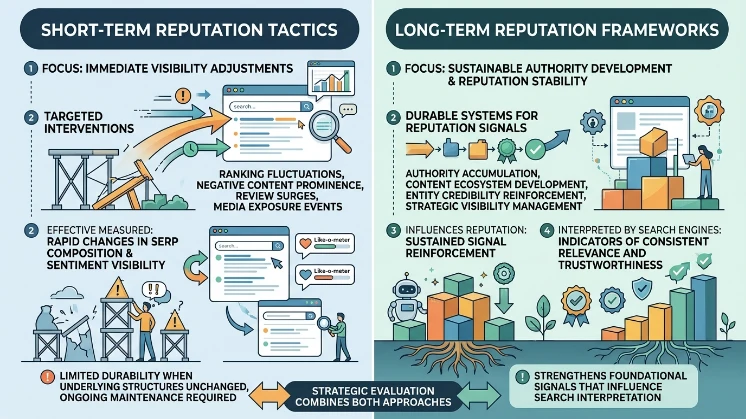
Short-term tactics focus on immediate visibility adjustments. Long-term frameworks focus on sustainable authority development and reputation stability. Both influence reputation outcomes, but their mechanisms and limitations differ significantly.
Short-term tactics operate through targeted interventions designed to influence immediate search visibility. These tactics often address ranking fluctuations, negative content prominence, review surges, or media exposure events. Their effectiveness is measured through rapid changes in SERP composition and sentiment visibility. Because search ecosystems continually evolve, short-term gains require ongoing maintenance.
Long-term reputation frameworks establish durable systems for managing reputation signals over extended periods. They operate through authority accumulation, content ecosystem development, entity credibility reinforcement, and strategic visibility management. Search engines interpret these activities as indicators of consistent relevance and trustworthiness. Long-term frameworks therefore influence reputation through sustained signal reinforcement.
The primary difference lies in sustainability. Short-term tactics provide immediate visibility adjustments but possess limited durability when underlying reputation structures remain unchanged. Long-term frameworks strengthen the foundational signals that influence search interpretation. Strategic evaluation frequently combines both approaches because immediate visibility concerns and ongoing credibility development exist simultaneously within digital reputation environments.
What strategic factors determine the most appropriate reputation management approach?
The most appropriate reputation management approach depends on the structure of reputational challenges, the authority of competing content, and the condition of existing reputation signals. Strategy selection is an analytical process rather than a procedural formula. Search ecosystems contain unique combinations of content, authority relationships, and visibility patterns that require individual assessment.
SERP composition influences strategy because different content categories require different mechanisms. Negative media coverage, review platform issues, outdated information, and weak entity credibility create distinct optimisation requirements. Strategic evaluation analyses how each factor contributes to overall perception and search ranking influence. The objective is to identify the mechanisms exerting the greatest effect on visibility and trust.
Entity credibility also determines strategic direction because stronger entities possess greater capacity to influence search interpretation through authoritative signals. Reputation management methods therefore differ according to existing credibility levels, content ownership opportunities, and authority distribution across search environments. Effective evaluation focuses on measurable relationships between visibility, sentiment distribution, and reputation signals rather than isolated metrics.
Reputation management approaches differ according to their objectives, mechanisms, and sustainability characteristics. Content enhancement compares with content suppression through long-term authority development versus ranking displacement. Removal-focused methods compare with visibility-management approaches through elimination versus discoverability control. Review management and search result management influence reputation through different trust and visibility ecosystems.
Read the Detailed Explanation:
Let a Brand Reputation Management Agency Protect What You Have Bu
Strategic evaluation depends on analysing reputation signals, entity credibility, sentiment distribution, and search ranking influence. Reactive approaches address existing visibility challenges, while organic development strengthens reputation architecture before significant exposure risks emerge. Short-term tactics deliver immediate adjustments, whereas long-term frameworks establish durable authority signals. Understanding these distinctions provides a structured basis for evaluating reputation management options and their influence on search perception, trust formation, and SERP composition.
Answers to Key Questions
What is brand reputation management and why is it important?
Brand reputation management is the process of monitoring, influencing, and improving how a business is perceived online. It helps manage reputation signals across search results, reviews, media coverage, and social platforms to strengthen trust and visibility.
How does brand reputation management affect search engine results?
Brand reputation management influences SERP composition by improving the visibility of authoritative and relevant content. Strong reputation signals can increase entity credibility and help create a more balanced search presence.
What factors are analysed during a brand reputation management strategy?
A strategy typically analyses sentiment distribution, search visibility, review profiles, media mentions, and entity credibility. These factors help identify reputation risks and opportunities for improving digital perception.
What is the difference between content suppression and content enhancement?
Content suppression focuses on reducing the visibility of negative search results through stronger competing content. Content enhancement focuses on creating and optimising authoritative assets that improve reputation signals and long-term search ranking influence.
How long does brand reputation management take to show results?
Results depend on search competition, content authority, and the scale of reputation challenges. Improvements in search visibility and sentiment distribution often occur gradually as search engines reassess reputation signals and content relevance.