

Reputation management is the strategic monitoring and adjustment of an entity’s public information footprint within search ecosystems. Online reputation refers to the aggregate of indexed content, review signals, and algorithmic evaluations that form an entity’s visible identity on SERPs.
Reputation management timelines vary from weeks to multiple years depending on issue severity, content volume, and the authority of competing sources. Timelines depend on the type of intervention, the pace of content indexing, and the rate at which search engines update reputation signals.
Timeline assessment is the process that defines expected durations for corrective or developmental reputation actions within search ecosystems. It refers to mapping tasks to search cycles, indexing latency, and entity-perception change windows.
Search engines evaluate changes through content indexing, backlink reassessment, review aggregation, and machine-learning updates to entity graphs. When new content or signals appear, crawlers detect them, indexers store them, and ranking systems evaluate changes against existing authority signals. Reputation change propagates as search visibility and SERP evaluation update across those layers.
Timelines govern when new content begins influencing SERP evaluation and when old content declines in visibility. Faster interventions (for example, publishing authoritative content on high-authority pages) accelerate positive visibility gains; slower channels (review remediation, legal remedies) delay SERP improvements.
What specific milestones define a reputation management timeline?
Milestones include detection, assessment, remediation, amplification, monitoring, and consolidation; each milestone corresponds to measurable search and trust-signal changes over defined windows.
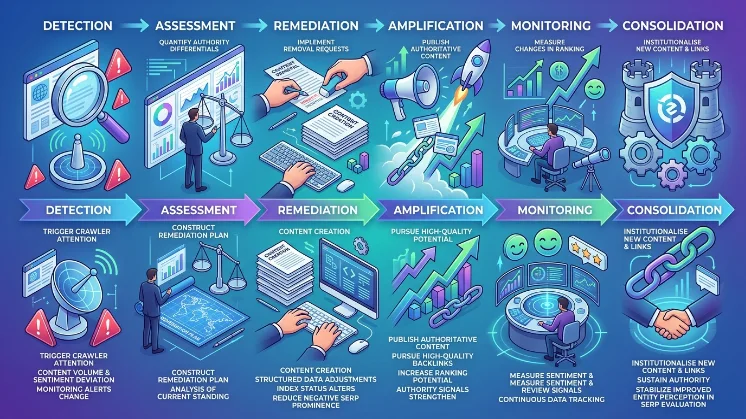
Detection triggers crawler attention when content volume or sentiment deviates from baseline. Assessment quantifies authority differentials and constructs a remediation plan. Remediation implements content removal requests, content creation, and structured data adjustments. Amplification publishes authoritative content and pursues high-quality backlinks. Monitoring measures changes in ranking, sentiment, and review signals. Consolidation institutionalises new content and links to sustain authority.
Each milestone produces measurable changes: detection changes monitoring alerts, remediation alters index status and may reduce negative SERP prominence, amplification increases ranking potential through authority signals, and consolidation stabilises improved entity perception in SERP evaluation.
How long does each stage normally take?
Typical durations are detection (1–14 days), assessment (3–21 days), remediation (2 weeks–6 months), amplification (1–12 months), monitoring (ongoing), consolidation (3–24 months). Variation depends on signal strength and search indexing cycles.
Detection depends on crawl frequency and monitoring tools; assessment depends on data collection and authority analysis; remediation depends on content removal complexity, publisher responsiveness, and legal processes; amplification relies on content quality and link acquisition velocity; monitoring continues as indexing and ranking algorithms update.
Shorter stage durations produce quicker visibility shifts; for instance, content published on an authoritative domain can influence SERP evaluation within weeks, while removal of entrenched negative content requires search index decay and replacement, which increases duration.
What factors accelerate or slow reputation recovery?
Authority of new content, crawl frequency, backlink profile shifts, review volumes, and algorithmic trust updates accelerate or slow recovery.
High-authority domains provide strong positive signals that search engines prioritise, accelerating visibility change. Frequent crawling increases index update speed. Strong backlinks preserve old content relevance, slowing decline of negative items. Large volumes of fresh negative reviews increase negative sentiment weight in aggregation models, delaying recovery. Algorithmic updates that refresh entity graphs or E‑A‑T-like assessments also alter timelines.
If new authoritative material appears and receives quality backlinks, SERP evaluation reallocates prominence faster. Conversely, entrenched backlinks to negative content and slow publisher response create persistent negative visibility.
How do search engines interpret trust and credibility signals during a timeline change?
Search engines evaluate credibility through provenance, authority metrics, link structures, structured data, and corroborative signal clustering; changes in those inputs recalibrate entity perception over time.
Provenance assessment examines domain history and editorial standards. Authority metrics evaluate backlink quality, topical relevance, and co-citation patterns. Structured data (schema) clarifies entity relationships, improving entity-graph updates. Corroborative clustering occurs when multiple independent sources present consistent information; clustering increases confidence and accelerates SERP evaluation shifts.
Improvements in trust signals raise content’s ranking potential. A surge of corroborative, authoritative references creates rapid reweighting in entity perception. Weak or inconsistent signals limit ranking movement despite content changes.
How do review signals and sentiment affect timeline and outcomes?
Review volume, recency, and sentiment distribution directly influence aggregation models and accelerate or decelerate perception shifts; high-volume, recent positive reviews reduce negative visibility faster than sparse ones.
Search systems parse ratings and textual sentiment, map reviewer authority, and weigh recency. They correlate review signals with entity identifiers and surface aggregates in SERPs (star ratings, review snippets). Review remediation changes sentiment distribution; volume and reviewer diversity alter confidence thresholds used in SERP evaluation.
Rapid acquisition of numerous recent, high-authority reviews shifts sentiment aggregates and reduces negative snippets. Sparse or manipulated reviews trigger detection and penalisation, slowing legitimate recovery.
How does content creation influence the timeline for reputation change?
Content creation influences timelines by providing replacement assets for indexing, altering entity associations, and generating authority signals through backlinks and shares; high-authority content shortens recovery windows.
New content indexed on authoritative domains adds weight to entity graphs. Optimised content that targets semantic queries and includes structured entity markers accelerates indexing and relevance signals. Backlink acquisition amplifies those signals. Search engines re-evaluate rankings as new page-level and entity-level signals aggregate.
Well-placed authoritative content reduces negative SERP prominence by occupying high-ranking positions. Poorly optimised or low-authority content has minimal effect and elongates timelines.
How do technical SEO and structured data change the pace of reputation repair?
Technical SEO and structured data accelerate indexing, clarify entity relationships, and improve SERP features inclusion, thereby shortening perception-adjustment intervals.
Improved crawlability reduces indexing latency. Canonical tags and URL hygiene prevent dilution of authority. Structured data (schema.org) enables entity linking and increases likelihood of inclusion in knowledge panels and rich results. Search systems use these signals to adjust entity perception more quickly and accurately.
Technical fixes and robust schema increase the speed at which positive content is recognised and rewarded in SERP evaluation, leading to faster visibility gains.
Dive Deeper With Our Expert Guides and Related Blog Posts:
What SERM Search Engine Reputation Management Is and Why Brands Are Investing
How Reputation Management SEO Works Differently From Traditional SEO Campaigns
What role does authority distribution across the web play in timeline predictability?
Authority distribution defines the resistance to change; when negative content resides on high-authority domains, timelines extend; when authoritative channels support positive content, timelines compress.
Search algorithms aggregate authority via link graphs, citation networks, and domain reputations. High-authority negative sources function as persistent anchors in ranking models. Positive authority distribution requires equal or greater-quality backlinks and corroboration to rebalance entity perception.
Improve reputation recovery outcomes with professional Corporate Reputation Management that strengthens positive authority signals and balances entity perception across search ecosystems. By building credible content and authoritative references, businesses can accelerate SERP improvements, increase predictability, and support long-term brand trust.
How is success measured across timeline stages?
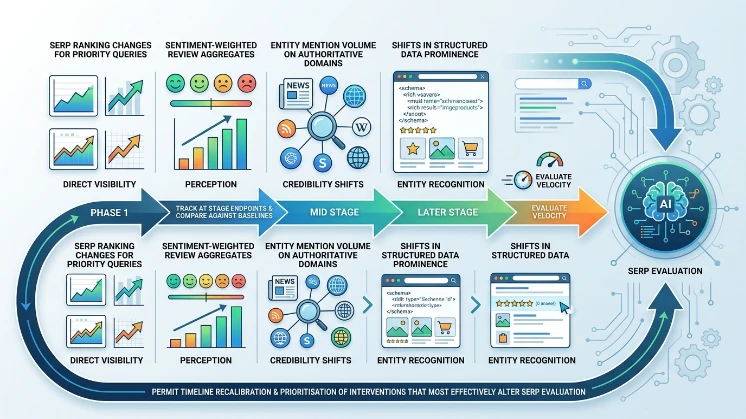
Success metrics include changes in SERP ranking for priority queries, sentiment-weighted review aggregates, entity mention volume on authoritative domains, and shifts in structured data prominence.
SERP ranking changes measure direct visibility; sentiment-weighted aggregates evaluate perception; authoritative mention counts and backlink quality measure credibility shifts; structured data presence measures entity recognition. These metrics should be tracked at stage endpoints and compared against baselines to evaluate velocity.
Regular measurement permits timeline recalibration and prioritisation of interventions that most effectively alter SERP evaluation.
Get the Full Insights Here:
What Milestones to Expect and How Long Each Stage of Reputation Management Takes
Reputation management timelines vary across discrete stages: detection, assessment, remediation, amplification, monitoring, and consolidation. Search ecosystems translate each action into indexing events, authority re-evaluations, and entity-graph adjustments. Timelines compress when interventions leverage high-authority channels, strong technical SEO, and dense corroborative signals; timelines extend when negative content remains on authoritative sources, when review signals are adverse, or when indexing and legal processes delay change. Measurement through SERP ranking shifts, sentiment aggregates, authoritative mentions, and structured-data visibility provides objective checkpoints to evaluate progress across the timeline.
Answers to Key Questions
How long does corporate reputation management take?
Corporate reputation management timelines vary from weeks to years depending on issue severity, content authority, and indexing speed. Track progress via SERP ranking changes, sentiment-weighted review aggregates, and authoritative mention volume.
What milestones should I expect in a corporate reputation campaign?
Expect detection, assessment, remediation, amplification, monitoring, and consolidation as key milestones. Each milestone aligns with measurable changes in indexing, entity perception, and search visibility.
How do online reviews affect corporate reputation timelines?
Review volume, recency, and reviewer authority directly influence sentiment aggregation and SERP features. Rapid acquisition of diverse, recent positive reviews accelerates recovery; entrenched negative reviews extend timelines.
Which SEO tactics most quickly improve corporate search visibility?
Publish authoritative content on high-authority domains, implement technical SEO fixes, and add structured data to clarify entity relationships. These tactics reduce indexing latency and increase the likelihood of favourable SERP evaluation.
How is success measured in corporate reputation management?
Measure success using priority-query SERP ranking shifts, sentiment-weighted review scores, authoritative mention counts, backlink quality, and structured-data prominence. Compare metrics to baseline measurements at each milestone.