

Reputation management is the discipline of shaping and protecting an entity’s public information as it appears across searchable systems. Online reputation refers to the aggregate of indexed content and signals that define an entity’s perceived trustworthiness and authority within search ecosystems.
Search engine reputation management is the practice of identifying, evaluating, and influencing how an entity’s information ranks and displays in search engine results pages (SERPs). SERM defines a set of interventions that modify content indexing, SERP evaluation, and interrelated reputation signals to alter entity perception.
SERM operates through content identification, content optimisation, and signal management. Content identification maps the digital footprint: indexed pages, authored content, review entries, social signals, and third‑party references. Content optimisation adjusts metadata, structured data, and topical relevance so algorithms index and surface preferred content. Signal management addresses backlinks, review distributions, and authoritative mentions that search engines use as proxies for credibility. These processes feed iterative measurement loops where content indexing outcomes inform further interventions.
How is reputation formed in search engines?
Reputation is a composite index of signals that algorithms use to infer entity credibility and topical authority. Reputation is thus a numeric and semantic construct derived from content, links, engagement, and structured at‑scale data.
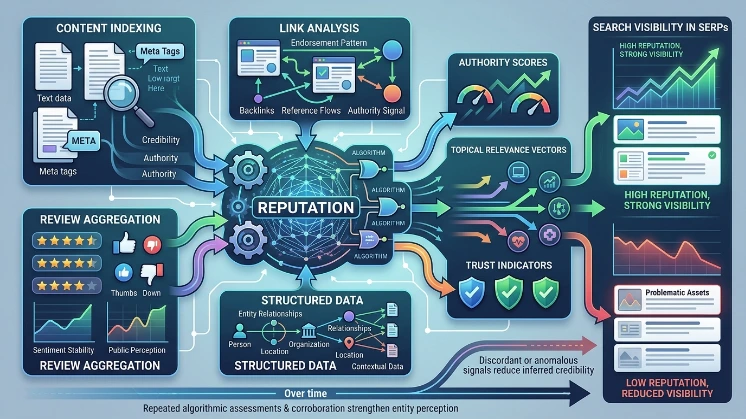
Reputation forms through repeated algorithmic assessments: content indexing captures text and metadata; link analysis assesses endorsement patterns; review aggregation quantifies sentiment and stability; structured data establishes entity relationships. Search engines synthesise these inputs into reputation signals such as authority scores, topical relevance vectors, and trust indicators. Over time, recurring corroboration across independent sources strengthens entity perception; conversely, discordant or anomalous signals reduce inferred credibility.
Search visibility changes as reputation signals shift. Strong, consistent signals increase the prevalence and ranking of positive or neutral content in SERPs. Negative or sparse signals lead to lower visibility or prominence of problematic assets. Therefore, reputation formation is not static but a continuous, algorithmically mediated process.
What are the primary reputation signals search algorithms evaluate?
Reputation signals are measurable elements that search engines evaluate to rank and present information about an entity. Primary reputation signals include content relevance, backlink authority, structured data, review metrics, and behavioural engagement.
Content relevance refers to topical alignment between query intent and indexed text; algorithms evaluate on‑page semantics and topical depth. Backlink authority refers to incoming link quantity and quality that indicate endorsement; algorithms evaluate linking domains’ authority, anchor semantics, and link context. Structured data provides explicit entity attributes that assist indexing agents in entity resolution. Review metrics aggregate star ratings, review volume, and review velocity; algorithms interpret distribution and recency as proxies for reliability. Behavioural engagement comprises click‑through rates, dwell time, and pogo‑sticking patterns; algorithms infer user satisfaction from these signals. Each signal integrates into SERP evaluation to influence which content represents the entity and how prominently.
How do algorithms interpret trust and credibility signals?
Algorithms interpret trust and credibility through multi‑dimensional scoring that combines provenance, corroboration, and temporal consistency. Trust is operationalised as evidence provenance (source reputation), corroborative patterns across independent sources, and stability of assertions over time.
Provenance assessment evaluates the inherent authority of publishing domains using historic indexing behaviour, editorial standards proxies and linking patterns. Corroboration evaluates whether multiple independent sources present consistent information; algorithms penalise isolated claims lacking corroboration. Temporal consistency evaluates whether assertions persist and are updated responsibly; frequent corrections or conflicting versions reduce inferred credibility. Algorithms also apply entity resolution to connect disparate mentions, enabling cumulative credibility assessment across the digital footprint.
The interpretation process influences which knowledge panels, featured snippets, and summary cards appear in SERPs. Higher trust scores promote authoritative content to prominent positions, thereby shaping entity perception in search contexts.
How does content influence perception and SERP outcomes?
Content influences perception and SERP outcomes by providing semantic signals for relevance, authority, and intent alignment. Content that demonstrates topical depth and structured clarity receives stronger indexing prominence and higher ranking potential.
Algorithms evaluate content using semantic analysis, topical clustering, and structured markup. Semantic analysis extracts entities, relationships, and sentiment. Topical clustering assesses whether content fits a coherent topical network associated with the entity. Structured markup (for example, schema) supplies machine‑readable entity attributes that improve indexing precision. High‑quality, well‑structured content attracts authoritative links and engagement, reinforcing reputation signals. Consequently, content acts both as the carrier of reputation claims and the instrument by which search engines calculate entity perception and allocate SERP real estate.
How do review systems and sentiment signals factor into search reputation?
Review systems and sentiment signals provide quantifiable reputation inputs used by algorithms to assess public evaluation and stability. Review signals are structured indicators: average rating, volume, distribution, and recency. Sentiment signals are derived from textual analysis across reviews, news, and social mentions.
Algorithms integrate review metrics into local and entity SERP features. High average ratings combined with sustained review volume generate favourable ranking adjustments for local packs and knowledge panels. Sentiment analysis extracts polarity and topical subjectivity; consistent negative sentiment linked to specific attributes reduces trust in those attributes within entity perception. Review velocity rapid increases or decreases in review counts trigger anomaly detection, requiring verification to avoid manipulation. Therefore, reviews and sentiment shape both direct search features and underlying reputation scores.
Dive Deeper With Our Expert Guides and Related Blog Posts:
How Reputation Management SEO Works Differently From Traditional SEO Campaigns
Why Search Result Reputation Management Starts With Understanding What Ranks
How do authority and trust signals interact within SERP evaluation?
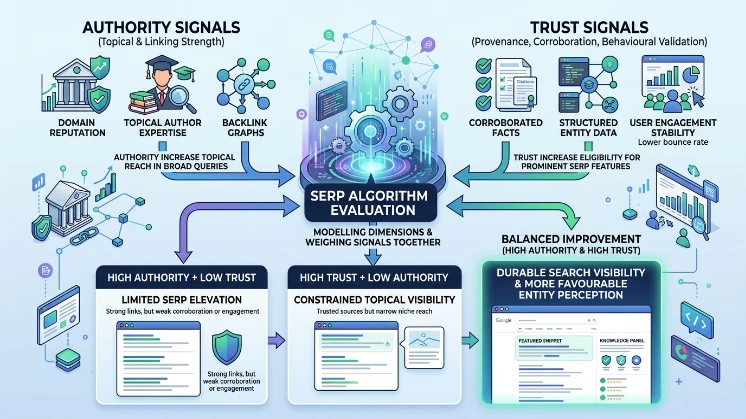
Authority and trust signals interact by creating reinforcing layers that algorithms weigh together to determine ranking and display decisions. Authority denotes topical and linking strength; trust denotes provenance, corroboration, and behavioural validation.
Authority manifests through domain-level reputation, topical author expertise, and backlink graphs. Trust manifests through corroborated facts, structured entity data, and user engagement stability. Search algorithms model both dimensions: authority increases topical reach in broader queries, while trust increases eligibility for prominent SERP features such as knowledge panels and featured snippets. The interaction produces a compounded effect—high authority with low trust yields limited SERP elevation, while high trust with low authority yields constrained topical visibility. Balanced improvement across both vectors yields durable search visibility and more favourable entity perception.
How should digital footprint and entity data be structured for effective indexing?
Digital footprint structuring requires coherent entity definition, canonicalised content, and consistent structured data across high‑value properties. Entity data should be explicit, machine‑readable, and contextually linked.
Define the entity using canonical identifiers: consistent name forms, official URLs, and matching structured data (for example, schema.org markup). Ensure canonical tags and redirects prevent duplicate indexing. Distribute consistent facts across primary properties and authoritative third‑party directories to create corroboration. Embed structured data that define key attributes (type, founding date, and contact points) to assist entity resolution. These measures improve content indexing precision, reduce ambiguity in SERP evaluation, and strengthen reputation signals by aligning disparate mentions into a single entity profile.
Build a stronger digital presence with professional Corporate Reputation Management that aligns entity data, structured markup, and authoritative content for accurate search engine indexing. Consistent entity signals help businesses improve credibility, strengthen SERP visibility, and maintain a unified reputation across digital ecosystems.
Check the Complete Explanation:
How SERM Search Engine Reputation Management Campaigns Are Built and Measured
This analysis defines SERM as a systems-orientated discipline that manipulates content indexing, reputation signals, and SERP evaluation to shape entity perception. Reputation forms from interconnected signals content relevance, backlinks, structured data, reviews and engagement that algorithms synthesise into authority and trust scores. Effective SERM requires explicit entity structuring, consistent signalling across the digital footprint, and measurement focused on search visibility and perception metrics. These elements combine to determine which information search ecosystems surface and how entities are perceived within those ecosystems.
Answers to Key Questions
What is corporate reputation management?
Corporate reputation management is the practice of monitoring, evaluating and influencing how a company appears across search engines and digital channels. It focuses on managing content indexing, review signals, backlinks and entity data to protect search visibility and brand credibility.
How does Reputation Management PR Agency measure reputation performance?
Reputation Management PR Agency measures performance using KPIs such as branded SERP share, percentage of positive assets in top ten results, review score trends, and authority score trajectories. These metrics link content ranking, review metrics and backlink quality to search visibility outcomes.
Which online signals most affect corporate reputation?
Primary signals include content relevance and topical depth, backlink authority, structured data consistency, review metrics (rating, volume, recency) and user engagement metrics (CTR, dwell time). Search algorithms synthesise these signals into reputation scores that determine SERP evaluation.
How long does it take to improve search reputation?
Improvement timelines vary by starting visibility and signal complexity; measurable changes in SERP composition often appear within 8–12 weeks, while durable authority shifts require 6–12 months of consistent content, link and review signal work. Progress depends on content indexing velocity, backlink acquisition and review accumulation.