

Reputation management strategies differ based on whether the goal is content suppression, content enhancement, or entity credibility recovery. Online reputation control methods are evaluated through how fast they reshape sentiment distribution, SERP composition, and trust signals across search ecosystems.
The results timeline is the period required for reputation signals to change enough that search visibility and audience perception shift in a measurable way. It operates by combining indexation speed, content relevance, link equity, review velocity, and the durability of existing negative assets. Search engines interpret reputation through entity-level associations, page authority, query matching, and the prominence of competing documents in the results set. A timeline becomes longer when the target entity has a dense historical footprint, strong third-party coverage, or entrenched negative search results.
The main variables are the scope of damage, the strength of the current SERP, and the chosen method of intervention. Fast-moving tactics focus on altering visible search results, while slower tactics build durable trust by increasing the depth and consistency of positive signals. In practice, the more a strategy depends on new content entering the index, the more it depends on crawl timing and ranking competition. The more it depends on legal or editorial removal, the more it depends on third-party process control rather than search optimisation.
Which approach works fastest?
Reactive suppression works fastest when the objective is to reduce the prominence of a harmful result already ranking for a brand or entity query. This approach uses reputation repair content, technical index control, and targeted publishing to displace negative pages with fresher or more relevant assets. It works through content replacement rather than reputation transformation, so the visible change can arrive sooner than the underlying trust recovery. Its main limitation is fragility, because suppressed results often return when the new content loses relevance or authority.
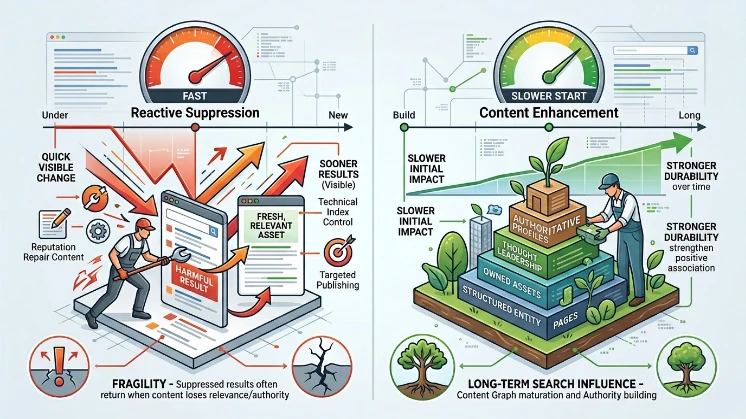
Content enhancement works slower at first but produces stronger durability over time. This approach publishes authoritative profiles, thought leadership, owned assets, and structured entity pages that strengthen positive association across the SERP. Search engines read these materials as broader evidence of topical relevance and entity consistency, which improves long-term search ranking influence. Compared with suppression, enhancement scales better and exposes the strategy to less churn, but it requires sustained publishing discipline and time for the content graph to mature.
How do organic and reactive methods compare?
Organic methods are long-horizon reputation systems that improve perception through sustained relevance, trust signals, and narrative consistency. Reactive methods are incident-response systems that target a specific negative event, page, or review cluster after damage appears. Organic work operates by building a broader semantic field around the entity, so the search engine encounters more corroborating signals when evaluating relevance. Reactive work operates by reducing the visibility of a harmful asset, which creates room for replacement but not necessarily for trust repair.
Organic methods outperform reactive methods when the issue involves repeat search queries, recurring stakeholder scrutiny, or a business that depends on stable authority. Reactive methods outperform organic methods when a single damaging result dominates the first page or when a new crisis has produced a sharp perception drop. Organic strategies reduce risk exposure because they create a deeper asset base, whereas reactive strategies concentrate risk in a small number of pages or tactics. The most resilient programmes combine both: reactive containment for immediate SERP control, and organic asset-building for reputation stabilisation.
What does search visibility actually change?
Search visibility changes which narratives dominate the first page, and that directly influences perceived legitimacy. When positive assets occupy prominent positions, the entity appears more credible, more established, and more consistent across information sources. When negative articles, complaints, or outdated profiles dominate, the search engine signals unresolved risk even if the issue is historic. This is why reputation management is not only about sentiment, but also about result ordering and document diversity.
SERP composition matters because users rarely inspect beyond the top results, and each visible result contributes to a cumulative judgement. A balanced page of results that includes owned content, neutral profiles, and reputable third-party references usually lowers the intensity of negative framing. A SERP dominated by critical pages creates the opposite effect, where even a limited amount of negative content shapes the entire perception. The timeline for change depends on whether the strategy alters one result, the whole page, or the broader entity footprint.
How do trust signals accumulate?
Trust signals accumulate through repetition, consistency, and corroboration across sources. A consistent company description, stable naming, accurate profiles, and aligned messaging across domains strengthen entity credibility. Search engines use these patterns to assess whether the entity behaves like a coherent real-world organisation rather than an isolated set of pages. Over time, this coherence supports better interpretation of branded queries and reduces volatility in how the entity appears in search.
Reviews, media references, citations, and structured content all contribute to this accumulation. Reviews alter sentiment distribution, media references expand external validation, citations reinforce factual consistency, and structured content improves machine readability. Each signal has a different pace, which is why reputation management timelines vary so sharply by channel. Search engines do not treat these signals equally, so a strategy that improves one channel without supporting the others produces uneven results.
Which strategy is most sustainable?
Content enhancement is the most sustainable strategy because it builds assets that continue to earn relevance after the initial campaign period. It operates by increasing topical coverage, strengthening supporting pages, and improving the semantic relationship between the entity and the search intent. This creates a wider buffer against future negative content because the entity already owns more of the relevant search space. The limitation is that sustainability depends on maintenance, since stale content and weak internal linking reduce long-term search ranking influence.
Removal-based strategies are less sustainable because they depend on external outcomes that sit outside direct control. Even when removal succeeds, the underlying reputation issue remains unresolved if the entity does not strengthen its public narrative. Suppression is also vulnerable to new coverage, alternative search queries, and content reindexation. For this reason, sustainability comes from aligning search visibility management with broader trust-building rather than treating the SERP as a single isolated target.
Dive Deeper With Our Expert Guides and Related Blog Posts:
What Milestones to Expect and How Long Each Stage of Reputation Management Takes
How SERM Search Engine Reputation Management Campaigns Are Built and Measured
How should expectations be set?
Expectations are set by separating visible SERP change from deeper reputation recovery. Visible change often arrives first when suppression, publishing, or profile optimisation works effectively, but deeper trust repair takes longer because it depends on accumulated evidence across search ecosystems. A realistic timeline accounts for crawl frequency, publication cadence, competitive ranking pressure, and the number of negative assets already indexed. It also recognises that reputation systems compound, so early movement does not equal final stability.
Set realistic recovery goals with professional Corporate Reputation Management that focuses on both immediate SERP improvements and long-term trust building. A strategic reputation programme helps businesses understand recovery timelines, manage stakeholder expectations, and achieve sustainable gains in search visibility and credibility.
What does a realistic timeline look like?
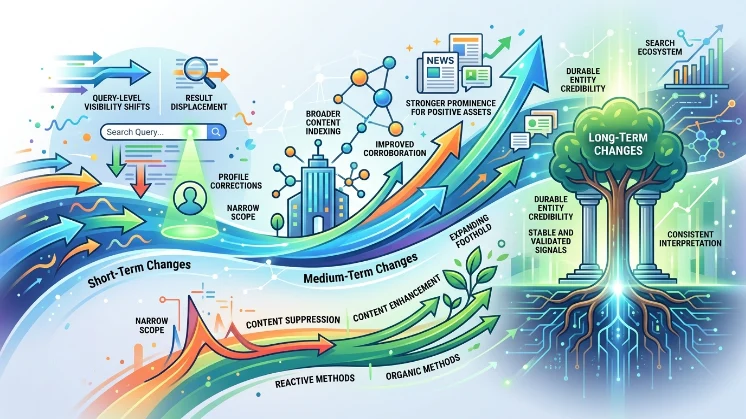
A realistic timeline is usually phased rather than linear. Short-term changes involve query-level visibility shifts, profile corrections, or result displacement for a narrow set of pages. Medium-term changes involve broader content indexing, improved corroboration, and stronger prominence for positive assets. Long-term changes involve durable entity credibility, where the search ecosystem consistently interprets the organisation through stable and validated signals.
The decisive factor is whether the strategy alters the visible story or the underlying information structure. Content suppression changes the surface quickly, but content enhancement changes the structure more reliably. Reactive methods produce sharper initial movement, while organic methods produce stronger persistence. The right expectation is therefore not one fixed date, but a sequence of increasingly stable improvements.
Reputation management results timelines depend on the mechanism in use, the strength of the current SERP, and the depth of the entity’s existing trust signals. Suppression and removal influence visibility faster, while enhancement and organic trust-building produce more durable outcomes. The best strategic choice balances short-term containment with long-term credibility so that search perception changes remain stable rather than temporary.
Discover the Full Information:
See a Transparent Reputation Management Results Timeline Before You Commit
Answers to Key Questions
What is corporate reputation management?
Corporate reputation management is the process of monitoring, shaping, and protecting how a business is perceived online and offline. It uses search visibility, content strategy, reviews, and brand messaging to strengthen trust and credibility.
How long does reputation management take to show results?
Results depend on the severity of the issue, the competitiveness of the search results, and the method used. Content-led reputation management usually takes longer than reactive suppression, but it creates more stable long-term outcomes.
What affects a company’s online reputation the most?
Search results, customer reviews, news coverage, and social media mentions all affect a company’s online reputation. Search engines and users both evaluate consistency, sentiment, and the credibility of sources.
Can negative search results be removed completely?
Some negative content can be removed if it violates platform rules, legal standards, or publication policies. When removal is not possible, reputation management focuses on reducing visibility and improving the strength of positive content.
Why is corporate reputation management important for businesses?
It helps protect trust, support customer confidence, and reduce the impact of negative content on decision-making. Strong reputation management also improves search perception, which influences how audiences judge a business before contact.