
SERM campaigns are built through structured entity mapping, content creation, and suppression tactics, then measured via sentiment distribution shifts and SERP composition changes. Reputation management strategies differ based on the severity of negative signals, the entity’s existing digital footprint, and the target search ecosystem’s tolerance for manipulation. Online reputation control methods are evaluated through their impact on reputation signals, entity credibility, and long-term search ranking influence.
What Are the Core Methods Used in SERM Campaigns and How Do They Compare?
SERM employs two primary methodological clusters: content enhancement and content suppression. Content enhancement focuses on generating positive, authoritative assets that dominate SERP slots for branded queries. Content suppression aims to push negative content below the first two pages of search results through strategic indexing manipulation.
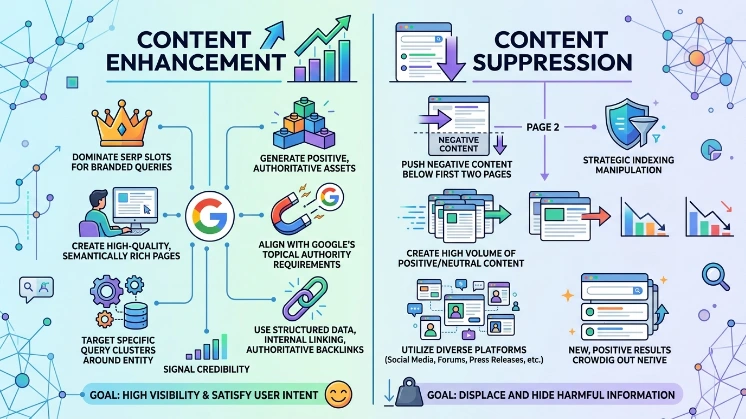
Content enhancement operates by creating high-quality, semantically rich pages that align with Google’s topical authority requirements. These pages target specific query clusters around the entity, incorporating structured data, internal linking, and authoritative backlinks to signal credibility. The mechanism relies on search engines rewarding content that satisfies user intent with higher visibility.
How Do Organic and Reactive SERM Approaches Differ in Effectiveness and Risk?
Organic SERM approaches build reputation through sustained content creation, relationship building, and genuine trust signal accumulation. Reactive approaches respond to specific negative events through targeted removal requests, legal actions, and rapid content deployment to counter immediate threats.
Organic approaches operate by accumulating reputation signals over time through consistent entity-centric content, positive review generation, and authoritative media associations. Search engines interpret these as natural trust indicators, resulting in stable ranking influence and resilient entity credibility. The mechanism aligns with Google’s long-term quality assessment frameworks.
Reactive approaches operate through emergency content deployment, legal removal requests to platforms, and strategic suppression of negative assets. These methods target specific SERP slots holding damaging content, attempting rapid composition changes. The mechanism relies on search engines’ tendency to refresh rankings when new, relevant content appears.
Organic approaches demonstrate lower risk exposure because they avoid manipulation tactics that trigger algorithmic scrutiny. They build sustainable entity credibility that withstands core updates and reputation attacks. However, they require 6–12 months to establish meaningful SERP dominance, making them unsuitable for crisis scenarios.
Reactive approaches carry higher risk exposure due to their manipulation-intent signals, which may trigger Google’s spam detection systems. They offer immediate impact (2–4 weeks) but lack sustainability, requiring continuous maintenance to prevent negative content resurgence. The effectiveness diminishes when negative content has established strong backlink profiles or media authority.
Organic strategies excel for entities with manageable reputation risks and long-term strategic planning. Reactive strategies are necessary for entities facing active reputation crises requiring immediate SERP intervention.
What Is the Impact of Short-Term Versus Long-Term SERM Strategies on Search Visibility?
Short-term SERM strategies prioritise immediate SERP composition changes through suppression tactics, rapid content deployment, and removal requests. Long-term strategies focus on building topical authority, accumulating trust signals, and establishing entity credibility through sustained content networks.
Short-term strategies operate by manipulating SERP slots through volume-based content saturation and targeted suppression. They achieve visible results within 2–6 weeks but require continuous investment to maintain composition changes. The mechanism exploits search engines’ freshness bias, where new content temporarily receives ranking advantages.
Long-term strategies operate by constructing semantic content networks that establish topical authority around the entity. They build reputation signals through consistent content quality, authoritative backlinks, and positive sentiment accumulation. The mechanism aligns with Google’s knowledge graph construction, resulting in stable entity recognition.
Short-term strategies deliver faster visibility improvements but demonstrate poor sustainability. SERP composition typically reverts within 3–6 months without continuous investment, as search engines recalibrate rankings based on long-term quality signals. Risk exposure remains elevated due to manipulation-intent patterns.
Long-term strategies show slower initial impact (6–12 months) but deliver superior sustainability. Once topical authority is established, entity credibility becomes resilient to negative content resurgence and core update fluctuations. Risk exposure remains minimal as strategies align with search engine quality frameworks.
Achieve sustainable search visibility with professional Corporate Reputation Management that balances short-term reputation recovery with long-term authority building. By strengthening trust signals, topical relevance, and entity credibility, businesses can maintain positive SERP control and protect their reputation against future challenges.
How Do Search Engines Interpret Reputation Signals and Influence SERP Composition?
Search engines interpret reputation signals through multi-dimensional assessment frameworks evaluating entity credibility, sentiment distribution, and content authority. These signals directly influence SERP composition by determining which assets rank for branded queries and how negative content is weighted against positive assets.
Reputation signals operate through three primary mechanisms: sentiment analysis (positive/negative ratio), authority signals (backlink quality, media associations), and engagement metrics (click-through rates, dwell time). Google’s algorithms aggregate these signals into entity credibility scores that determine ranking influence for branded queries.
SERP composition changes when reputation signals shift sufficiently to alter the algorithmic ranking equation. Positive signal accumulation increases the ranking probability of authoritative assets, while negative signal accumulation increases visibility of damaging content. The mechanism involves real-time recalibration of ranking scores based on new signal data.
Content suppression works by reducing the relative ranking score of negative assets through competitive dilution. When sufficient positive content occupies SERP slots, negative content’s click-through rate decreases, signalling lower relevance to search engines. This triggers ranking score reduction and visibility decline.
Content enhancement works by increasing the ranking score of positive assets through authority signal accumulation. High-quality content with strong backlinks and semantic relevance receives ranking advantages, pushing negative content to lower SERP positions. The mechanism relies on search engines’ preference for authoritative, intent-satisfying content.
Search engines increasingly penalise manipulation-intent signals through spam detection algorithms. Strategies appearing engineered for reputation manipulation rather than user value receive ranking penalties. The mechanism involves pattern recognition for unnatural content velocity, backlink profiles, and sentiment clustering.
Dive Deeper With Our Expert Guides and Related Blog Posts:
What Reputation Management SEO Involves Across Content Links and Technical Setup
How Search Result Reputation Management Combines SEO Content and Digital PR
What Metrics and Frameworks Are Used to Measure SERM Campaign Effectiveness?

SERM campaign effectiveness is measured through quantifiable metrics tracking sentiment distribution shifts, SERP composition changes, and entity credibility improvements. Measurement frameworks combine quantitative data (ranking positions, sentiment ratios) with qualitative assessment (content quality, authority signals).
Measurement frameworks operate through weekly data collection across multiple search engines, tracking branded query results for 50+ query variations. Campaign effectiveness is determined when sentiment distribution shifts by 20%+ and negative content drops below page 2 for 80%+ of branded queries.
Sustainability assessment requires 3–6 month post-campaign monitoring to verify composition stability without continuous investment. Campaigns demonstrating <10% negative content resurgence indicate successful long-term effectiveness. Those showing >30% resurgence require strategy adjustment or continued investment.
Effectiveness evaluation must account for external factors including core updates, competitor activity, and organic reputation signal changes. Isolated campaign impact is determined through control group comparison (unbranded queries) and historical baseline analysis.
What Are the Strategic Considerations for Selecting SERM Approaches?
Strategic selection of SERM approaches requires evaluating reputation risk severity, timeline constraints, resource availability, and sustainability requirements. Each approach carries distinct effectiveness profiles, risk exposures, and scalability characteristics that must align with organisational objectives.
High-risk entities facing active reputation crises require reactive, short-term suppression strategies followed by long-term content enhancement consolidation. The strategic priority is immediate SERP control to prevent further reputation damage, with sustainability as secondary consideration.
Low-risk entities with manageable reputation concerns benefit from exclusive organic, long-term content enhancement strategies. The strategic priority is sustainable entity credibility building, accepting slower initial results for superior long-term stability.
Resource-constrained organisations should prioritise content enhancement over suppression due to lower maintenance requirements and sustainable results. Suppression strategies demand continuous investment to prevent negative content resurgence, increasing long-term costs.
Organisations prioritising risk minimisation should avoid suppression tactics requiring manipulation-intent signals. Content enhancement aligned with SEO best practices carries minimal algorithmic scrutiny risk while building durable entity credibility.
Explore the Advanced Guide:
Implement a SERM Search Engine Reputation Management Plan With UK Expert Guidance
Strategic evaluation must consider industry-specific factors including regulatory requirements, competitor activity levels, and search engine tolerance for reputation manipulation. High-regulation industries (finance, healthcare) require conservative approaches prioritising compliance over rapid results.
Answers to Key Questions
What is corporate reputation management and why is it important?
Corporate reputation management is the strategic practice of monitoring, influencing, and maintaining how stakeholders perceive a business online. It protects brand trust, influences customer decisions, and supports long-term business growth by managing reputation signals across search engines and digital platforms.
How does a Reputation Management PR Agency improve corporate reputation?
A Reputation Management PR Agency combines PR strategy with SEO tactics to enhance entity credibility, publish authoritative content, and manage sentiment distribution. They implement Corporate Reputation Management frameworks that improve SERP composition and build sustainable trust signals for businesses.
What methods are used in corporate reputation management campaigns?
Corporate reputation management campaigns use content enhancement, content suppression, review management, and SERP control strategies. These methods work together to shift sentiment distribution, improve reputation signals, and increase search ranking influence for branded queries.
How long does it take to see results from corporate reputation management?
Short-term suppression tactics show results in 2–6 weeks, while long-term content enhancement strategies require 6–12 months to establish topical authority. Corporate Reputation Management effectiveness depends on reputation risk severity, resource availability, and the entity’s existing digital footprint.