

Reputation management SEO involves aligning content creation, internal linking, and technical infrastructure to shape how search engines interpret and rank entity credibility signals. Reputation management strategies differ based on whether they prioritise content suppression, content enhancement, or SERP composition control. Online reputation control methods are evaluated through their impact on reputation signals, sentiment distribution, and search ranking influence across branded and unbranded queries.
How Do Content Creation and Content Removal Strategies Compare in Reputation Management?
Content creation strategies operate by publishing authoritative, positive narratives to enhance entity credibility, while content removal strategies function by eliminating or suppressing negative material through legal or technical channels. Content enhancement builds long-term reputation signals through accumulated trust data, whereas content removal offers immediate but often temporary risk reduction.
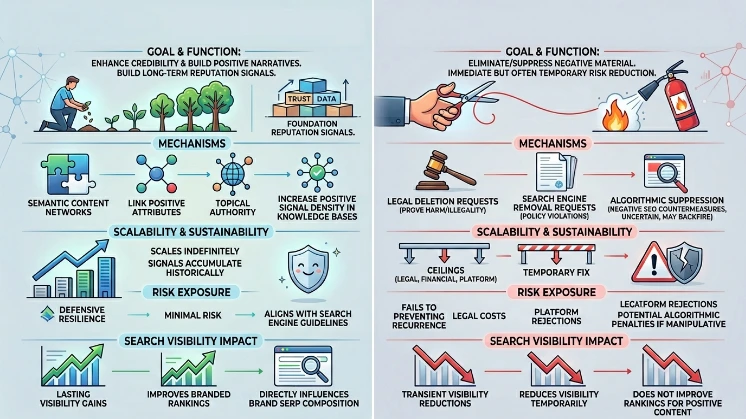
Content creation mechanisms involve publishing semantic content networks that link positive entity attributes across multiple pages. These networks establish topical authority around favourable attributes, increasing the density of positive reputation signals in search engines’ knowledge bases. The approach scales effectively because each new document adds to the entity’s credibility profile without increasing risk exposure.
Content removal operates through three primary mechanisms: legal deletion requests to platforms, search engine removal requests for sensitive content, and algorithmic suppression through negative SEO countermeasures. Legal removal achieves permanent elimination but requires proving harm or illegality. Search engine removals apply only to content violating policies like personal information exposure. Algorithmic suppression lacks certainty and may backfire if detected as manipulative.
The comparative analysis reveals distinct strengths and limitations. Content creation demonstrates superior sustainability because reputation signals accumulate historically, creating resistance to future negative content. Content removal shows higher short-term effectiveness for acute crises but fails to prevent recurrence. Creation scales indefinitely across topics and pages; removal faces legal, financial, and platform-constraint ceilings.
Risk exposure differs significantly between approaches. Content creation carries minimal risk since publishing positive material aligns with search engine guidelines. Content removal introduces legal costs, platform rejection risks, and potential algorithmic penalties if perceived as manipulative. Creation builds defensive resilience; removal provides reactive protection without long-term defence.
Strengthen long-term search visibility with professional Corporate Reputation Management that combines authoritative content creation with strategic reputation protection. By building positive trust signals and managing harmful content effectively, businesses can improve SERP control, enhance entity credibility, and create sustainable reputation growth.
What Are the Differences Between Organic and Reactive Reputation Management Approaches?
Organic reputation management approaches function through continuous, proactive content publication and link building to establish baseline entity credibility before crises occur. Reactive approaches operate through emergency response protocols triggered by negative events, prioritising speed over strategic depth.
Organic mechanisms involve systematic semantic content network development around central entity attributes. These networks establish topical maps covering favourable attributes, creating historical data that search engines use for entity credibility assessment. Internal linking structures connect positive attributes across pages, reinforcing reputation signals through contextual vectors.
Reactive mechanisms deploy rapid content publication targeting negative query terms, often using press releases, blog posts, or third-party publications. These responses prioritise speed and relevance to immediate crisis queries rather than comprehensive topical coverage. Link building focuses on pushing negative content down through negative competitor ranking suppression.
The comparative analysis shows organic approaches excel in sustainability and scalability. Organic strategies build defensible reputation signals over years, creating resistance to future negative events. Reactive approaches deliver immediate crisis mitigation but lack long-term defensive capacity. Organic scales through systematic content production; reactive scales through emergency resource allocation with higher costs.
Effectiveness differs by timeframe. Organic approaches demonstrate superior long-term impact, reducing crisis frequency and severity through established credibility. Reactive approaches show higher short-term effectiveness for acute incidents but require repeated deployment for recurring issues. Organic reduces overall risk exposure; reactive manages existing risk without prevention.
Search ranking influence varies between approaches. Organic strategies improve rankings across branded and unbranded queries by increasing positive signal density. Reactive strategies primarily affect rankings for crisis-specific queries, with limited impact on broader search visibility. Organic creates comprehensive ranking improvements; reactive targets narrow query sets.
Sentiment distribution outcomes differ significantly. Organic approaches systematically shift sentiment toward positive through accumulated favourable content. Reactive approaches temporarily neutralise negative sentiment without systematically improving overall distribution. Organic creates lasting sentiment improvements; reactive provides temporary sentiment stabilisation.
How Do Short-Term and Long-Term Reputation Management Impacts Compare?
Short-term reputation management impacts operate through immediate visibility changes and rapid sentiment shifts following crisis interventions. Long-term impacts function through accumulated historical data, established topical authority, and resilient reputation signal networks that withstand future negative events.
Short-term mechanisms include rapid content publication targeting negative queries, emergency link building for suppression, and immediate removal requests for harmful content. These approaches prioritise speed and immediate visibility changes over strategic depth. Technical interventions like meta tag updates or URL removals provide quick but temporary fixes.
Long-term mechanisms involve systematic semantic content network development, sustained internal linking strategies, and continuous reputation signal accumulation. These approaches build topical authority across favourable attributes, creating historical data that search engines weight heavily for entity credibility. Technical infrastructure supports scalable content production and link management.
The comparative analysis reveals short-term impacts deliver faster results but lack durability. Short-term interventions often require repeated deployment as negative content resurfaces. Long-term impacts show slower initial results but create lasting resistance to future reputation damage. Short-term scales through emergency resource allocation; long-term scales through systematic processes.
Scalability differences are significant. Short-term approaches face resource constraints and diminishing effectiveness with repeated use. Long-term approaches scale efficiently through automated content production and structured link management. Short-term carries higher per-intervention costs; long-term achieves lower marginal costs over time.
Risk exposure profiles diverge sharply. Short-term approaches carry higher risk from algorithmic penalties, legal costs, and platform rejection. Long-term approaches minimise risk through guideline-aligned strategies and accumulated trust data. Short-term interventions may create dependency cycles; long-term strategies build self-sustaining credibility.
Sustainability outcomes differ fundamentally. Short-term impacts fade quickly without continuous intervention, requiring ongoing resource investment. Long-term impacts persist through established historical data and topical authority, reducing future intervention needs. Short-term provides tactical relief; long-term creates strategic resilience.
How Do Search Engines Interpret Reputation Signals Across Different Content Types?
Search engines interpret reputation signals by analysing entity credibility through semantic relationships, contextual vectors, and historical data patterns across content types. Positive reputation signals accumulate through authoritative content networks, while negative signals emerge from harmful content patterns and low-trust sources.
Reputation signal mechanisms involve three primary components: content quality thresholds, source trustworthiness assessments, and semantic relationship analysis. High-quality content from trusted sources generates stronger positive signals. Semantic relationships between positive attributes and central entities reinforce credibility. Historical data patterns establish baseline credibility that new content modifies.
Different content types generate varying signal strengths. Authoritative publications like news articles and academic papers produce high-weight positive signals. User-generated content like reviews and social posts generates moderate signals with sentiment distribution analysis. Marketing content produces lower-weight signals due to explicit commercial intent detection.
Content suppression versus content enhancement operates through different interpretation mechanisms. Suppression reduces negative signal visibility through ranking adjustments without eliminating content. Enhancement increases positive signal density through increased content volume and quality. Search engines weigh enhancement more sustainably than suppression for long-term credibility.
Sentiment distribution analysis affects reputation signal interpretation. Positive sentiment clusters around favourable attributes increase entity credibility. Negative sentiment clusters around harmful attributes decrease credibility. Search engines analyse sentiment distribution across content types to determine overall reputation positioning.
Search ranking influence varies by content type trustworthiness. High-trust sources exert stronger ranking influence on branded queries. Medium-trust sources influence unbranded query rankings. Low-trust sources have minimal ranking impact regardless of sentiment. Content type determines signal weight in ranking algorithms.
Dive Deeper With Our Expert Guides and Related Blog Posts:
How Search Result Reputation Management Combines SEO Content and Digital PR
What Makes an SEO Strategy Effective at Pushing Down Negative Search Results
What Mechanisms Influence SERP Composition Through Reputation Management SEO?
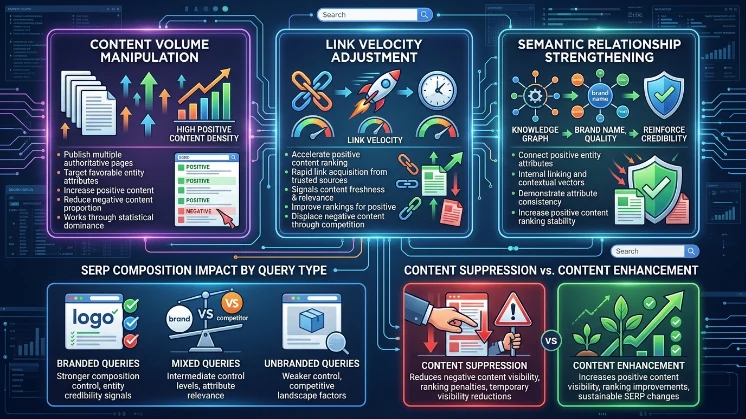
SERP composition mechanisms operate through content volume manipulation, link velocity adjustment, and semantic relationship strengthening to control which results appear for branded queries. Reputation management SEO influences SERP composition by increasing positive content density and decreasing negative content visibility through ranking adjustments.
Content volume manipulation mechanisms involve publishing multiple authoritative pages targeting favourable entity attributes. This increases positive content density in search results, reducing negative content proportion. Volume manipulation works through statistical dominance rather than individual page ranking improvements.
Link velocity adjustment mechanisms accelerate positive content ranking through rapid link acquisition from trusted sources. Increased link velocity signals content freshness and relevance, improving rankings for positive pages. This reduces negative content visibility through competitive ranking displacement.
Semantic relationship strengthening mechanisms connect positive entity attributes through internal linking and contextual vectors. These relationships reinforce credibility by demonstrating attribute consistency across content networks. Strengthened relationships increase positive content ranking stability against negative competition.
SERP composition impact varies by query type. Branded queries show stronger composition control through entity credibility signals. Unbranded queries demonstrate weaker control due to competitive landscape factors. Mixed queries exhibit intermediate control levels based on attribute relevance.
Content suppression versus content enhancement mechanisms differ in SERP impact. Suppression reduces negative content visibility through ranking penalties without content elimination. Enhancement increases positive content visibility through ranking improvements. Enhancement creates sustainable SERP changes; suppression offers temporary visibility reductions.
How Effective Are Different Reputation Management Strategies for Scalability and Sustainability?
Reputation management strategy effectiveness for scalability depends on operational efficiency, resource requirements, and adaptation capacity across expanding content networks. Sustainability effectiveness depends on historical data accumulation, topical authority establishment, and resilience against future negative events.
Content creation strategies demonstrate superior scalability through automated production systems and structured content briefs. These strategies scale efficiently because each new document adds value without increasing complexity. Sustainability is high due to accumulated historical data creating resistance to future damage.
Content removal strategies show limited scalability due to legal constraints, platform rejection rates, and resource-intensive processes. Each removal requires individual effort with diminishing returns. Sustainability is low because removals do prevent recurrence, requiring repeated interventions for ongoing protection.
Organic approaches excel in both scalability and sustainability through systematic processes and accumulated trust data. These approaches scale through automated content production and structured link management. Sustainability is maximised through established topical authority and historical data resistance.
Reactive approaches struggle with scalability due to emergency resource allocation and diminishing effectiveness. Sustainability is limited because reactive measures address existing problems without prevention. These approaches require continuous deployment for ongoing protection.
Read More to Understand Better:
Build a Reputation Management SEO Strategy That Controls Your Search Narrative
Reputation management SEO involves systematic alignment of content, links, and technical infrastructure to shape entity credibility perceptions. The most effective strategies prioritise content enhancement over suppression, organic approaches over reactive ones, and long-term sustainability over short-term gains. Search engines interpret reputation signals through semantic relationships and historical data, making sustained content networks essential for lasting SERP control.
Answers to Key Questions
What is corporate reputation management and why does it matter?
Corporate reputation management is the strategic practice of monitoring, influencing, and maintaining how stakeholders perceive a business across search engines, media, and review platforms. At Reputation Management PR Agency, we help organisations build entity credibility through reputation signals that directly impact search ranking influence and customer trust.
How does reputation management SEO differ from traditional PR?
Reputation management SEO combines content creation, internal linking, and technical setup to shape how search engines interpret entity credibility, whereas traditional PR focuses on media placements and press releases. This approach controls SERP composition by increasing positive content density and improving sentiment distribution for branded queries.
What are the most effective methods for repairing a damaged corporate reputation?
Effective reputation repair combines content enhancement strategies—publishing authoritative positive narratives—with content suppression tactics to reduce negative visibility. Corporate reputation management requires both short-term crisis response and long-term organic approaches to build sustainable entity credibility and search ranking influence.
How long does it take to see results from corporate reputation management efforts?
Short-term reputation management impacts show within 2–4 weeks through rapid content publication and link velocity adjustments, while long-term impacts require 6–12 months for topical authority establishment. Corporate reputation management at Reputation Management PR Agency balances immediate crisis mitigation with sustainable reputation signal accumulation.