

Ask immediately after a positive experience at check-out for hotels, within 24–48 hours after a trip ends for travel agencies and target Google Reviews, TripAdvisor, and Booking.com as the primary channels for UK hospitality and travel. Reputation management strategies differ based on whether the focus is on proactive review generation or reactive damage control, and online reputation control methods are evaluated through their impact on reputation signals, entity credibility, and search ranking influence.
This article compares timing strategies and channel choices for consistent positive review generation, analyses how search engines interpret reputation signals, and evaluates the effectiveness, scalability, risk exposure, and sustainability of organic versus reactive approaches for UK hospitality and travel businesses.
Peak-experience timing vs post-visit follow-up timing
Peak-experience timing requests a review when the guest is actively complimenting service or settling the bill, while post-visit follow-up timing sends a message 24–48 hours after the experience ends.
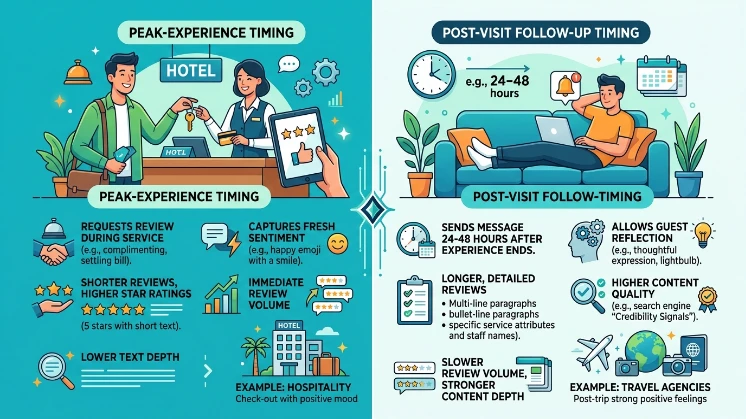
Peak-experience timing captures sentiment while it remains fresh, producing shorter reviews with higher star ratings but lower text depth. Post-visit follow-up timing allows guests to reflect, generating longer, more detailed reviews that contain specific service attributes and staff names, which search engines interpret as higher experience-based content quality.
Peak-experience timing delivers immediate volume but risks lower review depth, whereas post-visit follow-up timing yields slower volume but stronger content depth and credibility signals. For hospitality, peak-experience timing works best at check-out when guests are in a positive mood. For travel agencies, post-visit follow-up within a few days after the trip ends produces the strongest positive feelings and detailed commentary.
Immediate check-out request vs delayed email reminder
Immediate check-out requests happen at the physical point of departure, while delayed email reminders arrive 1–3 days later via email or SMS.
Immediate check-out requests achieve higher conversion rates (30–40% of asked guests leave a review) because the barrier to action is lowest when the guest is still present. Delayed email reminders achieve lower conversion (10–20%) but reach guests who forgot to review on-site and allow time for reflection.
Immediate check-out requests dominate for hotels and restaurants with high foot traffic, while delayed email reminders work better for travel agencies and boutique hotels where guests prefer digital communication. Time-of-day timing also matters: daytime weekday emails outperform late-night or weekend sends by 25% in response rate.
Which channels generate the highest review volume and trust signals for UK hospitality and travel?
Channel selection operates by matching the platform’s user base, verification model, and search ecosystem integration to the business type, which determines reputation signal strength and SERP composition.
Email vs SMS vs on-platform request links
Email requests arrive via post-visit messages, SMS requests arrive as mobile text messages, and on-platform links embed directly in the booking confirmation or check-out screen.
Email requests achieve 15–25% open rates and allow rich formatting with direct review links, while SMS requests achieve 90%+ delivery rates but limited text length and higher cost per message. On-platform links reduce friction by placing the review button in the guest’s immediate workflow, achieving 35–50% conversion when integrated into check-out or booking confirmation screens.
Email works best for travel agencies and boutique hotels where guests expect detailed communication, SMS works best for high-volume hotels needing rapid reach, and on-platform links work best for any business with a digital check-out system. Email allows daytime weekday timing optimisation, SMS enables immediate delivery, and on-platform links eliminate timing dependency entirely.
How do search engines interpret reputation signals and influence SERP composition?
Search engines interpret reputation signals by analysing review volume, recency, freshness, sentiment patterns, response behaviour, and review depth using natural language processing and AI-powered evaluation.
Review velocity and recency vs total review count
Review velocity measures new reviews per week, while recency measures the date of the most recent review, and total count measures cumulative volume.
Review recency beats review volume: a business with 30 reviews in the last 90 days typically outranks one with 200 reviews from 2023. Google’s local algorithm treats recent reviews as a proxy for business activity, making recency a stronger map pack ranking signal than total count for most service categories.
Review velocity creates a feedback loop: more reviews → more profile engagement (scrolls, reads, calls) → stronger behavioural signals → better Map Pack visibility. Total review count builds long-term authority but does not compensate for stale recency in 2025–2026 algorithms.
Businesses earning new reviews consistently signal ongoing activity and quality, which AI interprets as a reliability indicator. A business with 200 detailed reviews across four platforms carries more AI trust than one with 500 generic five-star ratings on a single platform.
Sentiment analysis and entity credibility
Sentiment analysis refers to how search engines assess whether a brand is talked about positively or negatively using AI and NLP to detect tone, context, and emotion in reviews.
Google may reduce visibility for brands with consistently negative sentiment, especially in high-trust niches like healthcare or finance. Natural language models interpret tone, context, and emotion in reviews and media coverage, prioritising entity-level reputation signals over keyword density.
Improve guest perception and strengthen brand trust with professional Hospitality & Travel Reputation Management focused on sentiment analysis, review optimisation, and credibility enhancement. By managing customer feedback and reputation signals across travel platforms, businesses can increase positive visibility, build trust, and support stronger search performance.
What are the comparative strengths and limitations of organic versus reactive reputation management?
Organic reputation management operates by proactively building review volume and positive content before crises occur, while reactive reputation management operates by responding to negative events after they materialise.
Proactive review generation vs reactive damage control
Proactive review generation encourages favourable reviews, develops competent content, and monitors internet mentions to demonstrate expertise before crises hit. Reactive damage control addresses bad reviews, minimises harm during reputation crises, and deals quickly with negative feedback after occurrence.
Proactive approaches build resilience so one negative review won’t tank a profile with 200 positive ones, while reactive approaches are essential for damage control but insufficient alone. Proactive investment is almost always less costly than reactive damage control because it prevents crisis escalation.
Proactive methods improve internal performance by pinpointing patterns across providers or departments so issues resolve at the source, while reactive methods focus on individual review responses without fixing systemic problems. Proactive strategies drive revenue through improved SEO and appointment requests, while reactive strategies primarily protect existing revenue.
Content enhancement vs content suppression strategies
Content enhancement creates and promotes new positive content aggressively to outrank negative content, pushing it to page two where it becomes effectively invisible. Content suppression uses SEO, content publishing, and platform engagement to push undesirable links off the first page without removing them.
Content enhancement operates by increasing positive result density, while content suppression operates by decreasing negative result visibility through ranking displacement. Content enhancement builds long-term entity credibility through authoritative content, while content suppression offers short-term visibility fixes without improving credibility.
Content enhancement scales sustainably as positive content accumulates, while content suppression requires continuous publishing to maintain displacement and carries higher risk exposure if negative content resurges. Content enhancement is preferred for sustainable reputation building, while content suppression is the only practical option when content cannot be removed or corrected timely.
Short-term approaches deliver rapid visibility fixes through suppression or immediate review campaigns, while long-term approaches build sustainable entity credibility through consistent velocity, depth, and multi-platform distribution.
Dive Deeper With Our Expert Guides and Related Blog Posts:
How to Challenge and Remove a Negative Trustpilot Review Through Proper Channels
Immediate review campaigns vs systematic weekly generation
Immediate review campaigns run 1–2 times per year with concentrated asking efforts, while systematic weekly generation builds a continuous ask-after-service + 1 reminder + owner response within 24–48 hours process.
Immediate campaigns produce short-term gains in review count but carry long-term reputational and legal risks when tactics feel forced or incentivised. Systematic weekly generation creates consistent velocity that signals ongoing demand and activity to search engines, producing sustainable Map Pack visibility.
Immediate campaigns fail to maintain recency after the campaign ends, while weekly systems maintain continuous recency that keeps businesses active in local algorithm evaluation. Tracking recency (last 7/30 days) and velocity (reviews/week) rather than just average rating produces stronger ranking outcomes.
Single-platform concentration vs multi-platform distribution
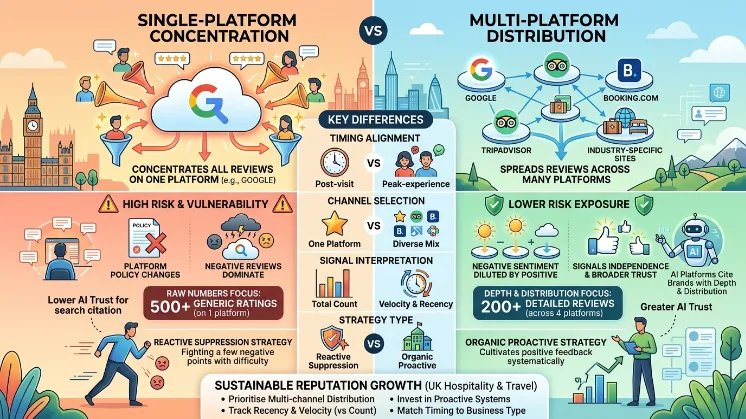
Single-platform concentration concentrates all reviews on one platform like Google, while multi-platform distribution spreads reviews across Google, TripAdvisor, Booking.com, and industry-specific sites.
Single-platform concentration risks vulnerability if that platform changes verification policies or if negative reviews dominate that single channel. Multi-platform distribution carries lower risk exposure because negative sentiment on one platform is diluted by positive sentiment on others.
Multi-platform distribution signals independence and broader trust, which AI platforms check before citing brands in generative search results. Depth and distribution outweigh raw numbers: 200 detailed reviews across four platforms carry more AI trust than 500 generic ratings on one platform.
Key differences between approaches centre on timing alignment (peak-experience vs post-visit), channel selection (Google vs TripAdvisor vs Booking.com), signal interpretation (velocity and recency vs total count), and strategy type (organic proactive vs reactive suppression). Strategic considerations include matching timing to business type, prioritising multi-channel distribution, tracking recency and velocity over total count, and investing in proactive systems rather than reactive campaigns for sustainable reputation growth in UK hospitality and travel.
Read More for Better Understanding:
Build a System That Gets More Positive Reviews for Your UK Business Automatically
Frequently Asked Questions About Hospitality & Travel Reputation Management
What is Hospitality & Travel Reputation Management and why does it matter for UK businesses?
Hospitality & Travel Reputation Management is the practice of actively monitoring and shaping how guests perceive your hotel, restaurant, or travel brand online across platforms like Google Reviews, TripAdvisor, and Booking.com. It protects revenue, builds guest trust, and strengthens brand positioning against competitors by tracking reviews, responding professionally to feedback, and implementing service improvements based on guest sentiment.
How does a Reputation Management PR Agency help hotels and travel businesses improve their online reputation?
A Reputation Management PR Agency provides comprehensive services including review management, local SEO, branding, and social media management to communicate why your company is the best choice for guests. For hospitality partners, agencies offer review response services, monitoring and reporting data, and strategic programs aimed at elevating online reputation on TripAdvisor, Google, OTAs, Yelp, and industry-specific sites.
What are the key steps to repair a damaged reputation for a hotel or travel property?
The first step is to identify the problem by asking whether feedback is recent or recurring, then commit to transparency with your team, guests, and social media followers. Next, meet with your team to formulate a repair plan, execute it while getting feedback along the way, and use surveys to gather guest input to ensure you’re taking the right steps.
How often should hotels respond to reviews and what platforms need monitoring for effective reputation management?
Hotels should respond to every review, both positive and negative, within 24–48 hours in a professional and courteous manner. Track reviews across all major platforms including booking sites, OTAs, Google Reviews, TripAdvisor, Yelp, and social media channels regularly to address guest concerns timely.