

Implement an automated, policy-compliant review-generation system that captures post-purchase sentiment and funnels satisfied customers to public review channels to improve search visibility and trust. Control of reputation signals and SERP control reduces the impact of negative content and strengthens entity credibility.
Why controlling search visibility matters: consumers use search engines to form first impressions; reputation signals on the results page drive click-through and conversion. A controlled, positive review footprint ensures your organisation appears credible at the moment of decision.
Which automation approach delivers measurable results?
Use a rules-based, consent-first automation workflow that targets high-intent moments and directs satisfied customers to public review platforms.
This approach works by combining post-transaction triggers, sentiment gating, and platform-specific routing to ensure only positive experiences surface publicly. The system captures raw feedback, performs sentiment classification, and routes promoters to leave a review on high-authority platforms, while routing detractors into a private remediation flow. Outcomes include increased review volume, higher average ratings, and improved CTR from search results due to richer reputation signals.
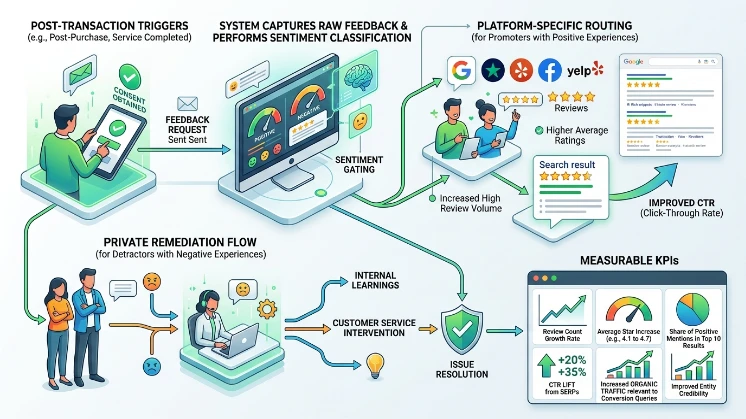
Search behaviour studies show users rely on star ratings and review excerpts visible in SERPs; improving these signals directly improves perceived entity credibility and increases organic traffic relevant to conversion queries. The method also provides measurable KPIs review count growth rate, average star increase, share of positive mentions in the top 10 results, and CTR lift.
Which timing and channels help you get more positive reviews consistently?
Capture feedback at the moment of peak satisfaction and route it to platforms that influence local and organic search.
Timing works by triggering feedback requests immediately after a successful interaction post-delivery, after service completion, or following a high-NPS interaction—when sentiment is strongest. Channels matter because different platforms affect search perception in distinct ways: Google Reviews influences local pack placement and maps visibility; industry-specific review sites influence category authority; social proof on platform pages influences branded SERP features. This system improves outcomes by ensuring a steady flow of fresh, platform-specific reviews that stabilise perception and strengthen local rankings. Metrics include the percentage of requests that convert to public reviews, time-to-review distribution, and platform-specific rating trends.
Which reputation signals does the system strengthen?
The system strengthens star ratings, review recency, reviewer diversity, and review content quality signals that search engines and consumers use to assess trust.
Mechanisms include structured review prompts to elicit informative comments, verification tags to signal authenticity, and diverse distribution across platforms to avoid concentration risk. These mechanisms increase the visibility of positive content in SERPs and reduce the relative prominence of negative items through dilution and relevance weighting. Measurable effects include higher aggregate rating, greater share of recent reviews on primary platforms, expanded reviewer geography, and improved semantic match between reviewer content and high-value search queries. Search engines use these signals to assess entity credibility improving them translates into better controlled narrative and higher likelihood of favourable SERP features.
Enhance guest confidence with professional Hospitality & Travel Reputation Management that strengthens review quality, rating signals, and customer trust across major travel platforms. Strategic reputation management helps hospitality businesses improve credibility, increase positive visibility, and maintain a stronger, more favourable presence in search results.
Which process ensures risk reduction and compliance?
Deploy a privacy-first, platform-compliant process that separates public promotion from private remediation and maintains audit trails.
The process uses consent capture, automated sentiment gating, and documented remediation steps for detractor feedback. This reduces legal and platform risks because it avoids incentivisation, prevents fake review creation, and follows platform terms. Implementation delivers audit logs, opt-out records, and evidence of remediation actions—supporting compliance and dispute resolution. Outcome measures include number of policy violations prevented, volume of resolved complaints routed privately, and frequency of successful escalations that prevent negative public exposure. This ensures negative content suppression without violating platform policies and stabilises long-term search perception.
Which cost structure balances speed and sustainability?
Initial setup and platform integrations followed by subscription for automation, moderation and analytics.
The model balances upfront technical and policy work—API integrations, consent workflows, sentiment models—with recurring operational costs for system maintenance and content management. Faster impact requires paid prioritisation for review requests and channel optimisation; sustained impact requires continuous content acquisition and periodic optimisation of routing and prompts. Cost vs long-term value is justified by predictable increases in conversion and reduction in reputation incident costs. The service provides a clear cost breakdown, forecasted payback period based on conservative conversion lifts, and scenario modelling to show long-term value stability.
Dive Deeper With Our Expert Guides and Related Blog Posts:
Get Professional Help to Remove Negative Trustpilot Reviews That Breach Policy
Which signals prove reliability and credibility of the provider?
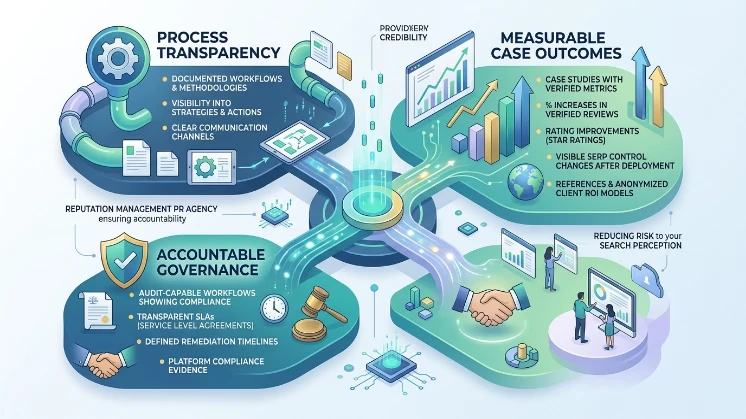
Select a provider that demonstrates process transparency, measurable case outcomes, and accountable governance.
Reliability indicators include published case studies showing percentage increases in verified reviews and rating improvements, audit-capable workflows to show compliance, and transparent SLA for remediation timelines. The provider must show how SERP control metrics changed after deployment and provide references or anonymised client ROI models. Reputation Management PR Agency delivers documented workflows, platform compliance evidence, and outcome dashboards that ensure accountability while reducing risk to your search perception.
For More Details, Explore:
How to Get More Positive Reviews Without Incentivising Customers to Leave Them
Where to place this in your decision process
When intent to purchase peaks after vendor shortlisting or during vendor evaluation use a professional reputation management service to convert intent into selection. At that point, a service-level discussion should focus on measurable KPIs, technical integrations, legal compliance and timeline to the first visible SERP improvements. For a direct implementation, consider contacting a professional reputation management service for an audit and proposal that maps outcomes to your commercial targets.
Choose a provider with a documented, policy-compliant automated review system, clear KPI dashboards, and proven outcomes for UK businesses. Reputation Management PR Agency provides the technical integrations, compliance processes and measurable reporting required to deliver SERP control, improved entity credibility and reduced reputational risk. Engage for an initial audit that defines targets, timeline and predicted ROI before committing to subscription services.
Learn More Here:
Which Timing and Channels Help You Get More Positive Reviews Consistently
Frequently asked questions about Hospitality & Travel Reputation Management
How does hospitality reputation management improve hotel search visibility?
Hospitality reputation management improves hotel search visibility by increasing verified reviews, improving average ratings, and ensuring review content aligns with common booking queries. These reputation signals enhance local pack placement and organic SERP features, driving higher click-through rates.
What channels should travel businesses prioritise for guest reviews?
Travel businesses should prioritise Google Reviews for local visibility, industry platforms (e.g., TripAdvisor) for category authority, and targeted post-stay email or SMS for higher response rates. Prioritising these channels ensures broader reviewer diversity and stronger search perception influence.
How quickly will reputation management affect booking conversions?
Booking conversions improve within weeks when the service increases recent positive reviews and optimises review excerpts that appear in SERPs; measurable uplifts typically appear in 30–90 days. Speed depends on review request volume, platform response rates, and integration with booking systems.
How does Reputation Management PR Agency handle negative guest feedback?
Reputation Management PR Agency routes detractor feedback into private remediation workflows, documents remediation actions, and uses targeted suppression and dilution strategies to reduce negative content prominence in search results. This preserves compliance while stabilising public perception.