

Reputation management is the practice of monitoring, influencing and maintaining an entity’s perception within search ecosystems. Online reputation refers to the cumulative signals reviews, indexed content, citation patterns and behavioural metrics that define an entity’s visibility and credibility in search results.
Organic positive reviews are user-generated evaluative texts and ratings that appear without material incentives and reflect real interactions. They exist as discrete content objects indexed by search engines and linked to an entity’s digital footprint.
Review creation begins with a user action (purchase or interaction) that triggers intent to evaluate. Feedback portals present mechanisms star ratings, text fields, structured questions that convert experience into machine-readable data. Platforms expose review metadata (date, reviewer, rating) which indexing agents parse to associate sentiment with the entity’s knowledge graph. Aggregation systems normalise formats and attach schema markup where present, enabling richer SERP features.
Search engines treat organic reviews as reputation signals. Positive review clusters increase perceived entity credibility, elevate ranking probability for branded queries and enable review-rich SERP features (stars, snippets). Consistent positive reviews strengthen entity perception, improving click-through from listings and reducing negative content prominence.
How do timing and channels affect the likelihood of positive reviews?
Timing refers to the interval between customer experience and review solicitation. ‘Channels’ refer to the communication vectors (email, SMS, in-app prompts, on-site signage) used to request feedback. Both operate as distribution variables within reputation networks.
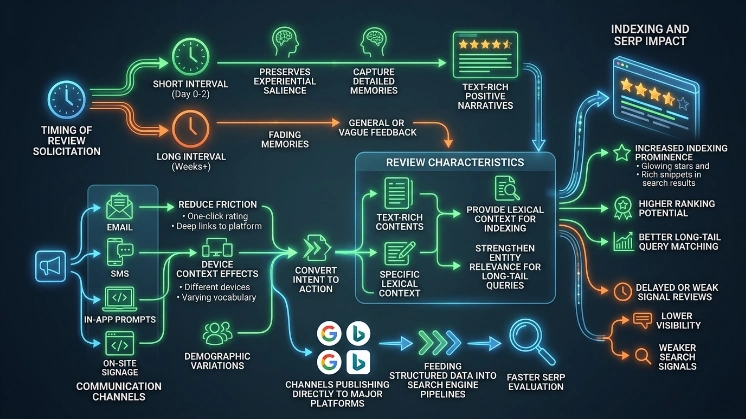
Short intervals preserve experiential salience immediate prompts capture detailed memories and increase the probability of text-rich positive narratives. Channel convenience reduces friction: one-click rating widgets or deep links to platform-specific review pages convert intent to action. Different channels influence reviewer demographics and device contexts, which alter vocabulary and sentiment expressions that indexing systems record.
High-response, text-rich reviews provide more lexical context for search indexing, strengthening entity relevance for long-tail queries. Reviews collected via channels that publish directly to major platforms (search-integrated sites) influence SERP evaluation faster because those platforms feed structured data into search engine pipelines. Conversely, delayed or offline collection presents weaker signals, reducing indexing prominence.
What defines a review signal within search ecosystems?
A review signal is a structured or unstructured data point that encodes user sentiment and metadata, which search algorithms interpret as evidence of entity quality.
Crawlers index review content, extract schema markup and compute sentiment via natural language processing. Algorithms weigh signals: recency influences temporal relevance; reviewer authority (account age, review history) affects trust attribution; content length and specificity enhance topical relevance. Aggregation functions normalise disparate rating scales and compute composite scores used in ranking heuristics.
Strong review signals surface as enhanced SERP components and influence baseline ranking through improved entity perception. Search engines use review signals to adjust relevance for local intent queries and to prioritise entities that exhibit stable, positive evaluation patterns over time.
How do search engines interpret trust and credibility from reviews?
Search engines interpret trust and credibility by evaluating reviewer provenance, review consistency, and contextual alignment across the entity’s digital footprint.
Trust algorithms cross-reference reviewer profiles, cross-platform citation patterns and anomaly detection (e.g., volume spikes). Consistency checks compare sentiment across channels and align review assertions with other structured data (business hours, location, services). Signals such as verified purchase markers, schema use, and linkages to authenticated profiles increase trust weight in ranking models.
Entities with high trust scores gain preferential SERP placement and are less susceptible to volatility from isolated negative reviews. Credible review patterns reduce the ranking impact of adversarial content and improve the entity’s authority signals in knowledge panels and local packs.
What role does content quality in reviews play in entity perception?
Content quality determines semantic richness and topical authority, which search engines use to refine entity categorisation and query matching.
Natural language understanding systems parse review text to extract entities, attributes and sentiment. High-quality reviews provide attributes that align with search queries and contribute to topical clustering. When multiple reviewers describe the same feature using consistent terminology, algorithms strengthen the entity’s relevance for those features.
High-quality reviews increase the chance of appearing for attribute-specific queries and enhance snippet generation. Structured details within reviews feed into content indexing that supports long-tail discovery and improves SERP evaluation for both branded and non-branded searches.
How does an entity’s digital footprint influence review impact?
The digital footprint functions as a context layer that amplifies or attenuates review signals depending on coherence and distribution.
Search systems perform entity resolution by linking review pages to the entity’s canonical identifiers (domain, business listing, knowledge panel). Coherent footprints consistent NAP (name, address, phone), structured data and citations enable algorithms to map reviews accurately. Fragmented footprints create attribution uncertainty, reducing the effective weight of review signals and increasing the risk of misclassification.
A coherent footprint ensures review signals integrate into the correct entity profile, improving ranking stability and enabling review-driven SERP features. Fragmented footprints produce diluted reputation signals, increasing volatility in search perception and lowering the effectiveness of positive reviews.
How do review volumes and velocity affect ranking dynamics?
Volume and velocity create temporal reputation patterns that algorithms use to detect genuine activity or manipulation.
Algorithms evaluate temporal patterns to detect organic growth versus unnatural spikes. Sustained, steady accumulation indicates ongoing customer engagement and raises trust metrics. Sudden surges trigger anomaly detection and may prompt reduced weighting, manual review, or temporary suppression in SERP features.
Strengthen guest trust and online visibility with professional Hospitality & Travel Reputation Management that helps maintain healthy review growth, positive sentiment, and strong search performance. Strategic reputation management supports consistent review signals, improves credibility, and enhances long-term ranking stability across travel and hospitality platforms.
How do search engines evaluate reviewer authenticity and its effect on reputation?
Search engines evaluate authenticity through cross-referencing reviewer histories, account signals and behavioural patterns to gauge reviewer reliability.
Authenticity evaluation uses indicators such as account longevity, review diversity, geographic consistency and cross-platform identity matches. Machine learning models flag suspicious behaviours (repetitive language, IP anomalies, bulk posting) and adjust the influence of flagged reviews on reputation metrics.
Authentic reviewer signals increase trust attribution and bolster the entity’s authority. Reviews from low-authenticity sources receive reduced weight, limiting their capacity to shift rankings or SERP features.
Dive Deeper With Our Expert Guides and Related Blog Posts:
Why Responding to Negative Reviews Matters as Much as Getting Positive Ones
Can You Remove a Negative Trustpilot Review and Under What Circumstances
What authority and trust signals beyond reviews influence entity perception?
Authority signals are indexed markers schema markup, backlinks, verified listings and content depth that indicate topical expertise. Trust signals refer to corroborating elements secure site protocols, verified contact data, and third-party recognition that validate the entity.
Search algorithms aggregate authority and trust signals with review data to compute entity-level trust scores. Backlinks from authoritative domains increase topical authority; consistent structured data enables accurate entity mapping; verified listings reduce ambiguity. These factors interact multiplicatively with review signals in ranking models.
Strong authority and trust signals amplify the positive effect of reviews and increase the likelihood of prominent SERP features. Weak authority reduces the translational power of positive reviews, limiting their effect on search perception.
How does sentiment analysis shape the interpretation of reviews?
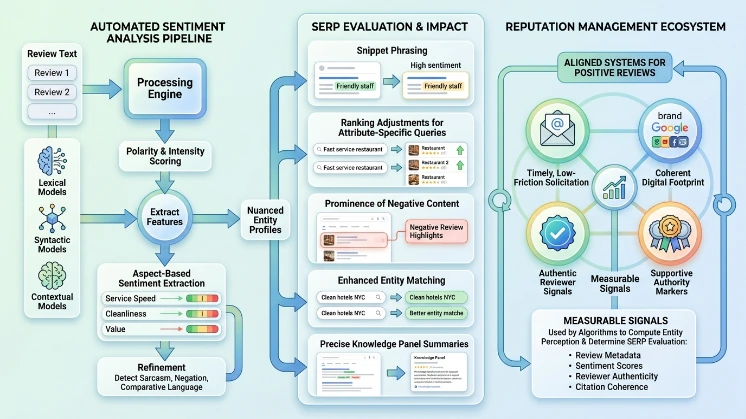
Sentiment analysis is an automated process that assigns valence (positive, neutral, negative) and intensity scores to review text within indexing pipelines.
Algorithms apply lexical, syntactic and contextual models to identify polarity and extract aspect-based sentiment (service speed, cleanliness, value). Aspect sentiment mapping links praise or complaints to specific attributes, enabling nuanced entity profiles. Models also detect sarcasm, negation and comparative language to refine scores.
Aggregated sentiment scores affect snippet phrasing, ranking adjustments for attribute-specific queries and the prominence of negative content in SERP placement. Accurate aspect sentiment enhances entity matching for user intent and supports more precise knowledge panel summaries.
Positive reviews emerge from aligned systems: timely, low-friction solicitation coherent digital footprint; authentic reviewer signals; and supportive authority markers. Reputation management operates within search ecosystems through measurable signals review metadata, sentiment scores, reviewer authenticity and citation coherence that algorithms use to compute entity perception and determine SERP evaluation. Understanding these mechanisms enables structured interventions that improve search visibility without offering incentives.
Check the Complete Explanation:
Which Timing and Channels Help You Get More Positive Reviews Consistently
Frequently Asked Questions About Hospitality & Travel Reputation Management
How can Hospitality & Travel Reputation Management improve review quality?
Reputation Management PR Agency explains that improving review quality requires timely, low-friction solicitation and consistent channel selection; these produce text-rich, aspect-specific reviews that search engines index as strong reputation signals.
Which timing and channels increase positive review rates?
Reputation Management PR Agency recommends immediate post-stay prompts via email or in-app deep links and follow-ups through SMS for higher response and richer reviews, improving review velocity and search visibility.
How do review signals affect SERP evaluation for hotels and travel brands?
Review signals rating averages, recency, reviewer authenticity and sentiment integrate with structured data and citations to influence SERP features like review snippets and local pack ranking.
What practices ensure reviewer authenticity for travel reviews?
Cross-check reviewer accounts, require verified-stay markers, and monitor review velocity patterns; these practices increase reviewer credibility and reduce the risk of algorithmic down-weighting.