

Reputation management is the control of how information about an entity is created, interpreted, and ranked across search ecosystems. Online reputation refers to the collection of review signals, search visibility, and entity perception that forms around a name, business, or brand in SERPs.
Can a negative Trustpilot review be removed?
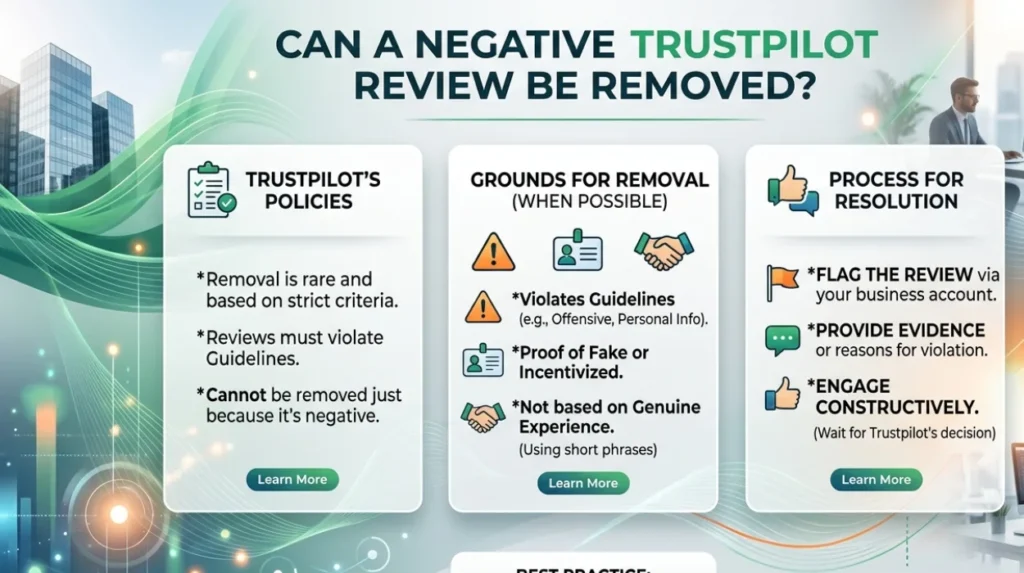
A negative Trustpilot review can be removed only when it breaches platform rules, contains unlawful material, or fails authenticity checks. Removal depends on policy status, evidence quality, and how Trustpilot evaluates the review within its moderation system.
Dive Deeper With Our Expert Guides and Related Blog Posts:
How to Report Fake Google Reviews and What Happens After You Submit
Why Trustpilot Review Management Has Become Critical for UK Consumer Trust
Trustpilot does not remove reviews because they are negative. The platform removes content when it violates its review guidelines or cannot be supported as a genuine customer experience. That distinction matters because sentiment alone does not trigger removal. A poor rating can remain visible if it fits within acceptable review policy. Trustpilot’s moderation model therefore evaluates authenticity, relevance, language, and conflict of interest. This defines the difference between criticism and removable content.
In search ecosystems, the review continues to influence entity perception until the platform acts. A live negative review contributes to sentiment distribution and can shape branded search results. It also affects trust signals when users evaluate a company through review pages before any direct contact. If the review remains indexed, it keeps contributing to search visibility even if the response underneath is strong. Removal changes that dynamic because the content no longer participates in SERP evaluation. That is why removal status matters more than tone alone.
What circumstances make removal possible?
Removal becomes possible when the review is fake, irrelevant, abusive, defamatory, confidential, or posted in breach of platform rules. These categories create a policy basis for moderation, which changes how the review affects online credibility and search perception.
A fake review is one that lacks a genuine customer relationship or misrepresents the interaction. Trustpilot evaluates authenticity because fake content distorts reputation signals. An irrelevant review is one that discusses matters outside the service experience or uses the platform as a complaint channel for unrelated issues. Abusive content creates a separate moderation issue because it breaches language and conduct standards. Confidential material, including personal data or sensitive details, can also trigger removal if it violates policy or privacy rules. Each of these circumstances changes the review from opinion into moderation-risk content.
Defamation creates a different threshold because it involves false factual claims that harm reputation. Trustpilot does not act on every disputed statement, but clear breaches of law or policy strengthen the removal case. The same applies when a review exposes private information or violates platform rules on conflict of interest. In those cases, the issue becomes less about disagreement and more about policy compliance. That shifts the probability of removal because moderation systems focus on documented breaches, not reputation discomfort. This is how content creation and content governance intersect inside reputation systems.
How does Trustpilot decide whether content stays live?
Trustpilot decides based on authenticity, guideline compliance, and whether the content reflects a verifiable customer experience. The moderation process evaluates the review against policy criteria rather than against the business’s preference for positive feedback.
The platform treats reviews as user-generated reputation signals. That means the content remains live unless it crosses a removal threshold. Trustpilot evaluates whether the review is genuine, relevant, and non-abusive. It also examines whether the writer appears to have a legitimate basis for the review. This is an important distinction because negative sentiment alone does not justify deletion. The platform is built to preserve consumer expression unless the expression breaks the rules.
This matters for search visibility because live reviews continue to rank and influence perception. A negative Trustpilot result often appears in branded search queries and comparison research. That makes moderation status a search-level issue, not only a platform-level issue. If the content stays live, it continues to affect entity credibility across the web. If it is removed, the search record changes and the impact on perception weakens. That is why moderation decisions carry direct SEO consequences.
What evidence improves the chance of removal?
Evidence improves the chance of removal when it proves the review is fake, irrelevant, abusive, or otherwise outside policy. Clear documentation strengthens moderation review and reduces ambiguity in the SERP evaluation that follows.
The strongest evidence is a clear mismatch between the review and the business’s customer records. If there is no transaction, no booking, or no identifiable service link, authenticity becomes questionable. Communication logs also matter because they can show that the reviewer is not a genuine customer or that the review contains inaccurate claims about the interaction. Screenshots, timestamps, order references, and correspondence all support the moderation case. Evidence of abuse or personal data exposure also strengthens the argument for removal. The quality of the evidence determines how the platform interprets the content.
This evidence matters beyond moderation because it affects how trust signals are recalibrated. A review that is removed ceases to reinforce negative sentiment distribution. That changes the entity’s visible profile and reduces the authority of the negative page. If the review remains live, the same evidence may still be useful for response strategy, but it does not change the index status. Search engines then continue to evaluate the page as part of the brand’s online footprint. Evidence therefore functions as both a moderation input and a reputation control tool.
How does a negative review affect search visibility?
A negative review affects search visibility by occupying branded search space, shaping snippet interpretation, and influencing user trust before any direct contact occurs. Its impact depends on ranking position, review volume, and the authority of the hosting domain.
Trustpilot pages often rank well for branded and comparative queries because the platform has strong authority. That means one negative review can appear in a result that users see before the main website. The page title, star rating, and snippet text all contribute to entity perception. Even when the review represents only one interaction, the visible result can create a broader trust problem. Search engines do not isolate the review from the domain that hosts it. They interpret it as part of the entity’s public record.
This is why content indexing matters. Once the review is indexed, it becomes part of the search layer attached to the business name. The negative page can influence clicks, not only rankings. It can also affect comparison behaviour, especially where users scan review scores before making a decision. A removed review stops contributing to this visibility layer. A live review continues to participate in SERP composition. That is the mechanism by which a single review can have disproportionate reputational effect.
What is the role of response versus removal?
Response is a visibility-management tool, while removal is a content-status tool. Response changes interpretation of the review, but removal changes whether the review continues to exist as a live reputation signal.
A public response can reduce ambiguity by showing accountability, context, or correction. It does not eliminate the review, but it influences how users interpret the claim. That matters because response quality can soften reputation damage even when removal fails. A clear response can signal professionalism and reduce perceived risk. It also demonstrates that the business monitors its online reputation. In search terms, this contributes to the wider trust profile even though the review remains indexed.
Removal has a stronger structural effect because it deletes the original negative signal from the live environment. That means the page no longer contributes in the same way to entity perception. Response alone cannot achieve that outcome. It can only alter the meaning of the content. For that reason, response and removal operate at different layers of reputation management. Response deals with interpretation. Removal deals with existence. The right choice depends on policy status, evidence strength, and the effect on search visibility.
Which removal routes are commonly used?
The main routes are policy reporting, defamation assessment, privacy-based complaints, and platform moderation appeals. Each route operates by challenging the content at a different level of policy, legality, or authenticity.
Policy reporting works when the review violates Trustpilot’s own rules. That includes fake reviews, abusive language, irrelevant content, or conflict-of-interest issues. Defamation assessment applies when the content makes false factual claims that harm reputation. Privacy-based complaints apply when the review reveals personal data or confidential information. Appeals can support the case when the first moderation outcome does not reflect the evidence. These routes differ in speed, documentation needs, and likely outcome.
The strongest route depends on the nature of the content. If the review is clearly outside platform policy, reporting is the most direct path. If the issue is factual falsehood, a more structured legal analysis becomes relevant. If the content is simply negative but genuine, removal becomes unlikely and reputation work shifts to response and perception management. That is an important boundary because not all harmful reviews are removable. Search ecosystems distinguish between objectionable content and removable content. The strategy must follow that distinction.
- Document the review content, because screenshots and timestamps establish the exact material under dispute.
- Compare the review to customer records, because mismatches support authenticity challenges.
- Report clear policy breaches, because platform moderation relies on guideline violations.
- Escalate legal issues where false factual claims exist, because defamation and privacy create separate thresholds.
- Monitor the search result after action, because index updates change visibility over time.
How does this connect to digital footprint and entity credibility?
A negative Trustpilot review becomes part of the digital footprint that search engines use to evaluate entity credibility. Its influence lasts as long as it remains indexed, visible, and linked to the brand’s search profile.
Digital footprint refers to the total web presence attached to an entity across review sites, search results, business listings, and linked mentions. A single negative review can sit inside that footprint as a persistent reputation signal. Search engines evaluate the footprint as a whole rather than one page in isolation. That means the review contributes to the broader entity record. If it stays live, it continues to inform trust judgments. If it is removed, the footprint becomes cleaner and less conflicted.
Entity credibility is the perceived reliability of the business as inferred from search and review signals. A low rating or repeated negative sentiment weakens that credibility. A removed review can improve credibility only when the wider footprint supports the change. If other negative signals remain, the effect stays limited. That is why reputation management is not only about one review. It is about the consistency of the information environment. Search systems reward coherence, and incoherent footprints reduce trust.
When does removal fail but perception still changes?
Perception can still change when the review remains live but the business responds well, resolves the underlying issue, and strengthens positive reputation signals across other channels. In that case, the review stays visible, but its influence weakens.
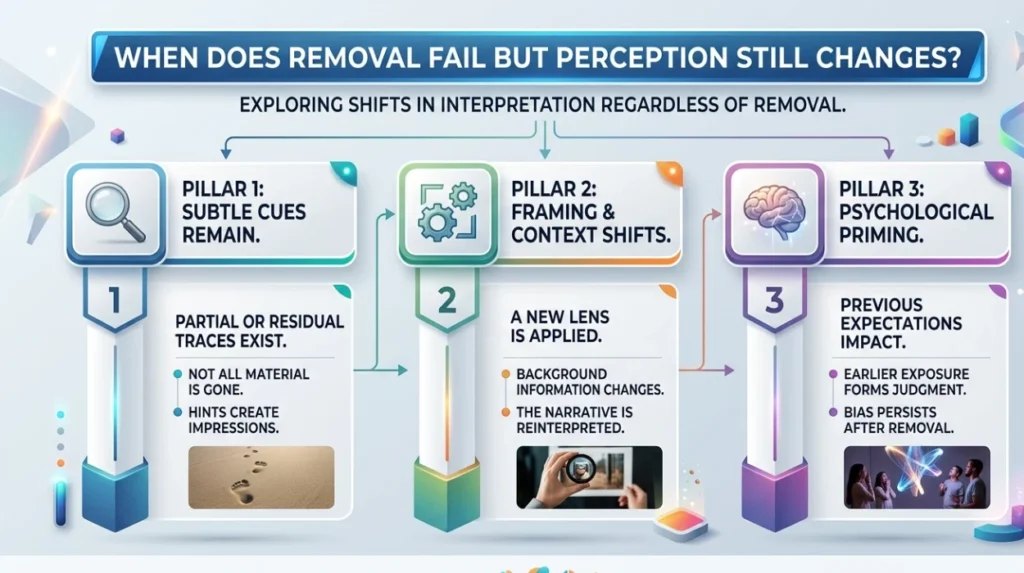
This happens because users interpret context as well as content. A calm, specific reply can reduce the force of a complaint. A strong overall review profile can also dilute the impact of one negative comment. That does not remove the issue, but it changes how the page contributes to sentiment distribution. Search engines may still index the review, yet user trust can improve if the broader profile looks credible. That is a practical distinction between removal and perception repair.
The limitation is obvious. The review still exists and can still appear in search. That means the entity remains exposed to the original negative signal. For high-stakes reputation problems, perception repair without removal often serves as a partial solution. It works best when the review is genuine and policy-compliant but not representative of the whole brand. In that case, the review is managed rather than erased. The public record stays intact, but its influence declines.
What should a UK audience understand from this?
A UK audience should understand that Trustpilot removal depends on policy, proof, and moderation thresholds, not on dissatisfaction alone. The review must breach rules or contain a clear legal or authenticity issue before removal becomes likely.
This matters because many review disputes begin with the assumption that a negative statement is removable by default. It is not. Search ecosystems distinguish lawful criticism from removable content. Trustpilot’s moderation system reflects that distinction. The same review can remain live, get amended, or be removed depending on the evidence and the platform rules. That creates a structured decision process rather than a simple complaint process.
The broader lesson is that reputation management is a system of content, indexing, and interpretation. A review affects search visibility because it contributes to a public trust profile. Removal changes the profile only when the platform acts. If it does not, response and broader reputation work become the next layer of control.