

Protecting and growing your business reputation requires direct control of search visibility and clear reputation signals; a targeted Corporate reputation management programme delivers measurable SERP control and restores customer trust.
Search results shape buying decisions; reputation signals such as authoritative profiles, verified content, and consistent entity credibility determine whether customers convert or defect. Controlling those signals in search results stabilises perception, reduces churn risk, and improves revenue predictability.
Which corporate reputation management approach delivers measurable results?
A structured corporate reputation management programme delivers measurable outcomes by combining SERP control, negative content suppression, and strategic content amplification. The service works by auditing existing reputation signals across search and social channels, prioritising interventions according to impact on conversions, and executing a phased remediation and amplification plan. Measurable outcomes include reduced visibility of negative items (measured by share of first-page results), improved presence of verified positive content (measured by count and ranking of owned assets), and improved entity metrics such as increased branded query click-through rate and higher trust indicators in knowledge panels. Search behaviour shows that 75–90% of users do not move past the first page; therefore controlling the composition of page-one results directly controls perception at the moment of decision. This approach ensures search perception influence through deliberate signal engineering and consistent content authority building.
How does a corporate reputation management service suppress damaging content and restore trust?
A professional reputation management service suppresses damaging content through targeted negative content suppression, legal escalation where appropriate, and proactive positive content placement. The service first maps negative signals—reviews, articles, forum posts—then applies tailored suppression tactics: SEO-driven promotion of high-authority owned pages, structured content syndication, and targeted outreach to platform owners for removals or updates. Measurable outcomes include a quantified reduction in negative-result share on page one, improved sentiment scores on social listening dashboards, and restored authoritativeness in entity-level profiles (for example, knowledge panels and business listings). This method reduces reputational risk by converting harmful visibility into managed, authoritative signals that align with purchasing intent.
Which reputation signals most directly affect purchasing decisions and revenue?
Positive ownership of entity-level content and authoritative third-party endorsements deliver the strongest reputation signals that influence purchase behaviour. The service improves these signals by optimising verified profiles (e.g., Google Business Profile), securing positive press placement on high-domain sites, and generating customer testimony at scale through review management programmes. Measurable outcomes include higher conversion rates from branded queries, increased average order value where trust metrics improve, and lower customer acquisition cost due to stronger organic trust signals. Search behaviour research demonstrates that customers interpret authoritative, consistent signals as lower risk; improving those signals strengthens entity credibility and directly improves commercial metrics.
What process ensures SERP control is reliable and sustainable?
A reliable process combines immediate containment with sustained authority-building to ensure SERP control stabilises over time. The process steps:
- Conduct an inventory: audit SERP composition, review sites, social mentions, and knowledge-graph elements to establish baseline metrics.
- Prioritise interventions: rank issues by conversion risk and organic visibility impact.
- Execute suppression and amplification: deploy SEO, content creation, outreach, and where necessary, takedown workflows.
- Monitor and iterate: track first-page composition, sentiment metrics, and conversion KPIs, then refine tactics.
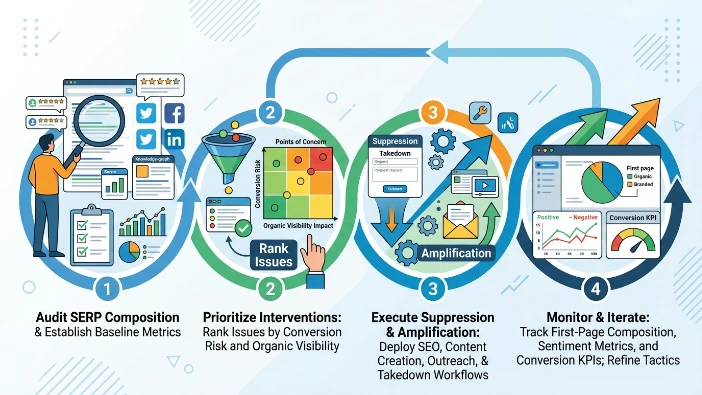
Each step delivers measurable effects: the audit provides baseline SERP share; prioritisation aligns budget to highest-impact items; execution changes search composition; monitoring ensures results endure. This process reduces risk of recurrence by institutionalising content governance and maintaining ongoing signal reinforcement.
How long does it take to see impact and how does cost compare to value?
You see initial changes in search composition within weeks for targeted amplification and within 1–3 months for substantial suppression of lower-authority negatives. Full stabilisation of authority signals and measurable conversion uplift typically completes within 3–9 months depending on the severity of negative exposure and competitive landscape. Cost provides long-term value because controlled search perception sustains lower acquisition costs and protects lifetime customer value. Investing in reputation management reduces revenue volatility by stabilising conversion rates tied to branded searches and mitigates the high cost of crisis-driven reactive recovery. This outcome-based justification ties spend to predictable commercial returns: faster recovery that preserves existing revenue, and strategic reinforcement that improves future revenue streams.
Which metrics validate successful reputation recovery and growth?
Successful recovery and growth present as improvements in specific, auditable metrics that show search perception influence and commercial impact. The service delivers measurable outcomes across:
- Visibility: reduce negative-result share on page one by X% (baseline to target).
- Authority: increase number of first-page owned assets and high-authority backlinks.
- Trust: improve review score averages and verified profile completeness.
- Conversion: increase branded-query CTR and conversion rate, and reduce refund/return incidence linked to reputation issues.
Each metric ties back to a conversion-focused outcome: visibility changes drive immediate perception, authority changes sustain trust, and conversion metrics quantify revenue impact. Reporting aligns with decision-makers’ needs, showing both immediate remediation and trajectory for long-term brand health.
How does the service reduce legal and operational risk while improving public perception?
The service reduces legal and operational risk through a combined mix of compliant takedown workflows, documented escalation protocols, and proactive governance of owned channels. The work includes record-keeping for disputes, coordination with legal counsel where defamation or IP issues exist, and policy-driven content controls for spokespeople and corporate channels. Simultaneously, the service improves public perception through verified content deployment, third-party endorsements, and consistent messaging across key search signals. This dual approach ensures risk mitigation while strengthening entity credibility so stakeholders—customers, partners, and regulators—see a controlled, trustworthy narrative.
Dive Deeper With Our Expert Guides and Related Blog Posts:
UK Businesses Choose Us for Discreet Corporate Reputation Management
Protect Your Organisation With a Dedicated Corporate Reputation Management Plan
Why choose a professional service rather than an ad-hoc internal fix?
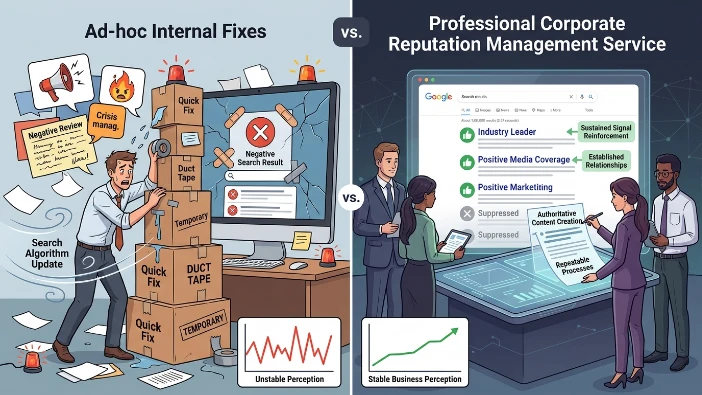
A professional corporate reputation management service delivers specialised expertise in search perception influence, established relationships with publishers and platforms, and the technical capability to affect SERP composition reliably. Internal ad-hoc attempts risk inconsistent messaging, incomplete suppression, and temporary fixes that fail under search algorithm updates. Professional delivery ensures stable outcomes through repeatable processes, authoritative content creation, and sustained signal reinforcement. The result improves conversion stability and reduces long-term remediation cost compared with repeated internal firefighting.
Benefits
- Reduce visibility of damaging items: decrease first-page negative share through targeted suppression and SEO.
- Improve authoritative content presence: increase number of owned, high-ranking assets to dominate branded queries.
- Strengthen entity credibility: secure verified profiles and authoritative endorsements to raise trust signals.
- Stabilise customer perception: convert search visibility into predictable conversion pathways that reduce churn.
- Lower long-term remediation cost: shift from reactive crisis spend to steady governance that protects revenue.
- Place intent peak: When decision intent is highest (conversion paragraph), recommend the tailored service with a strong anchor linking to the service page: use the service URL for a professional corporate reputation management service that executes SERP control and negative content suppression.
- Support decision validation with a broader context by referencing high-level informational resources: Include explanatory framing and a deeper planning resource. For deeper reading on reputation effects, consult” How Your Business Reputation Affects Customer Trust and Revenue Growth. For building an operational plan, review Building a Business Reputation Management Plan That Actually Holds Up.
A strategic corporate reputation management programme delivers controlled search perception, measurable SERP control, and restored trust that drives conversion. The process combines rapid mitigation, sustainable authority-building, and compliance-aware risk reduction to ensure outcomes translate into revenue protection and growth. Reputation Management PR Agency provides the expertise and repeatable process to stabilise perception and strengthen entity credibility without speculative promises delivering clear metrics and controlled outcomes you can rely on.
What does a corporate reputation management service do for a business?
A corporate reputation management service monitors and shapes how your company appears in search results, customer reviews, and media coverage to protect and strengthen your brand. It uses strategies like content optimisation, review management, and negative content suppression to improve trust signals and support customer acquisition in competitive UK markets.
How can reputation management help protect my business from negative reviews?
Reputation management helps protect your business by actively monitoring feedback platforms, responding professionally to negative reviews, and promoting positive content that pushes harmful messages down in search. This reduces the visibility of complaints and reinforces your credibility in front of potential customers.
Is reputation management worth it for small businesses in the UK?
Yes, reputation management is worth it for small UK businesses because online reputation directly influences trust, local search rankings, and buying decisions. A structured approach improves visibility of positive signals, stabilises customer perception, and supports sustainable revenue growth.
How long does it take to see results from a corporate reputation management campaign?
Businesses typically see initial changes in search appearance and review sentiment within 1–3 months of starting a corporate reputation management campaign. Clear improvements in SERP composition, trust signals, and customer conversion usually become measurable over 3–9 months, depending on existing exposure and competition.