

Reputation management strategies differ based on whether the objective is to suppress negative visibility, strengthen positive entity signals, or stabilise both across search and review environments. Online reputation control methods are evaluated through how they shape SERP composition, reputation signals, entity credibility, and long-term search ranking influence.
Which reputation approach holds up best?
A durable reputation management plan uses content enhancement, technical control, and response governance in combination rather than relying on a single tactic. Reputation management is the discipline of influencing how a business entity is represented across search results, review platforms, publisher content, and owned channels. It operates by shifting what search engines can crawl, index, and prioritise when users query a brand or company name. Content enhancement builds positive, relevant assets that compete for visibility, while removal strategies attempt to reduce the presence of harmful or inaccurate material. The stronger approach depends on whether the problem is absent trust signals, hostile third-party content, or weak brand coverage.
A content-first model usually performs better over time because it expands the business’s own information footprint. Search engines interpret repeated, coherent mentions across owned pages, profiles, and editorial references as structured reputation signals. That creates more stable SERP composition because the brand has more indexable assets that can occupy branded results. Removal-led approaches work faster when content is clearly defamatory, outdated, or policy-violating, but they depend on third-party action and legal or platform thresholds. The most resilient plans combine content creation with escalation routes for content suppression vs content enhancement.
How do organic and reactive methods compare?
Organic reputation management is the long-term construction of positive search presence through consistent publishing, entity alignment, and trust-building references. Reactive reputation management is the response layer that addresses incidents, complaints, negative coverage, or ranking volatility after it appears. Organic methods operate by increasing the quantity and quality of indexed assets tied to the business entity. Reactive methods operate by countering an existing narrative through clarifications, rebuttals, remediation, or the removal of inaccurate material. The two methods differ most in timing, cost structure, and dependence on external publishers.
Organic methods create compounding value because they strengthen entity credibility before a crisis emerges. A business with well-structured About, FAQ, service, leadership, and policy pages sends clearer semantic signals to search engines than a brand with a thin digital footprint. Reactive methods deliver immediate damage control, but they often produce fragmented messaging because they must answer an already dominant narrative. This makes reactive work more exposed to volatility in rankings, sentiment distribution, and media repetition. A plan that relies only on reaction remains vulnerable whenever a new negative result enters the index.
When does suppression work better than enhancement?
Suppression works better when harmful results rank for branded queries and cannot be removed quickly. Content suppression is the process of displacing negative or irrelevant URLs with stronger, better-optimised pages that take their place in search results. It operates by increasing the relevance, authority, and freshness of competing assets until the negative result loses visibility. Content enhancement is different because it adds positive material without directly targeting the offending page. In practice, suppression and enhancement overlap, but their mechanisms and risk profiles are not identical.
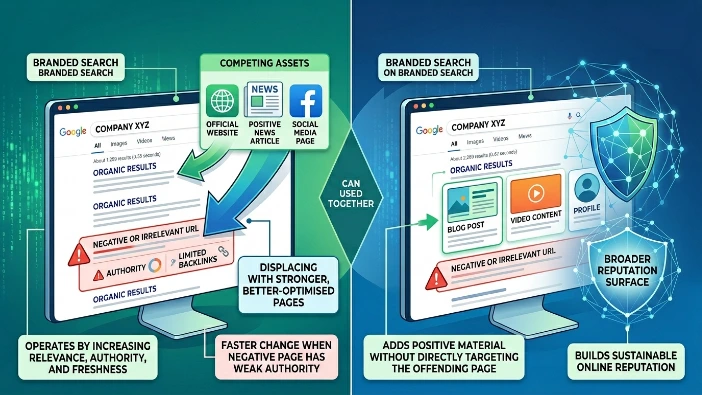
Suppression delivers faster visible change when the negative page has weak authority or limited backlinks. It is effective in branded SERPs because search engines often reorganise result sets when more relevant entity pages enter the index. Enhancement is safer and more sustainable because it builds a broader reputation surface rather than relying on one ranking battle. Suppression also carries a limitation: if the negative page has strong authority, repeated mentions, or high user engagement, displacement becomes more expensive and less stable. For that reason, suppression works best as a tactical layer inside a wider reputation architecture.
What role do reviews and SERPs play?
Reviews and SERPs act as the two most visible reputation layers for buyers and stakeholders. Review management is the process of influencing rating volume, review recency, review response quality, and sentiment balance on third-party platforms. Search engine results pages translate those signals into public perception by showing review snippets, news articles, company profiles, forums, and owned assets together. Search engines read reviews as external trust indicators, especially when review text repeatedly names the business, product, location, or service category. That makes reviews a direct input into perception and an indirect input into search ranking influence.
Review-focused plans are effective because they influence both conversion and discoverability. A balanced review profile increases trust signals and reduces the impact of isolated negative commentary. The limitation is that reviews remain platform-controlled, which means a business cannot fully govern moderation, indexing, or display order. SERP control is broader because it covers pages the business owns, pages it influences, and pages it cannot control but can compete against. The best plans treat reviews as reputation evidence and SERPs as the distribution layer for that evidence.
Dive Deeper With Our Expert Guides and Related Blog Posts:
Evaluating Corporate Reputation Management Options Available to UK Firms
How Corporate Reputation Management Strategies Are Built and Measured
Which method scales most sustainably?
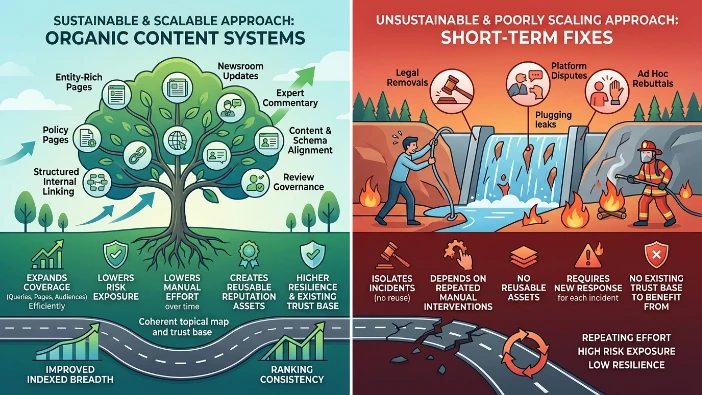
Organic content systems scale more sustainably than one-off reputation interventions. Scalability is the ability to expand coverage across more queries, more pages, and more audience segments without proportional increases in risk or manual effort. Content-led reputation systems scale by adding entity-rich pages, newsroom updates, expert commentary, policy pages, and structured internal linking. They also support search engines more effectively because they create a coherent topical map around the business entity. This improves both indexed breadth and ranking consistency.
Short-term fixes scale poorly because they depend on repeated manual interventions. Legal removals, platform disputes, and ad hoc rebuttals resolve isolated incidents but do not create reusable reputation assets. The sustainability gap appears when a business faces repeated negative stories, because each incident requires a new response rather than benefiting from an existing trust base. A scalable plan therefore uses content, schema alignment, profile consistency, and review governance as repeatable systems. That structure lowers risk exposure and raises resilience across future search events.
For more information explore:
Protect and Grow Your Business Reputation With Our Proven UK Service
How should a plan be evaluated?
A business reputation management plan is evaluated by measuring visibility, sentiment, and control across the SERP surface. The first step is to identify which pages rank for the brand name, leadership names, product names, and key service terms. The second step is to classify each result as owned, earned, shared, or hostile, because each class changes the response mechanism. The third step is to compare how fast each tactic changes visibility and how stable that change remains over time. This framework keeps the plan tied to measurable reputation signals rather than vague brand language.
- Audit branded queries, because they show the actual search narrative and reveal which entities dominate results.
- Classify indexable assets, because owned pages and third-party pages require different control mechanisms.
- Measure sentiment distribution, because review tone and article framing affect trust perception.
- Prioritise replacement assets, because strong counter-pages improve suppression and enhancement outcomes.
- Track ranking movement, because visibility changes show whether the strategy improves SERP composition.
Reputation management works best when organic authority, reactive response, and SERP control reinforce each other. The strongest plan balances short-term suppression with long-term content and trust building, because that combination holds up better against ranking shifts and new negative signals.
Building a Business Reputation Management Plan That Actually Holds Up
Business reputation management is the process of monitoring, shaping, and improving how a company appears across search results, reviews, and online mentions. It focuses on reputation signals such as sentiment, visibility, and trust to strengthen public perception.
What makes a reputation management plan effective?
An effective reputation management plan combines proactive content creation, review monitoring, and fast response to negative coverage. It works best when the business builds long-term entity credibility instead of relying on short-term fixes.
How does reputation management affect Google search results?
Reputation management affects Google search results by influencing which pages appear for branded queries and how those pages frame the business. Strong owned content, accurate profiles, and positive third-party mentions can improve SERP composition over time.
What is the difference between content suppression and content enhancement?
Content suppression pushes negative results lower in search visibility by strengthening competing pages. Content enhancement builds positive, relevant content that improves trust signals and gives search engines more authoritative material to rank.