

Reputation management works by systematically influencing how an organisation appears in search and discovery channels, primarily through content composition, visibility distribution, and sentiment shaping. Reputation strategies differ based on whether they prioritise content suppression, content enhancement, or preventive trust‑building, and search‑perception outcomes vary according to mechanism, scale, and operational duration.
Reputation management strategies differ based on whether they focus on reactive damage control or long‑term entity‑credibility development. Online reputation control methods are evaluated through their impact on SERP composition, sentiment distribution, and the perceived reliability of information surfaces linked to the brand. This article examines different approaches to corporate‑level reputation management, compares their mechanisms and limitations, and evaluates their effectiveness for UK‑based organisations operating under current digital‑trust and regulatory expectations.
How do reputation management methods differ in mechanism?
Reputation management methods fall into three broad categories: content creation / enhancement, content suppression / removal, and ongoing monitoring / trust‑signal optimisation. Each relies on distinct mechanisms within the search ecosystem and generates different patterns of visibility, trust signals, and perception.
Content creation and enhancement operate by increasing the volume and prominence of positive, authoritative content associated with an entity. This typically involves publishing owned content on owned domains, securing third‑party coverage from reputable publishers, and optimising structured data that support entity credibility. The mechanism is amplification: search engines respond to increased signal density, topical coverage, and backlink authority, which expand the share of SERP space occupied by favourable material.
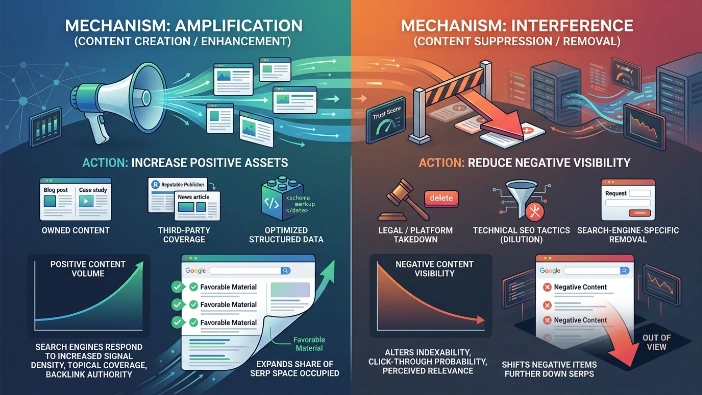
Content suppression and removal strategies focus on reducing the visibility of negative or credibility‑damaging content. This can involve legal or platform‑based takedown requests, search‑engine‑specific removal mechanisms, or technical SEO tactics that dilute the prominence of controversial pages. The underlying mechanism is interference: by altering indexability, click‑through probability, or perceived relevance, these tactics seek to shift negative items further down SERPs or out of mainstream search views altogether.
Monitoring and trust‑signal optimisation methods work by systematically tracking sentiment, visibility, and SERP composition over time. This includes audit‑style analysis of where an entity appears, how it is described, and what sentiment patterns emerge across review platforms, news outlets, and social services. The mechanism is detection and recalibration: regular measurement allows organisations to adjust messaging, content portfolios, and engagement practices to align with evolving reputation signals.
How do organic and reactive approaches compare in impact?
Organic reputation strategies are built on long‑term content and relationship development, whereas reactive approaches respond to specific spikes in negative visibility or sentiment. Both produce measurable effects on SERP composition and trust perception, but their mechanisms and risk profiles differ sharply.
Organic methods operate by systematically expanding the breadth and depth of positive signals associated with an entity. This includes building topical clusters around core services, maintaining consistent brand messaging, and cultivating authoritative third‑party mentions that reinforce entity credibility. The comparative strength of organic work is sustainability: once a critical mass of reputation signals is established, the default SERP state tends to skew positive without constant intervention. A limitation is latency: substantial changes in SERP composition usually require months of consistent execution, and the method is less effective in acute crisis scenarios.
Reactive methods prioritise rapid visibility shifts in response to specific negative events, such as scandals, regulatory actions, or viral complaints. Tactics may include urgent publishing of corrective statements, legal or policy‑based removal requests, or targeted content campaigns designed to push particular items down the rankings. The principal strength of reactive work is speed: it can materially alter what appears on the first page within weeks, especially when coordinated with PR and legal channels. The main limitations are scalability and sustainability: reactive campaigns often deplete resources quickly and may leave underlying credibility gaps unaddressed if not paired with longer‑term organic strategies.
How do short‑term and long‑term strategies differ in outcomes?
Short‑term reputation tactics focus on immediate SERP reshaping and sentiment diversion, while long‑term strategies aim to embed a stable, positive reputation architecture across digital ecosystems. Each generates characteristic patterns of visibility, trust evolution, and organisational risk.
Short‑term strategies operate by concentrating resources on specific visibility targets, such as reducing page‑one exposure for damaging keywords or accelerating takedown or moderation of specific posts. The mechanism is signal compression: by flooding the SERP with alternative, often corrective, content or by removing low‑quality items, these tactics create a temporary perception shift with relatively rapid results. Strengths include fast demonstrable impact and measurable cost‑per‑visibility‑point metrics, but they are constrained by limited durability and high dependency on ongoing maintenance once the intervention ceases.
Long‑term strategies work by gradually expanding the density and consistency of positive reputation signals across multiple domains and platforms. This includes continuous content production, structured authorship, and relationship‑building with media and specialist publishers that reinforce entity credibility. The mechanism is signal accumulation: over time, search and recommendation systems learn to associate the entity with stable, authoritative, and socially validated content, which stabilises SERP composition and reduces the impact of isolated negative events. The primary strength is systemic resilience, yet the approach exposes organisations to slower ROI curves and requires sustained investment and governance.
How do content creation and removal tactics compare in effectiveness?
Content creation and removal tactics occupy opposite ends of the reputation‑intervention spectrum, each with distinct effectiveness profiles and strategic implications. Both influence SERP composition and perceived trust, but they do so through contrasting mechanisms and with different limitations.
Content creation tactics operate by increasing the volume, relevance, and authority of content associated with an entity. This includes publishing articles, case studies, and commentary that align with core reputation themes, and optimising them for both topical and navigational search intents. The comparative strength is controllability: organisations can shape the narrative, tone, and specificity of the material, which enhances consistency in how the entity is described across search and discovery channels. A limitation is that creation work cannot erase existing content; it only dilutes its relative prominence, so effectiveness depends on the ability to out‑publish and out‑authority negative material.
Removal‑focused tactics rely on reducing the presence of content that is harmful, inaccurate, or inconsistent with desired reputation signals. This can involve legal or policy‑based requests, platform‑level moderation tools, or search‑engine‑specific mechanisms for delisting or deprioritising URLs. The mechanism is signal reduction: by decreasing the index density or visibility of specific items, these tactics attempt to narrow the pathway through which negative narratives reach audiences. The main strength is the potential to eliminate particular triggers of reputational harm, but limitations include partial coverage (not all jurisdictions or platforms respond alike), procedural complexity, and ethical or regulatory scrutiny.
How do search engines interpret reputation signals in practice?
Search engines interpret reputation signals through a combination of topical relevance, authority indicators, and sentiment‑related patterns embedded in content and behaviour. These systems treat reputation not as a single metric but as a composite of how entities are discussed, linked, and engaged with across the web.
Reputation signals are commonly derived from structured data, authorship patterns, and citation networks that indicate consistency and verifiability. Search algorithms compare the density and alignment of mentions, the characteristics of referring sources, and the stability of entity attributes over time to infer whether an organisation is presented as credible, specialised, and socially validated. Sentiment distribution—how often an entity is described positively, negatively, or neutrally—also contributes to how search systems weight and rank reputation‑relevant content.
Search ranking influence is not purely deterministic; it reflects how reputation signals interact with relevance and intent. For example, a brand with a high‑volume, positive‑leaning reputation corpus may still appear unfavourably in specific SERPs if those queries trigger crisis‑related content or negative reviews. This illustrates that reputation management is not about achieving a single “positive” score, but about structuring the distribution of signals so that the dominant perception aligns with strategic credibility goals.
For more insight explore:
Is Professional Reputation Management the Right Solution for Your Brand
How do different strategies influence SERP composition and perception?
Different reputation strategies produce predictable patterns in SERP composition, which in turn shape how audiences perceive an organisation’s credibility and reliability. The choice of method therefore affects not only where content appears, but also how consistently and coherently the entity is represented across search and discovery channels.
Content‑enhancement‑led strategies typically increase the proportion of branded, authoritative, and thematically aligned items in SERPs. This raises the visibility of official narratives, case studies, and expert commentary, which can strengthen entity credibility and reduce the space available for unverified or speculative content. The limitation is that SERP diversity is still constrained by external publishing patterns and user behaviour; unauthorised or adversarial content can still maintain visibility if it garners sufficient engagement or links.
Removal‑and‑suppression‑driven strategies often produce sharper short‑term shifts in SERP layout, especially when paired with rapid content publishing. By pushing specific items down or removing them from index coverage, these tactics can temporarily emphasise favourable or neutral material on the first page. However, the sustainability of this configuration depends on the underlying reputation architecture; if the broader corpus remains inconsistent or negative, SERPs may revert once the tactical pressure is reduced.
Dive Deeper With Our Expert Guides and Related Blog Posts:
Building a Business Reputation Management Plan That Actually Holds Up
Evaluating Corporate Reputation Management Options Available to UK Firms
What are the key strategic considerations for choosing an approach?

Selecting a reputation management approach requires evaluating effectiveness, scalability, risk exposure, and long‑term sustainability against an organisation’s operational context and regulatory environment. Each method carries distinct trade‑offs that must be mapped to realistic expectations about what “results” can be achieved.
Organisations should compare whether they need rapid visibility correction, ongoing trust‑signal optimisation, or a hybrid of both. A short‑term, reactive‑focused plan may be appropriate for acute incidents, while long‑term organic strategies are better suited for sustained credibility building and systemic risk reduction. The evaluation must also consider scalability: purely reactive campaigns can over‑extend resources, whereas consistently produced content and structured monitoring can be integrated into broader digital and communications governance.
Risk exposure varies according to the chosen mechanism. Aggressive removal or suppression tactics may attract regulatory or ethical scrutiny, particularly if they are perceived as attempting to erase legitimate criticism or public‑interest reporting. Conversely, content‑driven strategies that rely on transparency and verifiable information generally align better with evolving digital‑trust frameworks and can strengthen both search visibility and stakeholder confidence.
Reputation management works by shaping how an organisation appears in search and discovery channels through controlled content, visibility shifts, and sentiment patterns. Different approaches content creation, removal, organic growth, and reactive intervention—produce distinct outcomes in SERP composition, trust signals, and perceived credibility. Choosing a strategy requires balancing short‑term visibility goals with long‑term reputation resilience and aligning methods with regulatory and ethical expectations in the UK digital landscape.
How does corporate reputation management work?
Corporate reputation management works by shaping how a business appears in search and media through content creation, visibility control, and sentiment monitoring. It focuses on strengthening reputation signals, improving online credibility, and influencing what users see when they search for the brand.
What results can you expect from reputation management?
Reputation management typically improves search‑result composition, reduces the prominence of negative content, and reinforces positive brand narratives. Results include more stable SERP positioning, clearer entity credibility, and a more balanced sentiment distribution over time.
Why is online reputation management important for businesses?
Online reputation management helps protect a company’s credibility by aligning public perception with its actual behaviour and values. It supports trust signals, reduces reputational risk, and makes it easier for customers and stakeholders to find accurate, favourable information.
What is the difference between reactive and proactive reputation management?
Reactive reputation management focuses on responding to crises or negative spikes in visibility, often using removal or suppression tactics. Proactive reputation management builds long‑term entity credibility through consistent content, monitoring, and trust‑signal optimisation.