

Reputation management is the set of practices that monitor, measure, and influence how an organisation’s identity is represented across digital systems. Online reputation refers to the aggregate of signals, content and interactions that define an entity’s perceived credibility and trustworthiness within search ecosystems.
What is the relationship between business reputation and customer trust?
Business reputation defines the baseline of customer trust by supplying consistent reputation signals across digital touchpoints. Business reputation is the composite of publicly accessible attributes—content, reviews, citations, and entity metadata—that search ecosystems interpret as indicators of credibility. Customer trust refers to the cognitive judgement a user forms about an organisation’s reliability and integrity based on those indicators.
Search engines and discovery platforms ingest content (web pages, review platforms, social content, knowledge panels) and extract structured and unstructured signals—entity mentions, sentiment cues, backlink authority, schema markup, and review ratings. These signals feed entity graphs and ranking models that associate an organisation with topical expertise and trustworthiness. Users evaluating search results perform SERP evaluation, comparing visible fragments (titles, snippets, ratings) to decide on credibility, which reinforces behavioural signals (click-through, dwell time) back into ranking systems.
Impact on search visibility or perception: A coherent reputation produces consistent entity perception across SERPs and knowledge interfaces, increasing search visibility for branded and non-branded queries. Inconsistent or negative signals fragment entity perception, reduce click-through rates, and lower the probability that search engines will prioritise the organisation’s owned pages. The result is diminished customer trust as users encounter conflicting cues during SERP evaluation.
How does search reputation form within search engines?
Search reputation forms through automated indexing of content and the aggregation of reputation signals into entity-level representations. Search reputation refers to the representation of an entity inside index structures and knowledge graphs that ranking algorithms use to assess relevance and credibility.
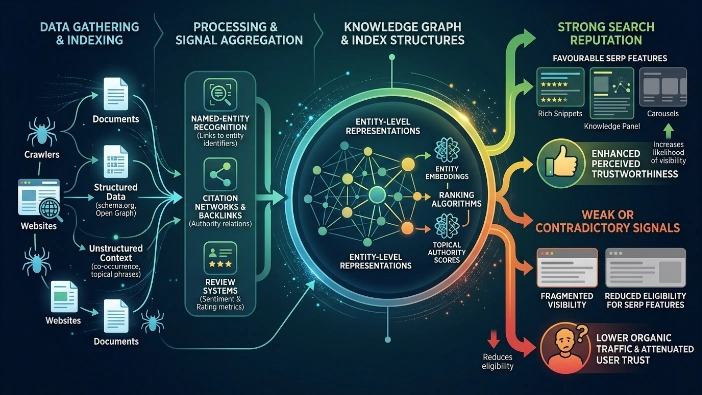
Crawlers index documents and extract structured data (schema.org, Open Graph) and unstructured context (co-occurrence, topical phrases). Named-entity recognition links mentions to entity identifiers; citation networks and backlinks establish authority relationships; review systems supply discrete sentiment and rating metrics. Machine learning models synthesise these signals to produce entity embeddings and topical authority scores, which inform rankings and featured result eligibility.
Impact on search visibility or perception: Strong search reputation increases the likelihood of favourable SERP features—rich snippets, knowledge panels, and review stars—thus enhancing perceived trustworthiness. Weak or contradictory signals reduce eligibility for those features and fragment visibility across query intents, producing lower organic traffic and attenuated user trust.
How do content and indexing influence reputation signals?
Content refers to authored pages, metadata, and user-generated material that communicates information about an organisation. Indexing refers to the process by which search systems parse, store and make content retrievable.
Algorithms parse content for topical relevance, entity mentions, structured metadata and semantic relationships. Indexing normalises variants (URL canonicalisation, hreflang, redirects) and records content freshness and change history. Ranking models evaluate signal subsets on-page entity associations, topical depth, and external corroboration—assigning weight to content that aligns with query intent and established trust anchors.
Impact on search visibility or perception: Well-structured content with explicit entity signals improves content indexing and increases the chance of appearing for relevant queries. Poorly indexed or shallow content weakens reputation signals, leading to reduced SERP prominence and diminished user confidence during SERP evaluation.
How do review signals and sentiment interpretation affect reputation?
Review signals are structured data points ratings, review volume, recency and text—that represent user evaluations. Sentiment interpretation refers to algorithmic analysis of review text to extract polarity and thematic concerns.
Platforms expose review metadata via APIs and structured markup; search engines harvest these as corroborative signals. Natural language processing models evaluate sentiment and surface topic-specific complaints or praise. Aggregation algorithms weight recency, reviewer credibility, and review diversity to generate composite sentiment scores that influence ranking and snippet presentation.
Impact on search visibility or perception: Positive, high-volume, and recent review signals increase visibility through enhanced snippet features and higher conversion signalling on SERPs. Negative or topically concentrated negative sentiment lowers entity perception, reduces conversions from SERP impressions and can trigger demotion in algorithmic relevance for trust-sensitive queries.
Which authority and trust signals define entity perception in search ecosystems?
Authority and trust signals include backlink quality, citation consistency, structured data, verified profiles, and third-party endorsements that collectively define entity perception. Authority signals are indicators that link an entity to recognised, credible sources. Trust signals are attributes that confirm identity, verifiability and consistent representation across platforms.
Algorithms evaluate backlink graphs for topical relevance and trustworthiness of referring domains; they verify citation consistency across directories and third-party data sources to resolve entity attributes; they detect presence of verified accounts, SSL, and robust schema markup as signals of legitimacy. Cross-source corroboration reduces ambiguity in entity resolution, improving the fidelity of knowledge graph representations.
Impact on search visibility or perception: Strong authority and trust signals increase SERP eligibility for authority-weighted features and raise the baseline trust perceived by searchers during SERP evaluation. Weak signals produce fractured entity perception, lowering search visibility and increasing user scepticism.
How does digital footprint construction influence brand and entity reputation?
Digital footprint construction defines the traceable network of content and references that search systems use to build entity profiles. Digital footprint refers to all public traces—owned content, third-party mentions, archived pages and social signals—that associate with an organisation’s identity online.
Each published asset contributes to the entity’s corpus. Crawlers index these assets and connect them through semantic relationships (co-citation, topical clustering). Persistent identifiers (canonical URLs, consistent NAP — name, address, phone) and structured markup improve entity resolution, while disparities generate ambiguous entity mappings. Behavioural signals from users interacting with the footprint feed back into ranking systems, adjusting entity prominence.
Impact on search visibility or perception: A deliberate, consistent digital footprint leads to coherent entity perception and predictable SERP positioning. Fragmented footprints reduce the predictability of indexing and lower the impact of reputation signals on search visibility, impairing customer trust formation during SERP evaluation.
How do algorithms interpret trust and credibility signals?
Algorithms interpret trust and credibility through multi-dimensional feature synthesis that weights provenance, corroboration, and user-behaviour metrics. Trust interpretation is the modelled assessment process where algorithmic systems evaluate the likelihood that content and entity attributes are accurate, reliable and authoritative.
Models ingest provenance features (domain reputation, SSL, author credentials), corroboration metrics (cross-site mentions, citation agreement), and behavioural metrics (CTR, bounce, dwell). They apply supervised and unsupervised learning to combine features into trust scores and entity embeddings. Signals with high provenance and consistent corroboration receive greater influence in ranking decisions for queries where trust is a primary relevance factor.
Impact on search visibility or perception: Clear, corroborated trust signals increase an entity’s ranking for trust-sensitive queries and improve representation in SERP features. Lack of provable provenance or contradictory corroboration reduces the trust score, causing lower visibility and more conservative SERP presentation that reduces perceived credibility.
How does content shape perception during SERP evaluation?
Content shapes perception by determining the visible cues users use to assess credibility during SERP evaluation. Content for SERP evaluation includes meta titles, descriptions, structured data snippets and review summaries that appear within search listings.
Ranking systems generate SERP snippets by selecting text fragments and structured attributes that signal topical relevance and trust (ratings, author, publication date). Users scan these cues and apply heuristic judgement—favouring results with authoritative language, corroborated facts and positive review signals. Search engines monitor user interactions with snippets and adjust ranking models based on aggregated behavioural outcomes.
Impact on search visibility or perception: Optimised, factual, and corroborated content increases click-through and favourable engagement metrics, reinforcing ranking models and enhancing perceived trust. Misleading or sparse snippets reduce engagement and signal lower credibility, decreasing long-term search visibility and trust formation.
What measurable impacts does reputation have on revenue growth?
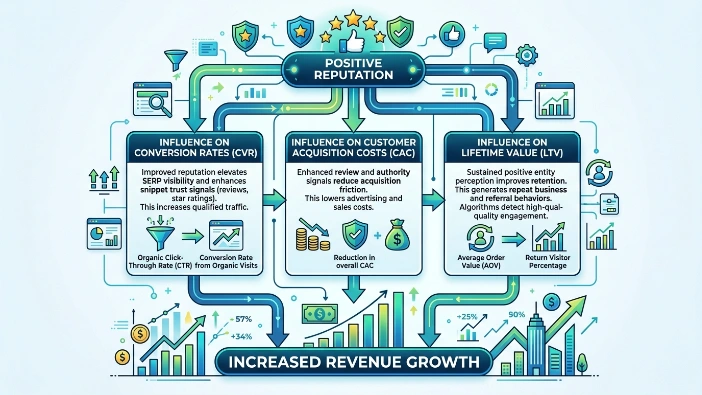
Reputation affects revenue growth through its influence on conversion rates, customer acquisition costs and lifetime value via search visibility and trust signals.
In this context, revenue impact refers to quantifiable changes in user behaviour and conversion funnels attributable to reputation-driven changes in search visibility and SERP perception.
Improved reputation elevates SERP visibility and enhances snippet trust signals, increasing qualified traffic and conversion rates. Enhanced review and authority signals reduce acquisition friction, lowering customer acquisition costs. Sustained positive entity perception improves retention and lifetime value through repeat business and referral behaviours that feed back into reputation signals.
Impact on search visibility or perception: Measurable metrics include changes in organic click-through rate, conversion rate from organic visits, average order value and return visitor percentage. Search ecosystems translate these behavioural outcomes into sustained visibility improvements when algorithms detect reliable, high-quality engagement with an entity’s content.
Dive Deeper With Our Expert Guides and Related Blog Posts:
How Corporate Reputation in the UK Is Shaped by Search and Reviews
Why Corporate Reputation Management Is a Board-Level Priority in 2026
How is a robust reputation signal network maintained over time?
Maintaining a robust reputation signal network requires ongoing alignment of content, structured data, citation consistency and active monitoring of sentiment and indexing events. Reputation signal network refers to the ensemble of content assets and external references that collectively inform entity perception.
Continuous publishing of authoritative content, regular schema maintenance, consistent NAP citations and systematically managed review channels produce stable signals. Monitoring systems detect indexing changes, sentiment shifts and citation drift; corrective actions—content updates, canonical fixes, and citation reclamation—restore signal coherence. Algorithms reward persistent consistency and penalise abrupt contradictions in entity representation.
Impact on search visibility or perception: A continually harmonised signal network sustains high search visibility and stable entity perception, which supports long-term customer trust and predictable revenue influence. Fragmented maintenance produces volatility in SERP evaluation and weakens long-term reputational influence.
For deeper insight explore:
Building a Business Reputation Management Plan That Actually Holds Up
This analysis defines how reputation management functions as a system of signals and processes that determine entity perception within search ecosystems. Reputation signals content, indexing, reviews, authority markers and behavioural metrics—combine into algorithmic trust assessments that influence SERP evaluation and search visibility. Coherent digital footprints, consistent citation practices and structured data maintenance generate durable reputation signals that increase customer trust and measurable revenue outcomes.
How does Corporate Reputation Management improve customer trust?
Corporate Reputation Management improves customer trust by ensuring consistent reputation signals—accurate entity information, verified profiles, and corroborated third‑party mentions—that search systems and users use to evaluate credibility. Using structured data, review management and citation consistency increases visible trust indicators in SERPs and raises click‑through and engagement metrics.
What reputation signals does Reputation Management PR Agency monitor?
Reputation Management PR Agency monitors review ratings and text, backlink provenance, citation (NAP) consistency, structured data presence and SERP feature appearances to detect shifts in entity perception. These signals provide measurable inputs for SERP evaluation and indexing behaviour used by ranking models.
How do online reviews influence revenue for businesses?
Online reviews influence revenue by altering conversion rates and acquisition costs through sentiment and volume signals that appear in snippets and knowledge panels. Positive, recent and high‑credibility reviews increase click‑through and purchase likelihood, while concentrated negative sentiment reduces conversions and long‑term search visibility.
How long does it take for reputation changes to affect search visibility?
Reputation changes affect search visibility over weeks to months depending on signal type, indexing cadence and algorithmic weighting of provenance and corroboration. Structural fixes (schema, canonicalisation) register faster in indexing; behavioural and backlink authority shifts require sustained positive engagement to change entity perception.