

In the digital age, a CEO’s reputation is a core driver of organisational value, with studies suggesting around half of a company’s market worth is tied to its leadership image. Within search ecosystems, online reputation is shaped by how executives, employees, media, and stakeholders define, discuss, and index the CEO’s name across platforms.
Why does CEO reputation matter for corporate value in 2026?
A CEO’s reputation matters because it directly shapes how investors, employees, regulators, and customers assess risk, credibility, and strategic direction, and recent research indicates that up to 49% of a company’s market value can be linked to leadership perception. In the UK, this is amplified by regulatory expectations, shareholder activism, and ESG reporting obligations that treat leadership credibility as a measurable governance factor rather than a soft‑skill attribute.
Corporate value is not only a function of financial metrics but also of trust signals embedded in public discourse. When a CEO’s name correlates with stability, transparency, and stakeholder responsibility, search engines reflect this in SERP evaluation and sentiment distribution, reinforcing investor confidence. Conversely, when leadership is associated with controversy, opaque decision‑making, or regulatory breaches, the same signals can depress market valuation even without formal penalties.
This mechanism is visible in UK‑listed companies where board‑level reputational incidents have coincided with share‑price volatility and commentary from institutional investors. Evidence from the Financial Reporting Council and the London School of Economics suggests that leadership credibility is increasingly treated as part of corporate governance, influencing how boards are evaluated and held accountable.
How do search engines perceive a CEO’s reputation in 2026?
Search engines do not assess character; they infer reputation from patterns of content indexing, linking, and user engagement, so when a CEO’s name appears in widely cited articles, official filings, and authoritative commentary, these references become part of an entity‑recognition framework that shapes SERP evaluation. For UK executives, this means that reputation is not controlled by intention but by how information is created, indexed, and weighted across platforms.
News coverage, interviews, regulatory‑body releases, and professional profiles are treated as reputation signals because they are crawled, stored, and linked by search engines. When external commentators, such as financial analysts, journalists, and industry peers, reference a CEO in a consistent or coherent way, those mentions reinforce how the name is interpreted in the broader knowledge graph.
Negative or unverified narratives can dominate early‑position SERPs if they are published on high‑domain‑authority sites or widely shared, even when accurate corrections exist at lower ranking priority. This asymmetry means that harmful coverage can function as a de facto reputation anchor for stakeholders who rely on search engines for due‑diligence research.
How can executive thought leadership build authority in search ecosystems?
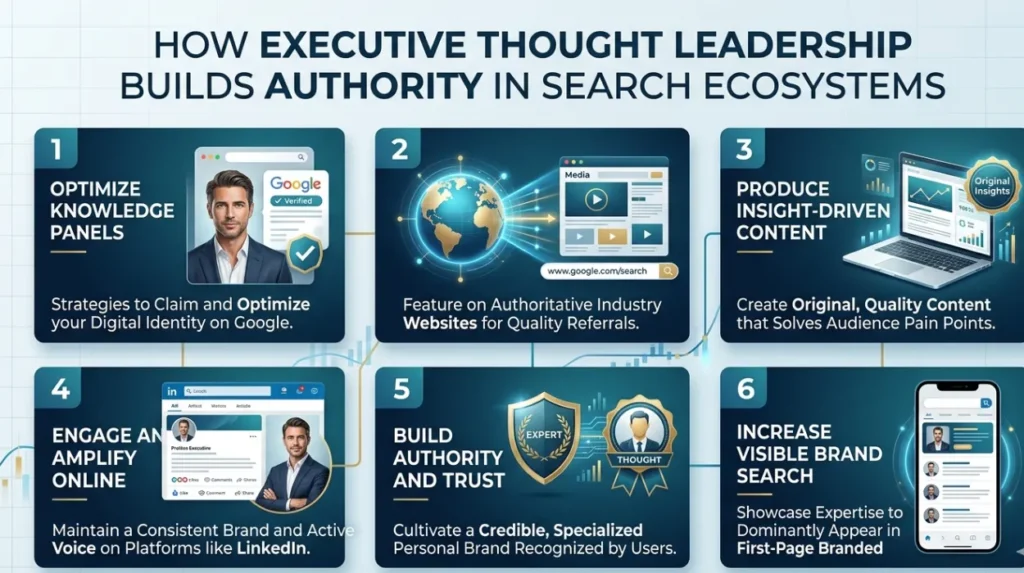
Executive thought leadership builds authority by positioning a CEO as a credible, consistent voice on topics relevant to the company, industry, and stakeholder expectations, which in turn strengthens how search engines index and weight references to the CEO’s name. In 2026, this is not about amplifying ego but about shaping how UK audiences discover and interpret leadership expertise.
Effective thought leadership involves publishing long‑form articles, interviews, and commentary that address strategic, regulatory, and ESG‑related themes, such as UK corporate governance codes, sustainability reporting, and board‑level accountability. For example, the Financial Reporting Council’s 2024 guidance on the UK Corporate Governance Code emphasises transparency and long‑term value creation, which aligns with themes that executives can leverage in thought‑leadership content.
Structuring content around specific semantic topics such as “UK‑listed board accountability,” “ESG‑aligned risk management,” or “stakeholder capitalism in retail banking” helps search engines treat these references as specialised knowledge. Publishing through authoritative channels, such as industry journals, professional associations, and regulated‑sector platforms, further increases the weight of these references in SERPs.
By aligning communication with sector‑specific and regulatory‑aware messaging, executives generate a stable layer of reputation signals that compete with transient or speculative coverage. This does not guarantee top ranking but creates a durable foundation for how leadership is perceived over time.
How should UK CEOs manage their LinkedIn profiles in 2026?
A CEO’s LinkedIn profile functions as both a professional network node and a reputation signal, where activity, endorsements, and visibility shape how colleagues, investors, and regulators interpret leadership credibility and current responsibilities. In 2026, this is particularly important in the UK, where directors’ roles and board memberships are scrutinised by shareholders, regulators, and activist campaigns.
Key priorities for UK executives include maintaining a detailed, consistent profile that reflects current roles, board positions, and governance responsibilities, with clear dates and titles to avoid ambiguity. For example, the UK Companies Act 2006 requires accurate disclosure of directorships, and discrepancies between official filings and public profiles can introduce doubt about transparency.
Publishing regular updates that demonstrate strategic literacy, stakeholder engagement, and regulatory awareness rather than purely promotional announcements strengthens how the CEO’s name is associated with credible insight. Encouraging intentional endorsements and connections with senior executives, institutional investors, and industry‑neutral bodies reinforces perception of network strength and professional credibility.
These signals are not just social; they are indexed and referenced by search engines. A sparse, inconsistent, or outdated LinkedIn profile can undermine the coherence of a CEO’s online reputation, especially when stakeholders cross‑check information against regulatory filings or company‑website disclosures.
How should UK CEOs handle negative press and reputation risk?
Negative press is a structural risk for UK Chief Executives, especially in sectors with high regulatory scrutiny, media interest, or public‑sector exposure, and in search ecosystems it can become the primary reference point for stakeholders who use search engines for due‑diligence research. This is particularly relevant in the UK, where regulators such as the Financial Conduct Authority and the Prudential Regulation Authority expect transparency and accountability from senior managers.
Managing this risk involves:
- Publishing accurate, authoritative statements promptly and ensuring they are indexed and linked in a way that competes with negative narratives for ranking priority.
- Structuring responses to align with regulatory expectations, such as proportionality, transparency, and accountability, which supports long‑term stability of reputation signals.
- Monitoring how coverage spreads across news aggregators, social‑media platforms, and citation networks, since these channels amplify SERP signals even if they are not the original source.
Executives should treat negative press not as a one‑off incident but as a reputation‑signal generator that can persist in search visibility until it is balanced or corrected by higher‑quality content. Historical examples, such as leadership controversies in UK‑listed banks or retail firms, show that prolonged negative coverage can influence investor behaviour and regulatory scrutiny even when formal sanctions are limited.
How can CEOs protect personal search results and digital footprints?
A CEO’s personal search results are a critical component of reputation, especially when employees, investors, and regulators search by name, and in 2026 these results are shaped by indexing, linking, and user behaviour rather than by individual control. Protecting this visibility does not mean erasing history but reshaping how that history is organised and weighted in SERPs.
Key actions for UK executives include ensuring that accurate, up‑to‑date profiles such as company websites, board‑nomination pages, and professional directories occupy top‑position SERP slots for name‑based queries. Correcting obvious factual errors, such as outdated roles or misleading affiliations, through formal channels or platform‑specific correction mechanisms reduces the risk of reputational misinterpretation.
Monitoring for unauthorised or misleading content that may violate privacy, data‑protection, or defamation standards such as the UK’s Data Protection Act 2018 or the Defamation Act 2013 and taking appropriate legal or platform‑based steps where remedies are available is another layer of protection. This approach acknowledges that reputation is not fully controllable but is highly malleable through structured, evidence‑based management of name‑related content.
How do content visibility, sentiment, and SERP evaluation shape CEO reputation?
Search engines interpret CEO reputation through patterns of content visibility, sentiment distribution, and trust‑related signals, so the way a CEO’s name appears in search results how positive, negative, or neutral references are clustered shapes how stakeholders evaluate credibility and risk. In the UK, where due‑diligence and transparency are central to corporate governance, this has direct implications for investor behaviour and regulatory scrutiny.
When early‑position SERP clusters lean heavily negative or controversial, users are more likely to interpret the CEO as high‑risk, even if favourable coverage exists further down. Recency and freshness patterns mean that recent coverage, even if less accurate, often receives short‑term ranking boosts, which can temporarily rewrite perception unless balanced by timely corrective content. Cross‑platform citations from external sources reinforce the weight of these references in search engines’ evaluation of reputation signals.
Executives cannot mandate sentiment, but they can influence it by aligning communication with transparency, consistency, and regulatory‑aware messaging. This approach is consistent with UK governance standards that emphasise accountability, long‑term value creation, and stakeholder engagement.
How should UK executives plan for reputation crises in 2026?
Crisis planning for UK executives is not primarily a communications exercise; it is a reputation‑resilience strategy that ensures leadership reputation signals are managed across search engines, media, and regulatory channels before, during, and after an incident. In 2026, this is essential in a landscape where investors and regulators routinely use search engines to assess risk and accountability.
A robust crisis plan should define triggers that activate reputation‑management protocols, such as sudden spikes in negative coverage, regulatory investigations, or major stakeholder‑driven scrutiny. It should specify how accurate information will be published, indexed, and promoted so that it competes for visibility with adverse narratives. Clear responsibilities for monitoring search results, correcting factual errors, and coordinating with media, legal, and compliance teams reduce the likelihood that a CEO’s reputation will be defined by reactive or poorly structured responses.
This planning aligns with UK governance expectations, which require boards to anticipate and manage reputational risk as part of broader risk‑management frameworks. Historical instances of leadership‑level crises in UK firms show that pre‑prepared protocols can mitigate long‑term damage to both individual and organisational reputation.
Which tools and resources support CEO reputation management in the UK?
UK executives do not need to manage reputation in isolation; there are structured tools and frameworks that help align online presence with governance and risk standards, including monitoring platforms, content‑management systems, and regulatory reporting frameworks. In 2026, these resources are integral to how boards and executives interpret and respond to digital‑reputation signals.
Monitoring platforms track mentions, sentiment, and SERP composition for the CEO’s name across search engines, news aggregators, and social‑media networks, providing data that can be reviewed in board‑level risk‑assessment meetings. Content‑management and publishing tools support consistent, compliant, and SEO‑aware thought‑leadership content, ensuring that leadership communication is both regulatory‑aligned and discoverable. Governance and risk‑management frameworks integrate reputation monitoring into formal reporting, treating leadership visibility as a strategic asset rather than a collateral concern.
By using these resources deliberately, UK executives can create a reputation‑management environment that is transparent, accountable, and consistent with UK regulatory expectations, reducing the risk that digital‑reputation signals will undermine long‑term corporate health.