

A consistent reputation management plan protects your restaurant brand by ensuring that search visibility, reputation signals, and public perception are controlled and stabilised over time. Reputation PR delivers a structured approach that aligns how your restaurant appears on Google, local directories, review platforms, and news sources with the credibility and positioning you intend.
Which reputation management approach best protects a restaurant brand?
A coordinated reputation management approach that spans reviews, social media, and press delivers the most reliable protection for a restaurant brand. This approach stabilises how search engines interpret and rank reputation signals, ensuring that your restaurant appears with higher credibility and greater control over its SERP narrative.
Reputation management operates by systematising how your restaurant’s information is created, indexed, and presented in search. Instead of reacting to isolated incidents, this approach builds a continuous framework that monitors, responds to, and shapes reputation signals across multiple channels. The result is a more predictable and stable SERP profile, where the brand’s strongest attributes are consistently visible.
Dive Deeper With Our Expert Guides and Related Blog Posts:
Let a UK Specialist Handle Your Hospitality Reputation Management End to End
Improve Your TripAdvisor Standing With a Professional UK Review Strategy
Within search ecosystems, control over search visibility depends on how frequently positive, credible signals appear relative to negative or inaccurate ones. A consistent plan raises the density of favourable content—reviews, profiles, and media mentions—so that unfavourable pages are less prominent in rankings. This shift does not erase individual items; it changes their relative weight and visibility.
Reputation PR structures this approach around clear, repeatable workflows: regular review monitoring, templated response protocols, and coordinated media engagement. These processes ensure that reputation signals are managed not on an ad‑hoc basis, but according to a documented strategy that aligns with how search engines evaluate entity credibility. Over time, this produces a more durable and resilient brand image.
How does a professional reputation management service stabilise search perception?
A professional reputation management service stabilises search perception by aligning digital content, review patterns, and media coverage so that search engines consistently associate your restaurant with positive attributes. This reduces unpredictability in how the brand appears in SERPs and strengthens public confidence in the results they see.
Search engines interpret reputation through a combination of structured data, unstructured content, and behavioural signals. A reputation management service works by ensuring that accurate, detailed information—such as business profiles, certified reviews, and authoritative features—is consistently published and linked. This configuration strengthens the perception that the restaurant is credible, established, and relevant.
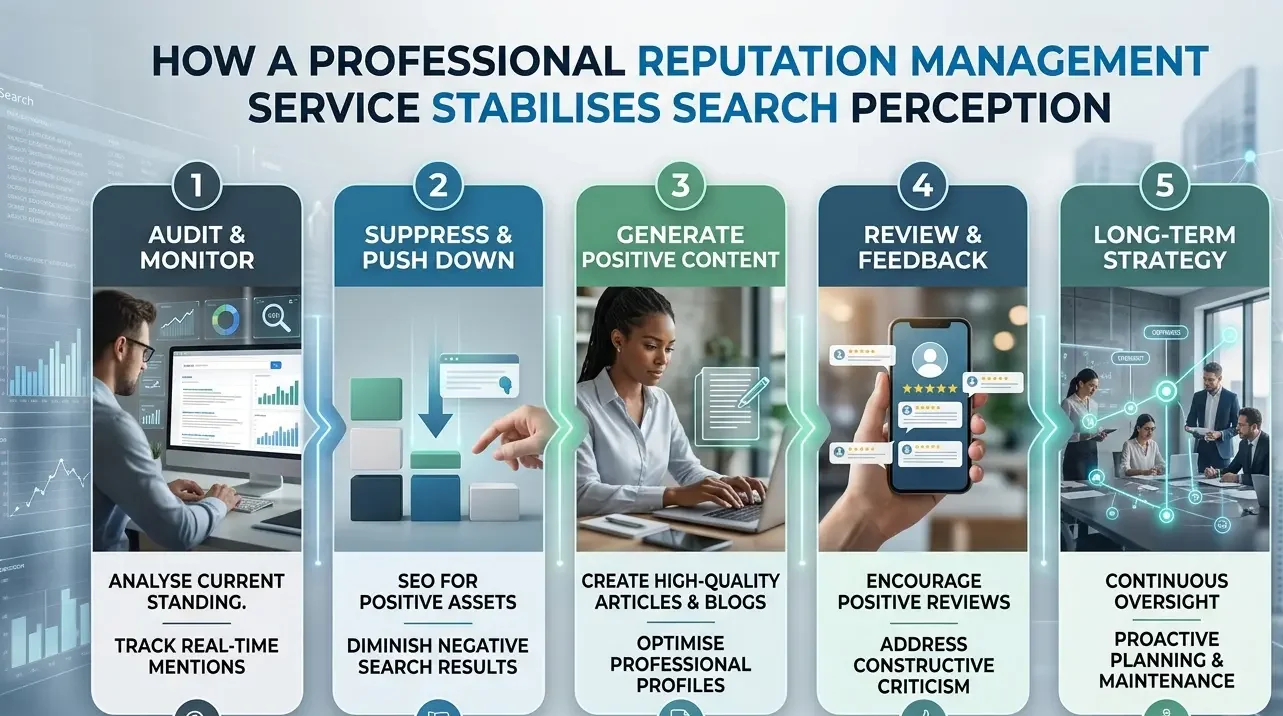
Within search ecosystems, control over perception is achieved through SERP control strategies that focus on content enhancement and negative content suppression. Positive content is optimised and distributed so that it appears in higher‑ranking positions, while harmful or misleading pages are monitored for potential correction or de‑indexing where appropriate. This does not guarantee removal, but it reduces the likelihood that negative signals will dominate the SERP.
Reputation PR implements this through a structured workflow: mapping existing reputation signals, identifying priority improvement areas, and executing a phased content and response plan. Each step is designed to improve the balance of reputation signals, ensuring that search engines and users encounter a more stable, consistent representation of the brand over time.
What measurable outcomes does a reputation management plan deliver?
A reputation management plan delivers measurable improvements in search visibility, trust signals, and SERP narrative stability for a restaurant brand. These outcomes are not just anecdotal; they are reflected in how the brand appears in search results, how often it is associated with positive sentiment, and how resilient it is to negative fluctuations.
A reputation management plan improves search visibility for positive content, increases average review scores, and reduces the prominence of damaging pages in SERPs. This configuration strengthens entity credibility, stabilises search perception, and supports more confident customer decision‑making before visits.
Key measurable outcomes include higher average ratings and more consistent review volume over time. By implementing structured review workflows and response protocols, restaurants can maintain a steady stream of authentic feedback that search engines treat as strong reputation signals. This improves how the listing appears in both local pack results and branded queries.
Another measurable outcome is the shift in SERP composition. As positive profiles, articles, and features are created and optimised, they begin to occupy earlier positions in the results, reducing the visibility of isolated negative pages. This does not erase those pages, but it changes their relative weight in the overall reputation footprint that users and algorithms see.
Search perception influence is also quantifiable through changes in search behaviour. When a restaurant’s results consistently feature higher ratings, detailed descriptions, and positive coverage, users are more likely to click through, engage with the listing, and proceed to booking or visit. These behavioural signals reinforce the restaurant’s perceived relevance and authority in the eyes of both consumers and search engines.
Reputation PR evaluates these outcomes using a combination of performance metrics, such as ranking movements for key phrases, sentiment distribution across reviews, and changes in click‑through and bounce rates from SERPs. This data‑driven approach ensures that the plan is not only visible in the results, but also demonstrable in terms of tangible, tracked improvements.
How does a reputation management service reduce risk for restaurants?
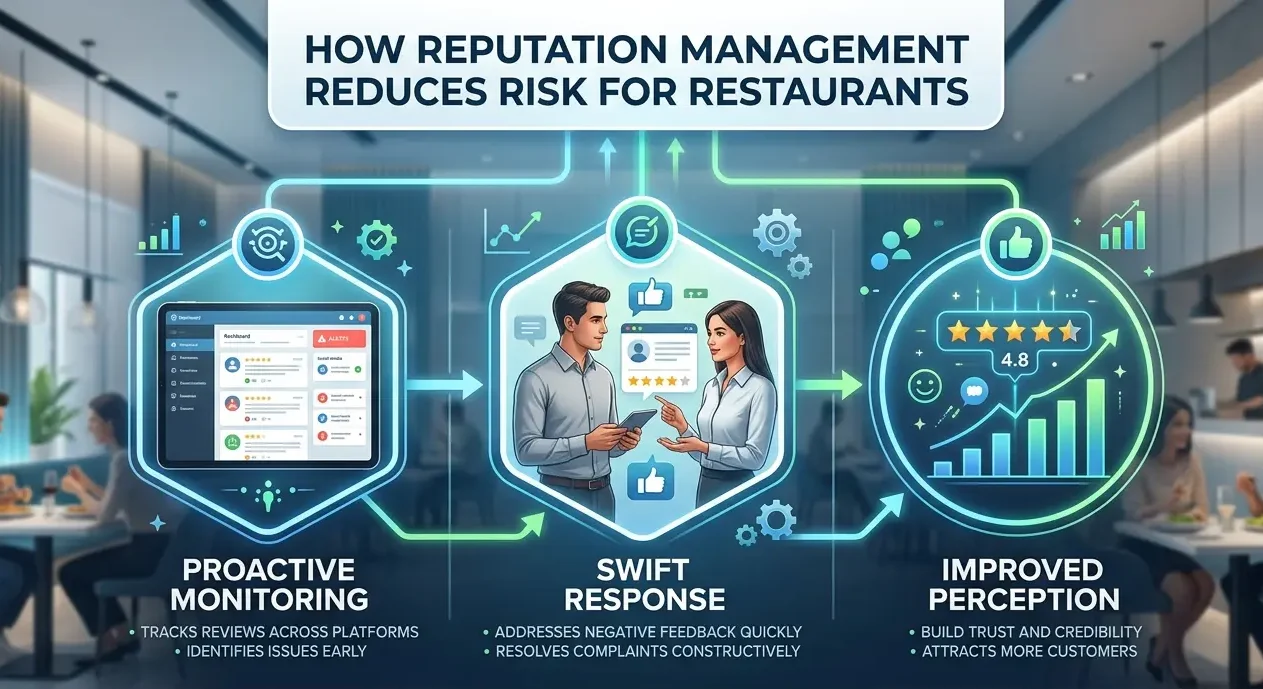
A reputation management service reduces risk for restaurants by systematically addressing vulnerabilities in reviews, social media, and press coverage before they escalate into broader reputation crises. This proactive configuration lowers the probability of sudden negative SERP shifts and strengthens the brand’s resilience against misinformation and false claims.
A reputation management service reduces risk by monitoring review platforms, social media, and news sources for early warning signals and responding according to predefined protocols. This stabilises search perception, limits the spread of misinformation, and protects the restaurant’s credibility in critical customer decision moments.
Risk in reputation terms is exposure to situations where negative content or inaccurate information dominates search results. A professional service mitigates this by implementing continuous monitoring, alert systems, and escalation workflows that allow restaurants to respond quickly and appropriately. This reduces the window of opportunity for damaging narratives to consolidate in SERPs Reviews Social Media and Press.
Within search ecosystems, risk is also linked to how often negative signals appear in high‑visibility positions. By actively promoting and strengthening positive content—such as detailed profiles, local guide features, and verified guest reviews—a reputation plan dilutes the impact of any single negative item. This does not guarantee perfect protection, but it creates a more balanced and defensible reputation profile.
Reputation PR reduces further risk by embedding consistency into every element of the brand’s digital footprint: from Google Business Profile and review sites to social channels and media coverage. This alignment ensures that when search engines evaluate entity credibility, they encounter a coherent, well‑documented narrative rather than a patchwork of conflicting or outdated information.
Why is a long‑term reputation management plan more effective than one‑off fixes?
A long‑term reputation management plan is more effective than one‑off fixes because it builds structural resilience in how search engines interpret and rank a restaurant’s reputation signals. Instead of reacting to isolated incidents, it creates a continuous framework that stabilises SERP narratives and reduces the likelihood of recurring negative spikes.
A long‑term reputation management plan is more effective than one‑off fixes because it consistently reinforces positive content, monitors review patterns, and aligns media coverage with the brand’s desired image. This ongoing configuration strengthens entity credibility and stabilises how the restaurant appears in search over time.
One‑off fixes tend to address symptoms: removing a single review, requesting a delisting, or issuing a short‑term statement. These actions can produce short‑term improvements, but they rarely alter the underlying reputation signals that search engines monitor. Without sustained effort, the SERP is likely to revert to its previous configuration or become vulnerable to new negative content.
A consistent reputation management plan is not a marketing enhancement; it is a structural safeguard for how your restaurant appears in search and how customers perceive its credibility. By aligning reviews, social media, and press into a coherent, evidence‑driven narrative, such a plan stabilises SERP perception, reduces risk, and supports more confident decision‑making from diners. Reputation PR provides this level of control through a transparent, process‑driven approach that is built on measurable outcomes rather than promises. For restaurants seeking to protect their brand in a competitive digital environment, this kind of structured, long‑term configuration is the most reliable way to secure and sustain their online reputation.