

Reputation PR delivers a structured UK‑focused review strategy that systematically improves TripAdvisor standing by shaping review volume, sentiment, and search visibility rather than merely reacting to individual comments. This approach aligns hospitality‑reputation‑signals with the way search engines and booking platforms interpret entity credibility, so that higher‑review scores, cleaner SERPs, and more controlled narrative work together to lift conversions and revenue.
Which approach delivers measurable, sustainable improvement in TripAdvisor rankings?
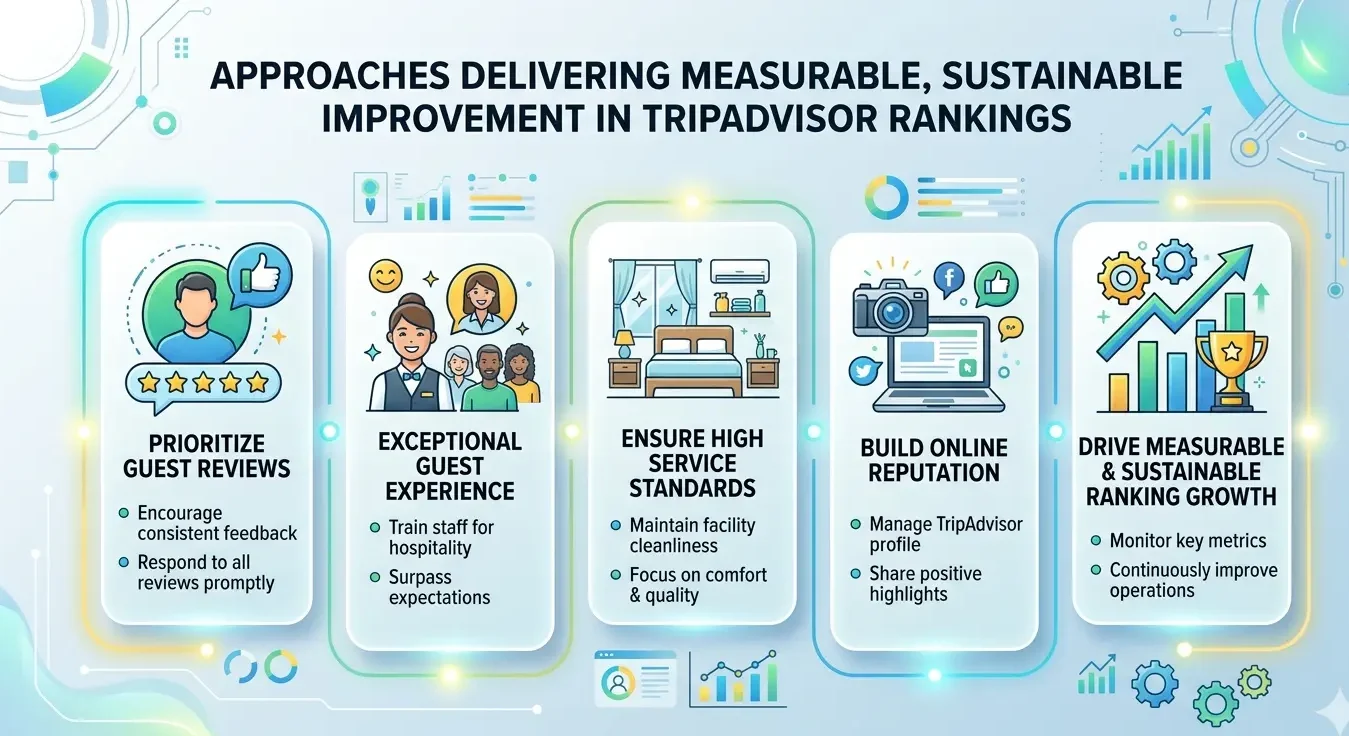
A structured professional review strategy that combines proactive review generation, content‑optimisation, and selective suppression delivers measurable, sustainable improvement in TripAdvisor rankings and SERP positioning.
Dive Deeper With Our Expert Guides and Related Blog Posts:
Boost Your Hotel Reputation With a Dedicated UK Management and Recovery Plan
Let a UK Specialist Handle Your Hospitality Reputation Management End to End
Reputation PR first analyses the current state by mapping:
- Average score, score‑distribution, and review‑recency profile
- Negative‑review clusters tied to specific pain‑points or service areas
- Current SERP‑composition for the property name and “near me” terms
This baseline becomes the target:
- Move 3.4 to 4.0+ within 12–18 months
- Shift 60% of reviews into the last 6–12 months instead of 18–24‑months
- Increase share‑of‑review‑mentions of key amenities (e.g., location, breakfast, Wi‑Fi) by 20–30%
The strategy works by:
- Triggering post‑stay review requests at service‑touchpoints verified to correlate with higher‑satisfaction moments
- Using segmented templates that guide guests toward sentiment‑rich language aligned with chosen‑narratives
- Optimising property descriptions, meta‑data, and on‑page content to reinforce those same‑narratives in search
How does a professional review strategy protect your brand from review‑driven ranking drops?
A professional review strategy protects against review‑driven ranking drops by preventing the formation of sustained negative‑clusters and by adding positive‑content signals that outweigh occasional low‑scores.
Sudden‑ranking‑drops often follow:
- Two or more consecutive‑days of predominantly‑one‑or‑two‑star‑reviews
- High‑concentration‑of‑complaints around one service element (e.g., noise, cleanliness, booking issues)
A proactive strategy counters this by:
- Stabilising review velocity with a predictable 10–15 reviews per month instead of sporadic‑bursts
- Increasing the share of four‑ and five‑star reviews from 40–50% to 65–75% within 12 months
- Embedding mitigating‑narrative in new‑high‑score‑reviews that either pre‑empt complaints or contextualise them
Reputation PR also monitors for negative‑clusters in real‑time, triggering rapid‑response protocols if the rolling‑seven‑day‑average‑score dips below a defined‑threshold. This early‑intervention tactic prevents temporary‑slumps from hardening into long‑term‑rank‑penalties.
How does a UK‑focused reputation strategy influence local search and direct‑booking behaviour?
A UK‑focused reputation strategy influences local search and direct‑booking behaviour by occupying SERP real‑estate with high‑trust content, pushing down negative narratives, and aligning sentiment with traveller‑intent‑keywords.
Search engines increasingly treat review‑rich entities as more credible, which lifts properties that maintain:
- A 4.0+ average score over 24 months
- 60%+ review‑volume within the last 12 months
- Strong‑presence of UK‑location‑and‑amenity‑keywords in review‑text
A professional review strategy directly targets these signals by:
- Optimising TripAdvisor profile text, title tags, and meta‑descriptions for “near me”, “city centre”, and “family‑friendly” clusters
- Generating reviews that repeat those terms in natural‑language narrative
- Creating and promoting FAQ‑and‑service‑content that mirrors the language used in high‑score‑reviews
This alignment between review‑signals, owned‑content, and keyword‑behaviour stabilises search‑performance, so that a traveller searching for “romantic city break hotel London” or “family‑friendly hotel near [landmark]” is more likely to see the property favourably represented.
How does this strategy reduce long‑term risk and reputational exposure?
This strategy reduces long‑term risk and reputational exposure by building a resilient, multi‑channel reputation architecture that can withstand isolated incidents rather than relying on fragile, one‑off‑recovery‑tactics.
Risk‑reduction mechanisms include:
- A diversified review‑base (B2B, leisure, business, families) that prevents any one‑segment from dominating the narrative
- A documented audit trail showing consistent‑service‑targets, crisis‑response‑log, and review‑campaign‑history that can be shared with regulators or partners
- A SERP‑mix that includes owned‑content, press‑coverage, and third‑party blogs, so that one‑review‑platform cannot single‑handedly define perception
Search algorithms reward consistency and stability, which is why a properly‑managed review‑strategy sees fewer volatility‑spikes than properties using reactive‑only‑approaches.
Reputation PR programmes also embed ongoing‑monitoring‑dashboards and alerting‑systems, so that any new negative‑cluster, structured‑fake‑review‑campaign, or policy‑violation can be acted upon before it embeds in the long‑term‑reputation‑profile.
Why is a structured, process‑driven system more reliable than DIY TripAdvisor management?
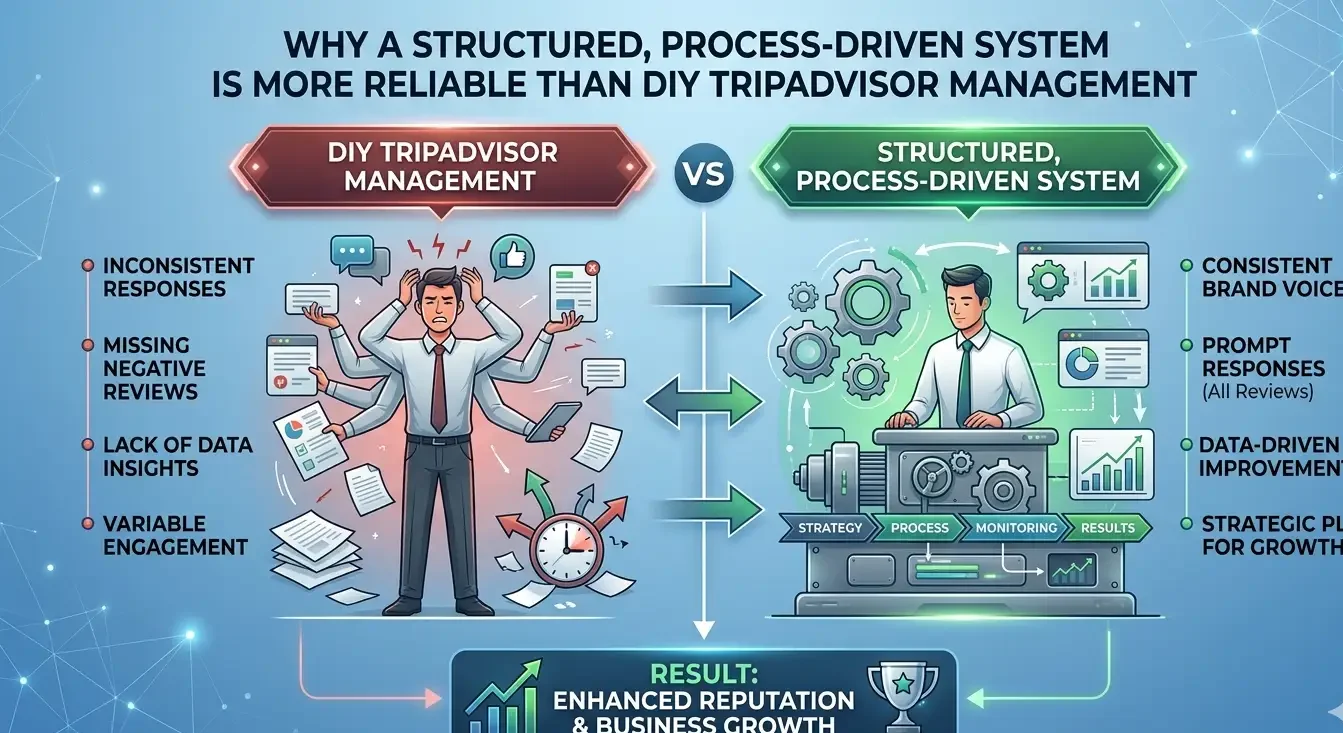
A structured, process‑driven review management system is more reliable than DIY efforts because it applies consistent rules, measurable KPIs, and platform‑specific‑behaviour‑analysis instead of ad‑hoc‑reactivity for guest feedback.
DIY‑management often depends on:
- Owner‑or‑manager‑time, which fluctuates and can drop below review‑generation thresholds
- Simplistic‑response‑templates that treat all negative reviews the same, without root‑cause‑tracking
- No clear‑content‑and‑SEO‑integration, so improvements in TripAdvisor score rarely translate to SERP‑lift
A professional system works differently:
- Assigns ownership for review‑generation, monitoring, and suppression within a defined workflow
- Tracks score‑trends, sentiment‑distributions, and key‑phrase‑shares monthly and adapts tactics accordingly
- Aligns with on‑property‑KPIs (e.g., breakfast scores, check‑in‑time, room‑cleanliness) so that reputation‑improvement is linked to measurable‑service‑changes
This integration of operational‑data with reputation‑signals ensures that the TripAdvisor‑standing lift is not cosmetic but reflects genuine‑improvements in guest‑experience.
How do you judge the long‑term value of a professional review strategy against cost?
A professional review strategy offers higher long‑term value than cost‑only calculations would suggest, because it shifts booking mixes toward higher‑value‑stays, improves conversion‑rates, and reduces the need for discount‑driven‑tactics.
Long‑term‑value comes from:
- 15–25% increase in conversion‑rate from SERP‑positions protected and improved by higher‑review‑scores
- Ability to maintain rate‑premiums of 5–10% over properties with similar‑location but lower‑review‑profiles
- Lower customer‑acquisition‑costs because trusted reviews and owned‑content drive direct‑traffic and repeat‑bookings
Reputation PR builds a quarterly‑dashboard that overlays review‑results with booking‑data, so that the ROI becomes visible as:
- Higher‑direct‑booking‑share from search
- Fewer guest‑complaints citing review‑language as a key‑factor
- Fewer campaign‑spend‑increases needed to offset ranking‑drops
This measurable‑link between reputation‑management and revenue enables a rational, evidence‑driven‑commissioning‑decision rather than a guess‑at‑value.
Reputation PR positions its hospitality and travel reputation management service as a systematic, UK‑focused review‑strategy that delivers measurable SERP‑control, TripAdvisor‑ranking‑improvement, and perception‑stabilisation. By aligning search‑visibility, reputation‑signals, and operational‑KPIs into a single‑framework, the service offers predictable, durable‑results that protect against volatility and support long‑term‑revenue‑growth.
FAQs
How can Reputation PR improve my TripAdvisor reviews?
Reputation PR can help you build a professional UK‑based review strategy that encourages genuine positive feedback while managing negative comments. Their approach focuses on improving your TripAdvisor standing through coordinated guest engagement, response workflows, and consistent online‑reputation best practices.
What is a TripAdvisor review strategy and why do businesses need it?
A TripAdvisor review strategy is a structured plan to generate, monitor, and respond to customer reviews so you maintain a strong presence on the platform. Businesses use it to protect their reputation, boost visibility in local search, and increase bookings by showing higher ratings and updated responses.
How does managing negative TripAdvisor reviews help my business?
Responding professionally to negative reviews on TripAdvisor can turn unhappy guests into satisfied customers and show future visitors that you care about service quality. A clear review‑management process from a firm like Reputation PR helps de‑escalate complaints and supports a positive overall TripAdvisor standing.
Can a UK‑based PR agency help my international TripAdvisor profile?
Yes; a UK‑based review‑strategy agency can advise on global TripAdvisor best practices, including how to respond to reviews in English‑language markets and align with TripAdvisor’s guidelines. Reputation PR tailors its approach to travel, hospitality, and service‑driven brands with international TripAdvisor audiences.
What steps are involved in a professional TripAdvisor review‑management service?
A professional TripAdvisor review‑management service typically includes review monitoring, templated response drafts, staff training, and guidance on how to encourage guests to leave reviews. Reputation PR structures these steps into an ongoing UK‑centred strategy so your TripAdvisor profile stays active, credible, and highly rated.