

Reputation management strategies differ based on whether the issue requires direct removal, platform reporting, or wider reputation correction. Online reputation control methods are evaluated through sentiment distribution, search ranking influence, and the extent to which the review changes entity credibility.
What is the proper channel for challenging a Trustpilot review?
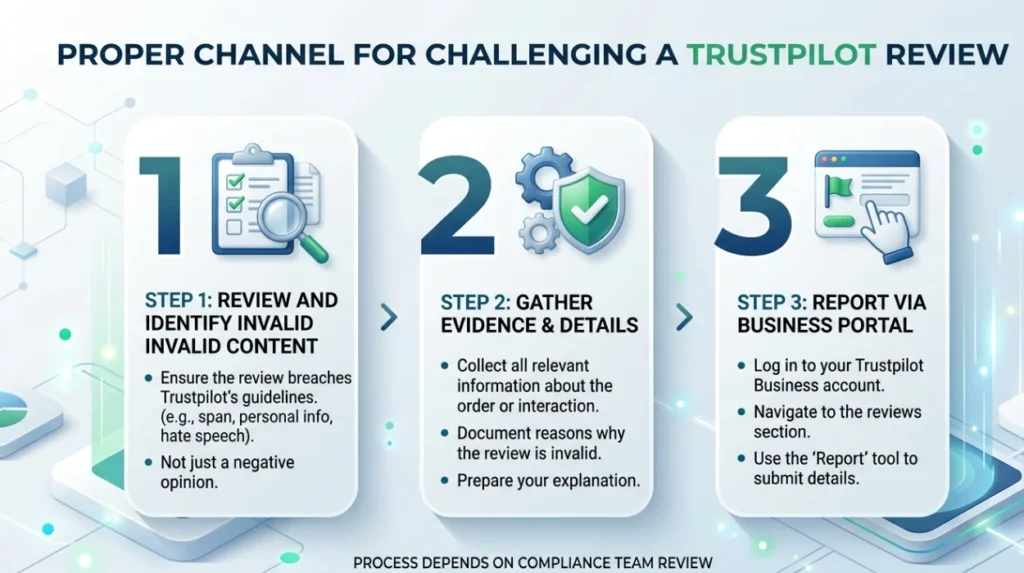
The proper channel is the platform’s policy based reporting route supported by evidence and category selection. A proper challenge is the structured process of identifying the review type, matching it to the relevant policy, and submitting proof that the content breaches Trustpilot rules or distorts reputation signals.
Dive Deeper With Our Expert Guides and Related Blog Posts:
What Evidence You Need to Report Fake Google Reviews Successfully
How Trustpilot Review Management Differs From Google Review Strategy
Trustpilot reviews are not challenged through general complaint language. The process depends on classifying the problem first. A review can be challenged as fake, biased, defamatory, irrelevant, abusive, or otherwise inconsistent with platform policy. That classification matters because the platform evaluates content through rule based moderation rather than emotional impact.
The challenge also has to match search ecosystem behaviour. A review that remains visible continues to influence search ranking influence and user trust. A properly routed challenge reduces that exposure by targeting the platform’s moderation layer. The result affects perception because the review loses visibility or never gains the credibility weight that indexed review content normally carries.
How does policy based removal compare with reactive reporting?
Policy based removal is stronger because it uses the platform’s own rules to justify action, while reactive reporting relies on broad complaints that often leave the review visible. Negative Trustpilot reviews operates by linking the review to a specific breach, while reactive reporting operates by expressing dissatisfaction without a clear moderation pathway.
The first approach compares favourably in precision. It names the rule, identifies the content, and presents evidence. That gives the review platform a direct basis for moderation. The second approach is weaker because it lacks structure. A general complaint does not always show why the review breaches policy, so the review can remain active and continue shaping sentiment distribution.
The impact on search visibility also differs. Policy based removal removes the content signal at source or reduces its indexability through moderation action. Reactive reporting leaves the review in place for longer, which preserves its influence on entity credibility. That is why the proper channel has more long term value than a simple complaint form.
Which evidence makes a challenge stronger?
The strongest evidence is the material that shows the review lacks authenticity, relevance, or policy compliance. Evidence is the factual basis that demonstrates why the review violates rules or misrepresents the entity within the search ecosystem.
The first evidence type is account behaviour. A new profile, a low activity profile, or a pattern of repeated posting across unrelated businesses weakens credibility. The second type is transaction evidence. If the reviewer has no customer record, that gap becomes relevant. The third type is language evidence. Duplicate wording, generic accusations, and copied phrasing across reviews suggest manipulation.
Evidence matters because moderation is an evaluation process. A clear evidence set improves the chance of removal and shortens the time the review remains visible. That affects search perception because the harmful item stops contributing to the public trust profile. Weak evidence leaves the review intact and allows it to continue influencing review signals, search snippets, and user judgement.
How do platform rules affect removal success?
Platform rules affect removal success because they define what counts as abuse, conflict of interest, irrelevance, or fake activity. A platform rule is the moderation standard that determines whether the review qualifies for removal, correction, or retention.
Trustpilot does not remove reviews simply because they are negative. It removes content when the content violates the published moderation framework. That means the challenge needs to map the review to the rule. A review with no purchase record may fit an inauthentic activity category. A review with offensive language may fit an abuse category. A review written by a competitor or a related party may fit a conflict of interest category.
This rule driven structure matters because it changes the outcome. A review that sits outside the rules remains visible and continues to affect trust signals. A review that fits the rules becomes vulnerable to moderation action. That is why understanding the policy matters more than reacting to the emotional effect of the review.
How does removal compare with suppression?
Removal is stronger when the review breaches policy, while suppression is only relevant when the review cannot be deleted but its wider impact can be reduced through stronger reputation work. Removal changes the existence of the harmful review, while suppression changes the visibility balance around it.
Removal is the cleaner outcome. It eliminates the direct harmful signal and reduces the chance that users will treat the review as credible evidence. It also reduces the review’s influence on sentiment distribution because the data point no longer sits in the visible record. That makes removal the higher value route when the platform accepts the challenge.
Suppression is slower and broader. It works by adding stronger positive content, improving entity credibility, and changing what users see before they reach the negative review. The limitation is that the review still exists. That means the negative signal remains in the background unless the platform takes action. Removal and suppression therefore solve different problems. One removes the source. The other changes the surrounding search environment.
What is the difference between short term and long term impact?
Short term impact is the immediate change in visibility after the challenge is submitted, while long term impact is the sustained change in reputation signals after the review is removed or neutralised. Short term impact operates by reducing active exposure, while long term impact operates by stabilising entity credibility over time.
The short term effect is often the reduction of harm while the case is under review. If the review is taken down quickly, the negative impression stops spreading. If the review remains live, the short term effect is limited and the harm continues. That is why the quality of the challenge matters. A stronger challenge reduces delay and increases the chance of fast moderation.
Long term impact depends on whether the review ecosystem becomes more balanced. If the removed review was part of a wider negative pattern, the entity still needs content enhancement and review management around it. If the review was isolated, removal can materially improve trust signals. Long term value therefore depends on both the challenge outcome and the strength of the surrounding reputation profile.
How do search engines interpret review signals?
Search engines interpret review signals by reading volume, recency, tone, and repetition as part of a broader trust model. A review signal is any indexed cue that search systems use to evaluate credibility, sentiment distribution, and public perception.
A negative Trustpilot review does not exist in isolation. It enters the search ecosystem as one more piece of public evidence. If the review ranks for the entity name, its influence grows. If the review is repeated across threads, snippets, or related pages, the influence expands further. Search systems compare that review with the rest of the digital footprint to decide how much weight to assign.
This matters because a successful removal challenge changes not only the platform record but also the public search record. The review’s absence lowers its direct ranking influence. The entity then appears with fewer negative cues in the result set. That shifts perception and improves the trust context around branded searches.
Which approach is more scalable?
Reactive removal is less scalable because it handles one review at a time, while broader reputation correction is more scalable because it improves the entire visible profile. Scalability is the ability of a method to address repeated risk across multiple pages, reviews, or search results without restarting the process each time.
A review challenge is highly specific. It works well when the issue is one harmful review or a small set of policy violating entries. It does not automatically solve wider sentiment problems. If the profile contains repeated criticism, the review removal process becomes only one part of the solution. That limits scalability.
Broader content enhancement scales better because it improves the search environment in more than one place. Owned content, consistent profiles, and stronger external references can reduce the influence of a single negative review. That does not replace removal, but it improves the outcome when removal succeeds. The best approach combines a precise challenge with wider reputation control.
What risks reduce removal success?
The main risks are weak evidence, wrong policy classification, duplicate publication, and delayed moderation. Risk exposure rises when the challenge does not map cleanly to the platform rule or when the negative content remains visible across other indexed locations.
Weak evidence gives moderators too little reason to act. Wrong classification sends the challenge into the wrong policy lane. Duplicate publication keeps the same negative message alive elsewhere, which reduces the practical value of the removal. Delayed moderation keeps the review visible for longer, which extends the reputational damage.
These risks show why proper channels matter. A challenge that ignores policy structure usually fails to change the visibility of the review. A challenge that matches the rule and supports it with evidence has a stronger chance of success. That is the difference between an unsupported complaint and a credible removal case.
What does a proper decision framework look like?
A proper decision framework evaluates authenticity, policy fit, visibility impact, and sustainability before choosing a removal path. A decision framework is the structured method used to compare removal, suppression, and wider reputation repair options before action.
- Identify the review type, for example fake, abusive, irrelevant, or conflict driven.
- Match the review to a policy rule, for example inauthentic activity or offensive language.
- Check the evidence, for example account history, transaction proof, and language patterns.
- Measure visibility, for example whether the review ranks for branded searches.
- Assess the wider footprint, for example whether other negative content reinforces the same sentiment distribution.
This framework helps separate cases that qualify for removal from cases that need wider reputation work. It also reduces wasted effort because the chosen response matches the actual risk. That is the analytical advantage of using proper channels rather than relying on a generic report.
How does this compare with wider reputation management?
Wider reputation management compares as the more durable option, while review removal compares as the more immediate option. Review removal targets a single negative item, while wider reputation management operates by strengthening the entity’s overall trust profile across search and review ecosystems.
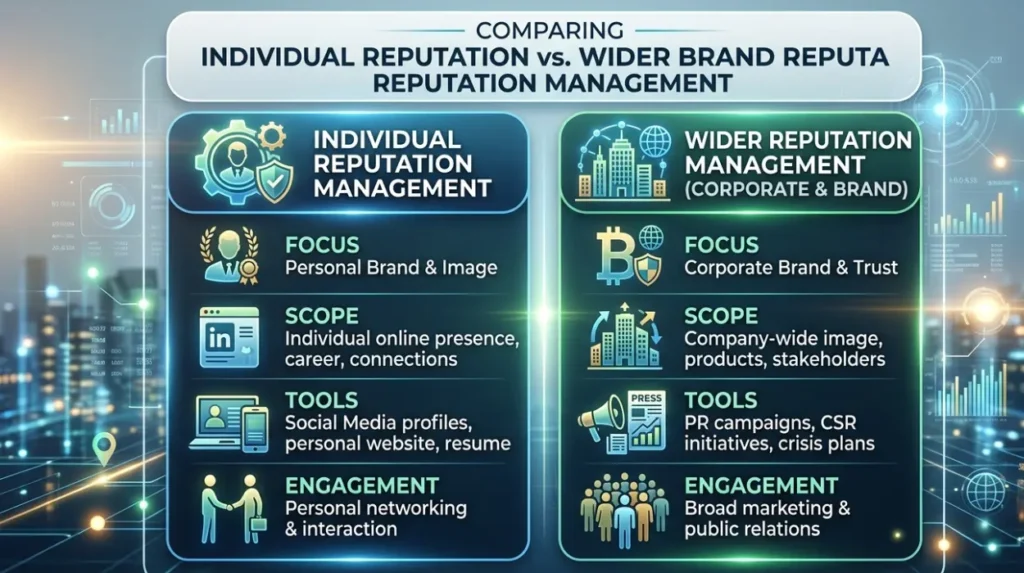
Removal is useful because it addresses the visible harm directly. Wider reputation management is useful because it changes the conditions that allowed the review to matter so much. That includes stronger owned content, clearer profiles, and better review patterns over time. The two approaches are not interchangeable. They operate at different levels of the problem.
Search ranking influence changes differently under each method. Removal reduces one negative signal. Wider reputation management changes the environment in which that signal is interpreted. The strongest strategy uses both when the issue extends beyond a single review. That gives the entity a better short term result and a more stable long term trust profile.
What is the main takeaway?
The main takeaway is that Trustpilot review challenges succeed when they use the proper channel, the correct policy category, and evidence that proves the review breaches platform rules. The most effective approach is the one that removes the harmful review at source while also limiting its influence on search visibility and entity credibility.
Removal is stronger than reactive complaint handling. Suppression is useful when removal fails. Wider reputation work is necessary when the negative review is part of a broader pattern. That comparison shows why strategy matters more than emotion in reputation management. The right channel improves the chance of removal and reduces the damage to public perception.