

Reputation management is the set of processes that govern how an organisation’s identity and credibility present within search ecosystems. Online reputation refers to the aggregated signals, content, and indexable records that define an entity’s standing in search visibility and SERP evaluation. This piece focuses on search reputation the mechanisms through which content, signals, and algorithmic evaluation construct entity perception in search engines.
What components define search reputation for a UK business?
Search reputation is the composite of indexed content, metadata, link signals, review signals, and behavioural metrics that search engines use to evaluate an entity’s standing.
Crawlers index web pages, structured data, and third-party mentions; ranking algorithms extract features (authority, relevance, freshness, sentiment) and store entity attributes in knowledge structures. Signals combine into a score that influences which pages surface for navigational and branded queries. A coherent search reputation increases the likelihood of favourable placements in SERP evaluation for branded and category searches, improves display in knowledge panels, and affects the prominence of negative versus positive content.
Strengthen your digital presence with professional Corporate Reputation Management that improves search reputation through authoritative content, trusted signals, and strategic SERP optimisation. A structured reputation strategy helps UK businesses increase positive visibility, reinforce entity credibility, and reduce the impact of harmful or misleading search results.
How do content indexing and metadata shape entity perception?
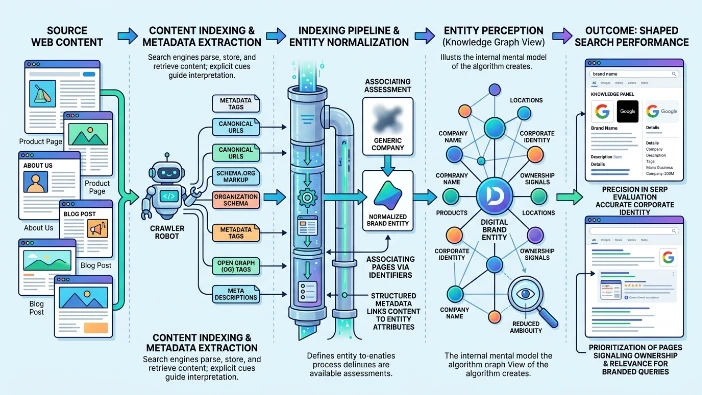
Content indexing defines which texts and attributes are available to algorithms for assessment; metadata provides explicit cues that guide entity interpretation.
Content indexing refers to the process by which search engines parse, store, and retrieve web content for ranking. Metadata refers to structured tags and schema that label content properties. Crawlers fetch pages, extract canonical tags, schema.org markup, Open Graph tags, and meta descriptions; indexing pipelines normalise entities via identifiers (canonical URLs, organisation schema). Structured metadata links content to entity attributes, allowing algorithms to associate pages with corporate identity. Proper indexing and metadata increase precision in SERP evaluation, reduce ambiguity in entity perception, and prioritise pages that correctly signal ownership and relevance for branded queries.
How do link and authority signals influence reputation signals?
Link and authority signals are the algorithmic indicators that define external validation and topical authority for an entity across the web.
Algorithms evaluate anchor text, linking domain relevance, link freshness, and nofollow/sponsored attributes to compute backlink profiles. Citation patterns and co-occurrence with authoritative sources feed into entity graphs that elevate or suppress perceived credibility. Strong authority signals increase ranking potential for owned assets and influence SERP evaluation to favour authoritative content for queries related to the entity, reducing visibility of low-authority or adversarial pages.
How do review signals and sentiment interpretation affect reputational outcomes?
Review signals and sentiment interpretation are explicit evidential inputs that alter perception and ranking for trust-dependent queries.
Review signals are quantified reviews, ratings, and contextual commentary attached to an entity within review platforms; sentiment interpretation refers to algorithmic classification of opinion polarity in text. Search ecosystems aggregate review counts, average ratings, and review recency; sentiment analysis extracts polarity, subjectivity, and intensity from review text. Algorithms combine quantitative scores with textual sentiment to adjust trust heuristics and snippet generation. Positive and recent review signals promote higher placement in local and knowledge-based SERPs; negative or high-volume adverse sentiment increases the probability that unfavourable pages rank prominently, altering entity perception during SERP evaluation.
What role do structured data and knowledge panels play in controlling entity perception?
Structured data and knowledge panels are high-visibility mechanisms that consolidate verified information and shorten the path from query to verified facts.
Structured data is machine-readable markup that describes entities and content; knowledge panels are SERP features that present consolidated entity facts extracted from structured and authoritative sources. Implemented schema (Organisation, LocalBusiness, Person) tags feed entity attributes into indexing systems. Algorithms reconcile structured data with third-party databases to populate knowledge panels, which display core attributes, contact details, and key facts. Accurate structured data increases the chance of favourable knowledge panel population and improves authority in SERP evaluation, reducing ambiguity and steering user perception toward authoritative facts.
How does content relevance and topical depth create reputation signals?
Content relevance and topical depth function as semantic proof points that align an entity with subject-matter authority and search intent.
Content relevance is the degree to which a piece of content answers queries and aligns with user intent; topical depth refers to the breadth and interconnectedness of content covering a subject area. Algorithms assess term usage, entity co-occurrence, semantic associations, and internal linking across content clusters. A dense semantic network of interlinked content signals topical authority and enriches the entity’s representation in the entity graph. Deep, semantically aligned content elevates pages for informational and navigational queries, improves internal SERP surfaces for branded terms, and strengthens entity perception by supplying the algorithm with coherent topical evidence.
How do behavioural metrics contribute to SERP evaluation and reputation formation?
Behavioural metrics are usage-derived signals that reflect how users interact with search results and owned assets; they feed back into algorithmic assessment of relevance and trust.
Behavioural metrics refer to click-through rates, dwell time, pogo-sticking, and bounce rates observed from search-originated visits. Algorithms collect anonymised interaction data to compare user engagement across candidate results. Higher engagement on a page for a query signals relevance; repeated negative interactions reduce perceived utility. Behavioural patterns feed into ranking adjustments and re-weight entity signals over time. Positive behavioural metrics strengthen visibility for pages that users find useful, while negative metrics accelerate demotion of low-quality pages in SERP evaluation, thereby reshaping the perceived reputation of an entity.
How do algorithms interpret trust and credibility signals at scale?
Algorithms operationalise trust through explicit and implicit signals that collectively quantify credibility for ranking decisions.
Trust signals are observable features (content quality, links, structured data, reviews, domain history) that algorithms map to credibility metrics. Ranking systems normalise trust signals into feature vectors, apply machine-learned models to predict relevance and reliability, and use entity-level aggregation to produce stable credibility estimates. Models evaluate cross-source corroboration, temporal consistency, and anomaly detection to discount spam or manipulative inputs. Robust trust assessments increase the probability of favourable placements for verified content and reduce the impact of ephemeral or manipulative content on entity perception during SERP evaluation.
Which parts of a digital footprint most directly alter entity perception in search?
Specific elements of a digital footprint produce disproportionate effects on entity perception and ranking.
Digital footprint refers to all indexable and publicly accessible content, metadata, and interaction traces associated with an entity. High-impact elements include official domain pages with correct canonicalisation, third-party mentions on authoritative domains, structured data, and platform-based reviews. Search engines weight these elements by source authority, link network position, and temporal recency. Changes to high-impact elements produce rapid shifts in SERP evaluation; authoritative third-party mentions or changes in review profiles cause re-evaluation of entity perception across multiple query clusters.
How should UK businesses evaluate reputational risk within search ecosystems?
Reputational risk assessment requires metricised evaluation of exposure vectors and ranking vulnerabilities that influence public perception.
Reputational risk in search ecosystems is the quantified probability and impact of negative or ambiguous signals affecting search visibility and entity perception. Risk evaluation analyses SERP composition for branded and relevant non-branded queries, audits backlink profiles, enumerates review distributions, and quantifies the presence of derogatory or ambiguous content. Scenario modelling uses historical ranking volatility and content indexing latency to estimate exposure windows. Identified risks prioritise mitigation of high-impact signals and inform resource allocation for content correction, structured data fixes, and authoritative signal reinforcement to stabilise SERP evaluation.
What measurable indicators show that reputation signals are changing?
Identifying signal shifts requires monitoring indexation, ranking, and sentiment metrics that reflect algorithmic reassessment.
Measurable indicators are time-series metrics that reveal changes in indexing status, ranking positions, traffic origin, and sentiment scores associated with entity-related queries. Key indicators include ranking fluctuations for top-of-funnel and branded queries, changes in knowledge panel contents, review velocity and average rating shifts, backlink acquisition or loss, and altered click-through or dwell metrics.
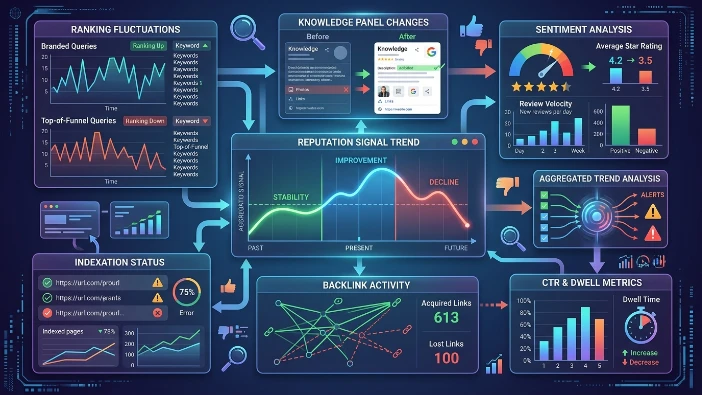
Aggregated trend analysis identifies whether signal change is transient or persistent. Impact on search visibility: Early detection of adverse indicator trends accelerates corrective measures and limits long-term perception damage in SERP evaluation.
Dive Deeper With Our Expert Guides and Related Blog Posts:
How a Reputation Management Company Protects Your Digital Presence
What Does a Reputation Management Agency Actually Do for Clients
What governance structures support consistent entity perception in search?
Governance ensures that content, technical signals, and external communications remain aligned to preserve a coherent entity representation.
Governance refers to policies, roles, and processes that control content publication, metadata standards, and external engagement protocols across digital channels. Governance includes canonical URL policies, schema implementation standards, content quality controls, review response protocols, and third-party mention tracking. Enforcement mechanisms include release approvals, scheduled audits, and alerting for indexing anomalies. Impact on search visibility: Strong governance reduces indexing errors, prevents contradictory signals, and stabilises entity perception by maintaining consistent inputs for SERP evaluation.
For more detail explore:
A Breakdown of Online Reputation Management Services and Their Results
This analysis defines how search reputation forms through indexed content, structured data, link and review signals, and behavioural feedback. It explains mechanisms by which algorithms translate those inputs into trust and credibility assessments and demonstrates how targeted elements of a digital footprint alter SERP evaluation. UK organisations require systematic assessment of indexing, authority, review, and governance vectors to understand and measure reputational exposure within search ecosystems.
What is corporate reputation management?
Corporate reputation management refers to the process of shaping how a business is perceived across search results, reviews, media coverage, and digital channels. It focuses on reputation signals, entity trust, and search visibility rather than promotion.
How does online reputation affect business trust?
Online reputation affects trust because users and search engines both evaluate signals such as reviews, media mentions, and content consistency. Stronger credibility signals improve entity perception and SERP evaluation.
What are the main parts of reputation management services?
Reputation management services usually cover review monitoring, search result analysis, content tracking, and brand mention analysis. These activities help identify which reputation signals are influencing visibility and public perception.
Why is search reputation important for businesses?
earch reputation is important because it shapes what people see first when they search for a company name or related terms. It influences ranking dynamics, content indexing, and the balance between positive and negative information in search ecosystems.