

Reputation management is the systemised practice of monitoring, influencing, and maintaining an entity’s perception within search ecosystems. Online reputation refers to the aggregate of digital signals, content, and indexed assets that define an entity’s visibility and credibility on search engine results pages (SERPs).
What mechanisms does a reputation management company use to monitor digital reputation?
A reputation management company defines monitoring as continuous collection and analysis of reputation signals across search ecosystems. Monitoring systems ingest content feeds, indexed pages, review platforms, social signals, news aggregators, and backlink profiles to construct an entity-level index. These systems tag content by sentiment, source authority, publication date, and entity mentions to produce time-series reputational metrics.
Monitoring mechanisms operate through automated crawlers, API integrations, and manual verification. Crawlers index public pages and extract metadata (titles, meta descriptions, schema), while APIs supply structured review and social data. Manual verification validates anomalies flagged by automation, ensuring data integrity for reputation analytics.
Monitoring impacts search visibility by providing timely inputs for SERP evaluation. Early detection of negative content or anomalous backlink patterns enables corrective content actions and indexing requests, which alter the mix of assets search engines evaluate for relevance and trust. Accurate monitoring therefore reduces latency between reputational events and remediation actions, improving entity perception in search.
How does analysis of content and signals define online reputation?
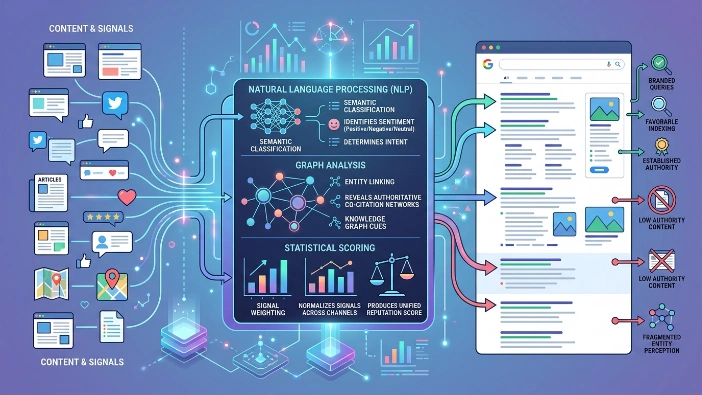
Analysis defines reputation as the composite evaluation of content credibility, signal provenance, and entity relationships within search ecosystems. Analytical models parse text for sentiment and topical relevance, score source authority using domain-level metrics and schema presence, and map entity relationships through co-mentions and knowledge graph cues.
Mechanisms for analysis include natural language processing (NLP) for semantic classification, graph analysis for entity linking, and statistical scoring for signal weighting. NLP identifies sentiment polarity and intent; graph analysis reveals authoritative co-citation networks; statistical models normalise signal strength across channels to produce a unified reputation score.
Analysis influences SERP composition because search algorithms weigh similar signals when ranking content. Well-structured, authoritative content increases the probability of favourable indexing and higher placement for branded queries. Conversely, content with low authority or conflicting entity signals reduces search visibility and fragments entity perception.
How do reputation signals influence search engine interpretation of credibility?
Reputation signals are discrete attributes that search ecosystems evaluate to infer credibility and authority. Signals include review ratings, backlink quality, publisher trust metrics, structured data markup, content freshness, and user engagement metrics. Each signal defines a facet of credibility that algorithms combine into an overall ranking decision.
Mechanisms for signal interpretation involve weighted scoring and machine-learned models. Search engines assign higher weight to provenance indicators (trusted domains, verified publishers) and corroborative signals (multiple independent sources reporting consistent facts). Structured data and schema provide explicit entity attributes that simplify entity resolution during indexing.
Signal influence on SERPs manifests through differential ranking. Content that accumulates high-weight signals ascends for branded and topical queries, improving entity perception. Negative signals—high-volume negative reviews, authoritative negative coverage, or spammy backlinks—reduce content visibility and shift SERP composition away from favourable assets.
What role does content creation and optimisation play in shaping search perception?
Content creation defines reputation by generating authoritative, indexed assets that convey entity attributes within search ecosystems. Creation focuses on producing well-structured, semantically rich content that aligns with user intent for branded and topical queries. Optimisation applies on-page and technical practices to aid content indexing and enhance visibility signals.
Mechanisms for optimisation include applying schema markup to clarify entity type and attributes; producing content with clear topical clusters to strengthen semantic relevance; and creating supporting assets that link to primary entity pages to build internal authority. Technical optimisation ensures correct canonicalisation, indexability (robots/meta), and page speed—factors that affect crawl efficiency and ranking.
Optimised content shifts entity perception on SERPs by increasing the prevalence of high-quality assets in search results. When search engines index and rank optimised content, the visible mix of assets presented to users reflects stronger credibility and controlled narrative, thereby improving entity perception in search.
How are review signals and sentiment interpreted within search ecosystems?
Review signals are structured evaluative inputs that search ecosystems interpret as direct measures of user trust and satisfaction. Reviews refer to ratings, textual feedback, and reviewer identity within review platforms, e-commerce listings, and local business directories. Sentiment analysis transforms textual reviews into quantifiable sentiment metrics that feed reputation models.
Mechanisms for interpretation include verification of reviewer authenticity, aggregation of rating distributions, and sentiment scoring of text. Platforms and search engines apply heuristics for review recency, reviewer authority, and review diversity to mitigate manipulation. Automated sentiment classifiers detect polarity and intensity to quantify impact on entity reputation.
Review and sentiment interpretation affects SERP features and prominence. Positive cumulative review signals can trigger rich snippets or knowledge panel enhancements, increasing search visibility. Negative or manipulated review clusters reduce trust signals and influence search engines to devalue affiliated pages, diminishing favourable SERP placements.
How do authority and trust signals form entity perception in search?
Authority signals are measurable indicators that search ecosystems use to evaluate entity expertise and reliability. Trust signals define provenance, verifiability, and consistency across digital assets. Together, authority and trust form entity perception by signalling to algorithms and users that an entity is credible and relevant.
Mechanisms generating authority include inbound links from high-trust domains, citations in reputable publications, consistent structured data across canonical pages, and verified entity records in knowledge graph sources. Trust mechanisms include secure site architecture (HTTPS), transparency markers (contact information, policies), and consistent NAP (name, address, phone) data across directories.
Authority and trust signals modify indexing priorities and ranking weight. High-authority signals increase the probability that content satisfies query intent and therefore gains higher ranks. Weak trust signals lead to indexing ambiguity and inconsistent SERP representation, degrading entity perception and search visibility.
How does content indexing and SERP evaluation determine digital footprint outcomes?
Content indexing is the process by which search ecosystems parse, store, and make retrievable web assets associated with an entity. SERP evaluation defines how those indexed assets are selected and ordered in response to queries. Digital footprint refers to the aggregate of indexed assets that collectively represent an entity across search results.
Mechanisms of indexing include crawling schedules, content parsing (text, metadata, structured data), and storage in search indexes with associated ranking features. SERP evaluation uses query intent matching, relevance scoring, and reputation-related signals (authority, freshness, engagement) to select the most relevant assets for display.
Indexing and SERP evaluation determine digital footprint outcomes by controlling which assets appear for target queries and in what order. A concentrated footprint of authoritative, semantically aligned assets produces coherent entity perception. A fragmented footprint with conflicting or low-authority assets generates inconsistent or negative entity perception in search.
Dive Deeper With Our Expert Guides and Related Blog Posts:
What Does a Reputation Management Agency Actually Do for Clients
How Online Reputation Management Shapes What People Find About You
What patterns indicate a damaged or at-risk corporate reputation online?
A damaged reputation is indicated by persistent negative signals that reduce search visibility and entity trust. Patterns include recurring negative content ranking on first SERP pages for branded queries, concentrated negative review clusters with high authority sources, sudden spikes in spammy backlinks, and inconsistencies in structured entity data across knowledge sources.
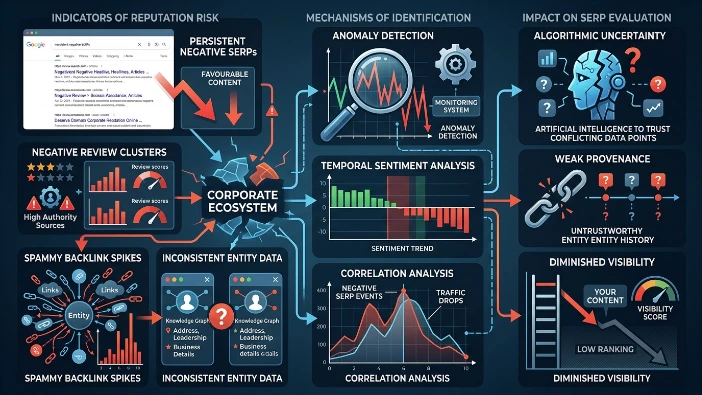
Mechanisms that surface risk patterns involve anomaly detection in monitoring systems, temporal analysis of sentiment trends, and correlation of traffic drops with negative SERP events. These mechanisms pinpoint sources and timelines of reputational shifts for targeted action.
Risk patterns impact SERP evaluation because persistent negative or conflicting signals raise algorithmic uncertainty about entity credibility. Algorithms downgrade assets with weak provenance, producing lower rankings and diminished visibility for favourable content.
How do knowledge graph and entity resolution processes shape brand/entity reputation?
Knowledge graph processes resolve named entities by aggregating factual attributes and relationships from authoritative sources. Entity resolution is the mechanism that maps mentions and pages to a canonical entity identity, enabling search ecosystems to present consolidated information (knowledge panels, entity cards).
Mechanisms include schema parsing, cross-source reconciliation, and confidence scoring for attribute claims. Search systems reconcile duplicate or conflicting attribute data through provenance-weighted voting from trusted sources.
Knowledge graph outcomes alter SERP evaluation by providing direct entity-level displays that summarise the most authoritative attributes. Accurate entity resolution increases clarity and trust signals; inaccurate or sparse resolution produces fragmented SERP representation and reduces coherent entity perception.
For more detail explore:
What to Look for When Choosing a Reputation Management Company
Improve search visibility and strengthen digital trust with expert Corporate Reputation Management that enhances entity resolution, knowledge graph accuracy, and authoritative brand signals. Effective reputation management helps businesses build consistent entity recognition across search ecosystems, improving SERP perception, credibility, and long-term online reputation.
What is corporate reputation management?
Corporate reputation management refers to the process of monitoring, influencing, and maintaining how a business is perceived online and offline. It focuses on search visibility, brand sentiment, review signals, and trust indicators across digital channels.
Why is corporate reputation important for a business?
Corporate reputation affects customer trust, search performance, and overall brand credibility. Strong reputation signals help a business appear more reliable in search results and across review platforms.
How does online reputation affect search results?
Online reputation influences which pages, reviews, and articles appear when people search for a business name. Search engines evaluate authority, sentiment, and relevance to decide which content ranks most prominently.
What are the main signals used in reputation management?
The main signals include reviews, ratings, backlinks, brand mentions, content quality, and consistent business information. These signals help search engines and users assess credibility and trust.