

When choosing a reputation management company, evaluate whether they specialise exclusively in reputation work, demonstrate proven technical SEO capabilities, and offer transparent methodologies without guaranteeing 100% success. Reputation management strategies differ based on whether your priority is crisis repair, proactive brand building, or ongoing monitoring, with effectiveness determined by the provider’s ability to influence SERP composition through content suppression or content enhancement mechanisms.
Online reputation control methods are evaluated through their impact on reputation signals, entity credibility, and sentiment distribution across search results, review platforms, and news coverage.
How Do Content Suppression and Content Enhancement Strategies Compare?
Content suppression pushes negative results below the first two pages of search results, while content enhancement builds owned and earned positive assets that dominate SERP real estate through organic ranking strength.
Content suppression operates by creating high-authority positive URLs that outrank negative third-party content through SEO optimisation, backlink acquisition, and domain authority leverage. This approach acknowledges that most negative content on review sites, news outlets, or complaint platforms cannot be removed legally or technically. The mechanism relies on Google’s ranking algorithms prioritising relevance, authority, and freshness, meaning suppressed content remains accessible on page two or three but rarely impacts user perception since 75% of users never scroll past page one.
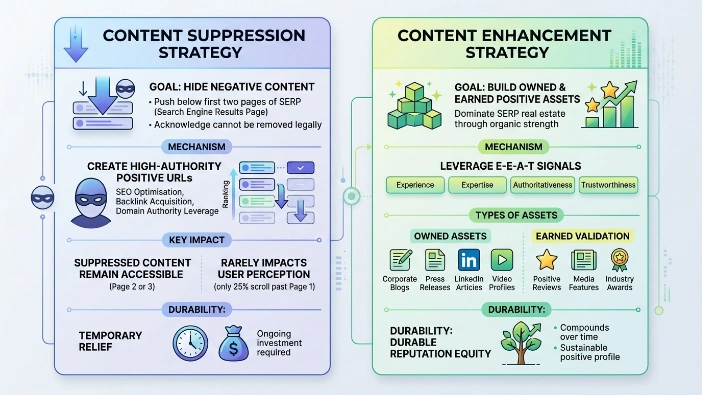
Content enhancement operates by publishing owned assets (corporate blogs, press releases, LinkedIn articles, video profiles) and earning third-party validation (positive reviews, media features, industry awards) that naturally rank for branded queries. This strategy builds entity credibility through E-E-A-T signals Experience, Expertise, Authoritativeness, and Trustworthiness which Google uses to assess content quality and brand authority. Enhancement creates durable reputation equity that compounds over time, whereas suppression provides temporary relief that requires ongoing investment.
Comparative analysis reveals distinct strengths and limitations. Content suppression delivers faster visible results for crisis scenarios, often within 4–8 weeks, but carries recidivism risk if negative content gains fresh engagement or new backlinks.
Content enhancement requires 6–12 months for substantial SERP dominance but creates sustainable protection that resists future attacks. Suppression scales poorly when negative content exists across multiple high-authority domains (e.g., Trustpilot, Google Reviews, News UK), whereas enhancement scales efficiently through systematic content production and review acquisition. For UK businesses facing regulatory scrutiny or B2B buyer due diligence, enhancement provides superior long-term risk mitigation since it demonstrates genuine market validation rather than algorithmic manipulation.
What Are the Differences Between Proactive and Reactive Reputation Management Approaches?
Proactive reputation management builds defensive reputation equity before crises occur through systematic review collection, content creation, and monitoring, while reactive management responds to negative events after they gain traction through damage control and suppression tactics.
Proactive approaches operate by establishing baseline sentiment distribution where 80–90% of search results and reviews are positive, creating an “immune system” that absorbs occasional negative feedback without impacting overall perception. This mechanism includes consistent collection of verified customer reviews, regular publication of expertise-driven content, active Google Business Profile management, and real-time mention monitoring using tools that flag sentiment shifts before they escalate. Proactive strategies also train internal teams on customer experience improvements that reduce negative feedback at the source.
Reactive approaches operate by identifying negative content after it ranks or spreads, then deploying removal requests (where legally valid), suppression campaigns, crisis PR statements, and review response protocols. This mechanism necessarily works against momentum since negative content has already gained ranking strength through engagement signals, backlinks, or viral distribution. Reactive ORM requires finding and managing every URL sharing negative views, often on third-party platforms where content cannot be removed, forcing reliance on suppression as the primary tool.
Comparative analysis shows proactive management delivers superior cost-efficiency and risk reduction. A practice with 200 positive reviews absorbs one negative review without profile rating impact, whereas a practice with 10 reviews sees the same negative feedback drop ratings by 10%. Proactive strategies improve internal operations through feedback trend analytics, driving revenue through better SEO and brand equity. Reactive-only approaches face higher costs: negative reviews ranking first on Google, escalations into social media firestorms, competitor selection by prospects, and credibility loss with partners. However, reactive capabilities remain essential since no proactive program prevents all crises. The optimal strategy combines both: build positive reputation proactively while maintaining reactive crisis response protocols.
How Do Short-Term and Long-Term Reputation Management Strategies Differ in Effectiveness?
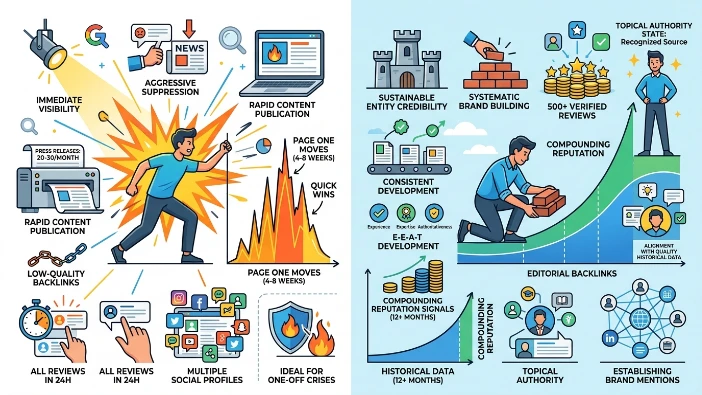
Short-term reputation strategies prioritise immediate visibility improvements through aggressive suppression and rapid content publication, while long-term strategies prioritise sustainable entity credibility through systematic brand building, E-E-A-T development, and compounding reputation signals.
Short-term mechanisms focus on quick wins: publishing 20–30 press releases in one month, acquiring low-quality backlinks to boost domain authority, responding to all reviews within 24 hours, and creating multiple social profiles to occupy SERP real estate. These tactics exploit Google’s freshness algorithm and can push negative content off page one within 4–8 weeks. Short-term approaches work well for one-off crises (e.g., a single negative news article, viral complaint) where immediate perception correction is critical for sales cycles or recruitment.
Long-term mechanisms focus on building historical data that search engines use to classify knowledge domain authority. This includes consistent content publication over 12+ months, earning editorial backlinks from industry publications, accumulating 500+ verified reviews, developing author profiles with topical authority, and establishing brand mention patterns across reputable sources. Long-term strategies align with Google’s requirement for “quality historical data” to achieve topical authority state, where the entity becomes the recognised source for its topic.
Comparative analysis reveals short-term strategies deliver faster ROI but higher risk exposure. Aggressive suppression can trigger algorithmic penalties if Google detects manipulative link-building or coordinated review manipulation. Short-term content clusters often lack semantic depth, ranking for branded queries but failing for industry terms that drive organic discovery. Long-term strategies show slower initial results (6–12 months) but create defensible market position resistant to competitor attacks and algorithm updates. Short-term approaches scale poorly beyond crisis windows since they require continuous content production without compounding returns. Long-term approaches improve search ranking influence across all branded and non-branded queries, driving sustained organic traffic and trust signals. UK businesses in regulated sectors (finance, healthcare, legal) should prioritise long-term strategies since B2B buyers conduct extended due diligence where historical credibility matters more than immediate SERP appearance.
How Do Search Engines Interpret Reputation Signals and What Impact Does This Have on Strategy Selection?
Search engines interpret reputation signals through E-E-A-T frameworks, brand authority metrics, and trust signal analysis, where entity credibility derives from consistent positive mentions, verified reviews, authoritative backlinks, and branded search volume rather than isolated optimisation tactics.
Google’s algorithms actively look for signs of real-world reputation through brand signals: branded search volume (users searching your company name), unlinked brand mentions (recognition without links), quality backlinks from authoritative industry sites, and social engagement with positive sentiment. These signals answer whether “people know, trust, and talk about this brand,” creating competitive advantage difficult to replicate since they reflect earned reputation rather than on-page optimisation. Search engines connect these signals to authority through E-E-A-T assessment, where mentions from industry publications, citations in research, and news features act as authority votes.
Trust signals in AI search (2026) include credibility (consistent customer satisfaction), clarity (structured content communicating expertise), and authority (topical recognition). AI models use pattern recognition to assess risk, looking for consistent business information (NAP: Name, Address, Phone), positive reviews, secure websites, and genuine community engagement. Reputation signals now influence AI search rankings more than backlinks, as AI prioritises credibility assessment over traditional link-based authority.
Strategic impact requires providers to demonstrate technical understanding of how reputation signals interact with ranking algorithms. Effective companies publish original research and data studies proving expertise, engage authentically on industry forums building recognition, and manage reputation through excellent service rather than manipulation. Strategies that ignore signal interpretation—such as buying fake reviews, creating low-quality content farms, or acquiring spammy backlinks—trigger algorithmic penalties and damage entity credibility permanently. Providers must show how their methods strengthen reputation signals: review strategies that increase verified customer feedback, content strategies that earn editorial mentions, and monitoring that detects signal degradation before ranking impact occurs.
Dive Deeper With Our Expert Guides and Related Blog Posts:
Key Questions to Ask Before Hiring a Reputation Management Agency
Comparing Online Reputation Management Approaches for UK Businesses
What Evaluation Criteria Determine Whether a Reputation Management Provider Delivers Effective Results?
Effective providers demonstrate specialisation in reputation work exclusively, provide transparent case studies with measurable outcomes, possess strong technical SEO and content management capabilities, and avoid guaranteeing 100% success rates since third-party search engines cannot be controlled.
Specialisation evaluation requires confirming reputation management is the provider’s primary service, not an add-on to general digital marketing. Specialist firms maintain their own reputation in the field, visible through media appearances, thought leadership, and client portfolios in your sector. Generalist agencies lack the technical depth for SERP control, understanding of E-E-A-T requirements, and crisis response protocols that specialists develop through daily practice.
Track record evaluation demands accessible client testimonials, direct evidence of expertise, and case studies showing specific processes and outcomes. Case studies reveal how much work your situation requires and provide price estimates, while also demonstrating the firm’s legitimacy and effectiveness. Absence of verifiable results indicates insufficient experience or unsuccessful outcomes.
Technical capability evaluation requires proof of SEO expertise, content management systems knowledge, Google Analytics proficiency, and search engine analysis skills. Reputation management spans from technical SEO to content curation, requiring complex skill integration managed carefully. Providers should demonstrate understanding of content suppression versus enhancement mechanisms, SERP composition control, and sentiment distribution optimisation.
Transparency evaluation requires clear communication about work completed, planned activities, and realistic timelines. Companies promising 100% success rates or guarantees are untrustworthy since they cannot control third-party search engines. Transparent providers offer multiple package options suited to specific budgets, maintain extended communication with dedicated account managers, and provide regular updates preventing confusion about progress.
For more information explore:
Find the Right Reputation Management Company for Your UK Business
Which Strategic Considerations Should Guide Your Decision Between Different Reputation Management Options?
Strategic selection depends on your crisis status (active crisis vs. proactive prevention), sector requirements (regulated B2B vs. consumer retail), budget capacity for short-term versus long-term investment, and risk tolerance for manipulation tactics versus sustainable brand building.
Active crisis scenarios require providers with immediate reactive capabilities, suppression expertise, and crisis PR experience. These situations prioritise speed over sustainability, accepting higher costs and recidivism risk for immediate perception correction. Proactive prevention scenarios favour providers specialising in long-term enhancement, review strategy, and content systems that build compounding reputation equity.
Regulated B2B sectors (finance, healthcare, legal) require providers demonstrating E-E-A-T expertise, long-term credibility building, and compliance with industry regulations. Consumer retail sectors can prioritise review management and rapid response capabilities since purchase decisions depend heavily on immediate sentiment. Budget capacity determines whether you can sustain 12-month enhancement programs or require 3-month suppression campaigns. Risk tolerance separates providers using white-hat signal building from those employing manipulative tactics that risk algorithmic penalties.
The decision framework evaluates whether providers offer personalised bespoke plans rather than generic solutions, since no one-size-fits-all approach works for reputation repair or creation. Effective providers combine proactive and reactive capabilities, offer review management specialisation (essential since 93% of buying decisions depend on online reviews), and maintain attention to detail with personalised service levels.
What is corporate reputation management and why does it matter for UK businesses?
Corporate reputation management is the strategic practice of monitoring, influencing, and protecting how stakeholders perceive a business across search engines, review platforms, and media. For UK businesses, it directly impacts customer trust, investor confidence, and search ranking influence since 93% of buying decisions depend on online reputation signals.
How long does it take to see results from corporate reputation management services?
Short-term results from content suppression strategies typically appear within 4–8 weeks, while long-term content enhancement and entity credibility building require 6–12 months for sustainable SERP dominance. A Reputation Management PR Agency combines both approaches to deliver immediate crisis relief while building compounding reputation equity.
What is the difference between proactive and reactive corporate reputation management?
Proactive corporate reputation management builds positive sentiment through systematic review collection, content creation, and monitoring before crises occur. Reactive management responds to negative events after they gain traction through damage control and suppression, making proactive approaches more cost-efficient and risk-reducing.
How do search engines evaluate reputation signals for corporate brands?
Search engines interpret reputation signals through E-E-A-T frameworks, brand authority metrics, and trust signals including verified reviews, authoritative backlinks, branded search volume, and unlinked brand mentions. These signals determine entity credibility and directly influence AI search rankings more than traditional backlinks in 2026.
What should I look for when choosing a corporate reputation management provider?
Choose a provider that specialises exclusively in reputation management, demonstrates proven technical SEO capabilities, provides transparent case studies with measurable outcomes, and avoids guaranteeing 100% success rates. A reputable Reputation Management PR Agency offers personalised bespoke plans, review management specialisation, and combines proactive enhancement with reactive crisis response capabilities.