

Reputation management strategies differ based on the type of reputational risk, the search ecosystem affected, and the balance between content removal, content suppression, and content enhancement. Online reputation control methods are evaluated through entity credibility, search ranking influence, sentiment distribution, and the durability of trust signals.
The correct answer is defined by the search problem, not the service label. Corporate reputation management is a broad discipline that covers review monitoring, brand sentiment analysis, crisis communication, content creation, search results optimisation, and stakeholder messaging. In practice, a negative review issue, a defamatory article, and a weak branded SERP all require different mechanisms because search engines interpret those signals through different document types and ranking paths. A useful agency question is whether the issue sits in review platforms, news results, social profiles, or owned pages, because each surface responds to distinct interventions. This distinction matters because a strategy built for review repair does not automatically solve SERP contamination.
Does the agency prioritise removal, suppression, or enhancement?
The best answer depends on what is technically and legally possible. Removal operates by eliminating the source document from the ecosystem, usually through platform reporting, policy enforcement, or legal escalation, and it produces the cleanest outcome when successful. Suppression operates by publishing or optimising competing pages so negative results lose visibility, which shifts search ranking influence rather than deleting the original source.

Content enhancement operates by building stronger positive assets such as profiles, articles, press material, and brand pages that occupy the SERP with favourable entities. The main difference is durability: removal is strongest when valid, suppression is more scalable, and enhancement is the most sustainable when the goal is long-term control of search perception.
How does the agency interpret search signals?
A strong provider explains search behaviour in terms of ranking signals, entity context, and topical relevance. Search engines interpret reputation signals through page quality, authority, relevance, internal linking, brand mentions, and the consistency of entity references across the web. A reputation agency that understands semantic SEO treats each result as part of a wider entity graph rather than as an isolated URL.
That matters because a branded SERP usually reflects a mixture of owned pages, third-party commentary, news coverage, and profile listings, all of which compete for visibility. The question to ask is whether the agency analyses the SERP composition before prescribing actions, because tactics work better when they map to the existing information structure.
Which approach works faster?
Reactive approaches create faster movement, while organic approaches build stronger endurance. Reactive reputation management focuses on immediate response, takedowns, crisis messaging, and quick content deployment to reduce exposure after a reputational event. Organic reputation management focuses on sustained publishing, profile building, review accumulation, and authority growth that reshape perception over time. The short-term path often produces visible changes sooner because it attacks the current SERP directly, but it also faces higher volatility if the underlying trust deficit remains unresolved. The long-term path takes longer to influence rankings and sentiment distribution, yet it creates deeper entity credibility because the reputation profile becomes supported by repeated, consistent signals.
Which approach scales better?
Content enhancement scales better than one-off removals because it compounds across topics, platforms, and query variants. A removal strategy solves a specific source problem, but it stops scaling once the harmful content disappears or remains protected by policy or jurisdiction limits. An enhancement strategy expands into articles, profiles, thought-leadership pages, press coverage, and social entities, which creates more ranking surfaces for branded and related queries. This is also where semantic content networks matter: interconnected pages strengthen topical coverage and make the positive narrative easier for search engines to understand and retrieve. The important question is whether the agency builds a system that can extend beyond a single incident into broader reputation architecture.
How much risk sits in each method?
Removal carries legal and evidential risk, suppression carries ranking risk, and enhancement carries consistency risk. Removal fails when the source content is lawful, platform policy does not support takedown, or the publisher resists requests. Suppression depends on the ability to outrank negative assets, which means search visibility can fluctuate whenever competitors publish stronger content or algorithms shift. Enhancement avoids direct confrontation with hostile sources, but it fails when content lacks authority, distinctiveness, or internal structure, because weak assets do not change the SERP meaningfully. A serious agency explains these exposure points clearly and matches them to the client’s tolerance for legal, operational, and reputational uncertainty.
What evidence shows effectiveness?
Effectiveness is measured through SERP change, sentiment movement, and trust reconstruction. An agency with a credible process tracks first-page composition before and after intervention, monitors review volume and tone, and measures whether positive entities replace negative ones in branded results. It also evaluates whether the result is cosmetic or structural: cosmetic changes alter one URL, while structural changes alter the broader information environment around the entity. The strongest evidence comes from changes that persist across time, because stable reputation repair reflects actual trust recalibration rather than temporary rank movement. The question to ask is what reporting framework the agency uses, because without baseline and follow-up measurement, reputation work becomes anecdotal.
Dive Deeper With Our Expert Guides and Related Blog Posts:
Comparing Online Reputation Management Approaches for UK Businesses
How Reputation Management Works and What Results to Expect
Which strategic option fits corporate reputation?
Corporate reputation management needs a blended answer rather than a single tactic. Review management handles customer-facing trust, public relations shapes external narrative, search optimisation controls branded visibility, and crisis communication limits damage during escalation. For a UK business, the right mix depends on whether the main risk comes from consumer feedback, media coverage, executive visibility, or search results dominated by irrelevant or hostile pages. A mature agency evaluates the entity as a whole and designs interventions across owned, earned, and controlled media rather than treating reputation as a single channel problem. That approach improves search perception because every channel contributes to the same entity profile in the eyes of users and search systems.
For more information explore:
Why UK Businesses Trust a Specialist Reputation Management Agency
What questions expose weak agencies?
The best questions reveal mechanism, not marketing language. Ask how the agency identifies the source of the reputational problem, how it separates removal from suppression, and how it measures impact across SERPs, reviews, and sentiment. Ask what happens if a takedown request fails, which pages the agency plans to publish, and how it keeps positive content visible over time. Ask how it handles compliance, evidence collection, and message consistency, because weak processes create fragmented trust signals. Ask whether its strategy supports corporate reputation management in the context of broader entity credibility, because that phrase only has value when tied to measurable search and perception outcomes.
How should the final decision be framed?
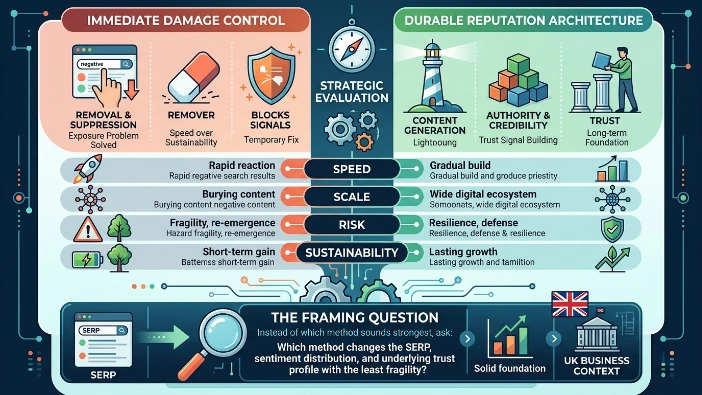
The final decision rests on whether the priority is immediate damage control or durable reputation architecture. Removal and suppression solve exposure problems, but enhancement builds the wider system of trust signals that search engines and users rely on over time. A strategic buyer weighs speed, scale, risk, and sustainability together rather than assuming one tactic covers all reputational scenarios.
For UK businesses, the most resilient option is the one that aligns search visibility with genuine entity credibility, not just temporary keyword movement. The right evaluation question is therefore not which method sounds strongest, but which method changes the SERP, the sentiment distribution, and the underlying trust profile with the least fragility.
What is corporate reputation management?
Corporate reputation management is the process of monitoring and shaping how a business is perceived across search results, reviews, news coverage, and social channels. It uses reputation signals such as content quality, sentiment, and brand mentions to influence trust and visibility.
Why is corporate reputation management important for UK businesses?
Corporate reputation management matters because search results and reviews strongly affect customer trust before contact or purchase. In the UK market, strong entity credibility helps businesses control perception, reduce risk, and improve branded search visibility.
What are the main methods used in corporate reputation management?
The main methods include review management, content enhancement, search result suppression, and crisis response. Each method works differently: some remove or reduce negative visibility, while others build stronger positive signals in search ecosystems.
How long does corporate reputation management take to show results?
Timelines depend on the problem type, the visibility of the negative content, and the strength of existing brand signals. Faster changes often come from reactive actions, while durable results usually come from long-term content and trust-building strategies.