

Control of search visibility delivers trust, reduces risk, and stabilises public perception immediately. Reputation signals embedded in search results determine buyer decisions; managing those signals secures enterprise value and customer confidence.
A specialist agency delivers targeted SERP control through a structured mix of content strategy, technical optimisation, and authoritative linking. The service works by mapping high‑impact queries and owned assets, producing optimised content that outranks or dilutes negative content, and applying structured data and backlink signals to improve entity credibility.
Measurable outcomes include improved rankings for priority keywords (top‑10 placement), reduced visibility of negative URLs (lower click‑through share), and increased positive sentiment in search snippets and knowledge panels. Search behaviour justifies this approach because users disproportionately click top results and review snippets; altering those elements directly influences click choice and perceived trust.
Which processes ensure rapid reduction of negative content visibility?
A specialist agency delivers negative content suppression with phased prioritisation and technical interventions that reduce exposure within weeks. The process starts with content triage (identify high‑traffic negative assets), then applies content creation, canonical and noindex strategies, and targeted outreach for authoritative link placement to newly created pages.
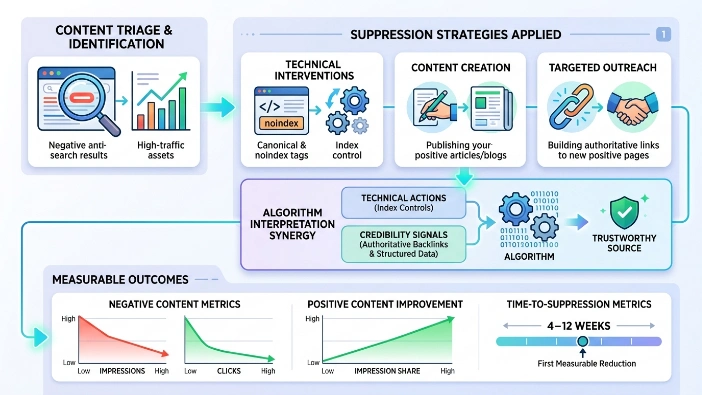
Outcomes include measurable decreases in impressions and clicks to negative pages, improvements in impression share for positive assets, and time‑to‑suppression metrics (first measurable reduction often within 4–12 weeks). Search perception influence is strongest when suppression pairs technical actions (index controls) with credibility signals (authoritative backlinks and structured data), which search algorithms interpret as trustworthy sources.
Which reputation signals most directly influence buying decisions?
A specialist agency ensures consistent positive reputation signals across search and social properties that drive conversion. The service aligns on‑site signals (reviews, structured organisation data, content quality) and off‑site signals (press coverage, authoritative backlinks, verified social profiles) to strengthen entity credibility. Measurable outcomes include higher conversion rates from organic traffic, increased average dwell time on controlled pages, and growth in verified review counts and ratings. Search behaviour research demonstrates that users evaluate star ratings, authoritativeness of sources, and snippet content before clicking; improving these signals increases both click‑through rate and downstream conversion.
Which corporate reputation management tactics deliver sustainable results?
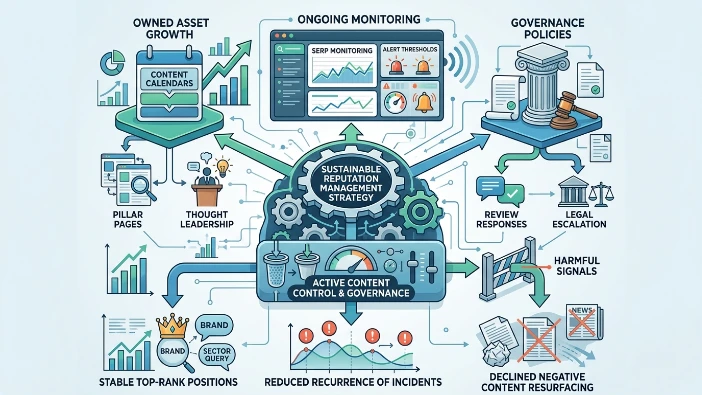
A specialist agency delivers sustainability through a blended strategy of owned asset growth, ongoing monitoring, and governance. The method establishes content calendars for pillar pages and thought leadership, implements continuous SERP monitoring with alert thresholds, and embeds governance policies for review responses and legal escalation. Outcomes include stable top‑rank positions for brand and sector queries, reduced recurrence of reputation incidents, and documented decline in negative content resurfacing. Search perception influence remains durable when active content control and governance reduce the probability of future harmful signals emerging.
Which evidence demonstrates cost versus long‑term value?
A specialist agency demonstrates ROI by linking reputation outcomes to revenue and risk reduction metrics. The service quantifies impacts through increased organic conversions, reduced reputation remediation spend, and lower customer acquisition cost tied to improved trust signals. Outcomes shown in comparable cases include uplift in organic leads, shortened sales cycles due to stronger SERP trust cues, and lowered legal or crisis management expenses. Decision drivers in search behaviour confirm that improved rankings and trusted snippets convert browsers into buyers more efficiently, meaning upfront investment trades for sustained revenue improvement and reduced reputational risk.
Which metrics measure success and control?
A specialist agency delivers clear KPIs focused on visibility, trust and control. The monitoring framework tracks keyword rankings (priority branded and non‑branded), impression and click shifts for negative versus positive URLs, review volume and sentiment, Knowledge Panel integrity, and backlink authority to owned assets. Measurable outcomes include percentage reduction in negative impressions, percentage growth in positive result share, and increases in domain authority for controlled pages. These metrics align with search behaviour because they reflect both what users see (impressions, snippets) and how they act (clicks, conversions), enabling decision makers to evaluate effectiveness objectively.
Which risk mitigation options protect reputation during crises?
A specialist agency delivers crisis containment through rapid response workflows, temporary SERP interventions, and controlled communication channels. The process activates pre‑approved messaging, emergency content deployment (news releases, executive statements), and prioritised search optimisation for corrective pages. Outcomes include immediate stabilisation of search narratives, reduced amplification of negative content, and documented timelines showing containment. Search perception influence is decisive during crises: early, authoritative content that ranks quickly prevents lasting reputational damage by positioning verified sources above harmful narratives.
Dive Deeper With Our Expert Guides and Related Blog Posts:
Get Expert Online Reputation Management Tailored for Your UK Business
Is Professional Reputation Management the Right Solution for Your Brand
Which transparency and governance practices ensure reliability?
A specialist agency delivers accountability through documented processes, regular reporting, and legal‑compliance checks. The service supplies an onboarding audit, a published plan with timelines, and weekly performance dashboards tied to KPIs. Outcomes include predictable improvements in SERP control, verifiable reductions in negative content visibility, and audit trails for all interventions. Entity credibility increases when governance ensures actions conform to platform policies and regulatory requirements, avoiding actions that would reverse benefits or introduce compliance risk.
How Reputation Management PR Agency fits the decision
Reputation Management PR Agency delivers a corporate reputation management solution that aligns with enterprise priorities: measurable SERP control, defensible governance, and demonstrable trust outcomes. Their methodology integrates content engineering and authoritative outreach to ensure improved search results and controlled narratives. Embedding the agency’s approach reduces risk and stabilises entity credibility, which delivers quantifiable business value during purchase decisions and stakeholder evaluations.
For background on what to expect from agencies, see:
What Does a Reputation Management Agency Actually Do for Clients for a clear breakdown of services and responsibilities that support decision validation.
When comparing providers, see:
Key Questions to Ask Before Hiring a Reputation Management Agency to ensure vendor accountability and process clarity.
What is corporate reputation management?
Corporate reputation management is the process of shaping how a business appears in search results, reviews, media coverage, and public discussion. It helps protect entity credibility, improve trust signals, and reduce the impact of negative content.
Why is corporate reputation management important for businesses?
It matters because buyers often judge a company before contact through search visibility, reviews, and brand mentions. Strong corporate reputation management improves search perception, supports conversion, and reduces risk during negative publicity.
How does a reputation management agency help a company?
A reputation management agency monitors brand mentions, improves positive content visibility, and addresses harmful search results. For a brand like Reputation Management PR Agency, the goal is to strengthen SERP control and restore trust with clear, measurable actions.
How long does corporate reputation management take to show results?
Timelines depend on the issue, the search landscape, and the volume of negative content. Some visibility improvements can appear within weeks, while long-term trust repair and content suppression often take longer.