

Controlling search visibility delivers immediate decision clarity; strong reputation signals determine customer trust and commercial outcomes. Reputation management stabilises perception and suppresses harmful content to ensure your organisation’s search presence reflects verified entity credibility.
Which reputation management approach delivers measurable results?
A targeted corporate reputation management strategy delivers measurable improvements in search visibility and entity credibility within three to six months. The service works by auditing current reputation signals—owned content, third-party mentions, review profiles, and structured data—then executing suppression, promotion and correction campaigns that alter SERP control.
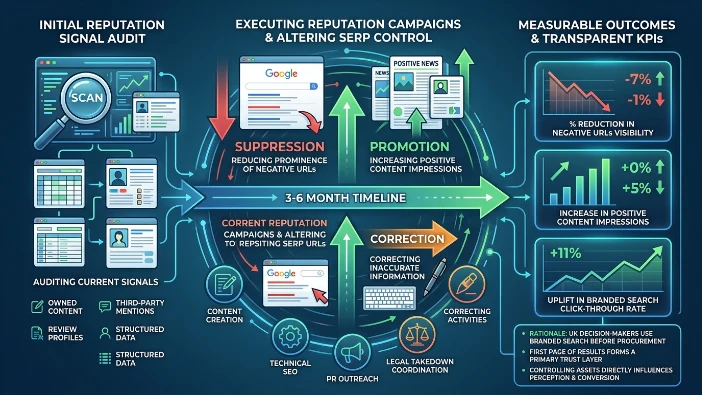
Measurable outcomes include reduction in prominence of negative URLs (tracked as percentage visibility drop), increase in positive content impressions, and uplift in branded search click-through rate. This approach justifies itself through search behaviour: UK decision-makers use branded search before procurement, and the first page of results forms a primary trust layer; controlling those assets directly influences perception and conversion. For organisations that require an immediate decision, a professional reputation management service centralises activities—content creation, technical SEO, PR outreach and legal takedown coordination—to deliver transparent KPIs and accountability.
Which methods reduce risk from negative content fastest?
A combined negative content suppression and correction protocol delivers the fastest measurable reduction in reputational risk. The protocol initiates with rapid takedown requests and de-indexing where legal or policy grounds exist, followed by high-authority content promotion and targeted canonicalisation to dilute remaining negative assets. Outcomes include a quantifiable fall in negative content share of SERP real estate and a stabilised sentiment score on monitored platforms. This method aligns with how search engines weigh signals: authoritative, recent, and contextually optimised pages outrank older unfavourable content, and consistent entity signals (schema, verified profiles) strengthen perceived credibility. The service ensures end-to-end handling—legal liaison, webmaster communication, and editorial publishing—so risk is reduced without transferring liability back to your internal teams.
Which investments produce the best long-term value for corporate reputation?
Investing in sustained reputation signal optimisation delivers the highest long-term return on trust and commercial resilience. The process combines technical improvements (structured data, HTTPS, crawl optimisation), ongoing high-authority content creation (case studies, leadership commentary), and proactive review management to maintain entity credibility. Measurable outcomes encompass steady ranking improvements for branded and category queries, improved click-through rates from SERPs, and higher conversion rates from referral traffic. Justification rests on search perception influence: consistent authoritative signals prevent recurrence of negative narratives and reduce future remediation costs. Cost analysis compares one-off suppression actions versus continuous management; continuous programmes lower total cost of ownership by preventing escalation and preserving customer trust, thereby reducing churn and litigation exposure.
Which metrics demonstrate restored trust to stakeholders?
A focused measurement suite delivers clear evidence of restored trust through search and engagement metrics. The service monitors SERP share by sentiment, branded query CTR, owned-content impressions, average review rating, and backlink authority for brand-related pages. Outcomes provide numeric proof: percentage reduction in negative result visibility, uplift in positive content share, and improved engagement from branded searches. These metrics correspond directly to decision-making processes used by procurement teams and investors who evaluate entity credibility through searchable evidence. The system reports regularly and delivers trend lines that validate intervention effectiveness and maintain transparency with stakeholders.
Which process ensures transparency and control during remediation?
A staged remediation workflow ensures transparency, control and predictable outcomes at each phase. Stage 1 delivers a comprehensive audit of reputation signals and threat mapping; Stage 2 executes suppression, correction and positive signal amplification; Stage 3 monitors results and hardens defences with governance and alerting. Measurable outcomes include time-to-impact metrics, percentage reduction in complaint-derived visibility, and durability scores for restored content placements. This process aligns with search behaviour: continuous monitoring prevents re-emergence of suppressed pages and maintains consistent entity data across directories and platforms. The service provides clear SLAs, reporting cadence, and escalation pathways so decision-makers retain control without adding operational burden.
Which legal and technical actions ensure sustainable suppression?
A coordinated legal-technical approach ensures sustainable negative content suppression and strengthens SERP control. Legal actions (data protection requests, cease-and-desist letters) remove or limit access to defamatory or policy-violating content when grounds exist, while technical actions (noindex directives, canonical tags, and signal-driven publishing) bury remaining assets beneath authoritative owned pages.
Outcomes include long-term exclusion of removed URLs from index and a measurable decline in recurrence rate. The approach leverages search engines’ respect for verified entity signals and adherence to publisher policies; combining legal leverage with technical SEO yields the most reliable suppression outcomes. The service manages both fronts to reduce legal exposure and maintain continuity of your public narrative.
Dive Deeper With Our Expert Guides and Related Blog Posts:
Is Professional Reputation Management the Right Solution for Your Brand
Protect and Grow Your Business Reputation With Our Proven UK Service
Which case elements prove ROI for decision-makers?
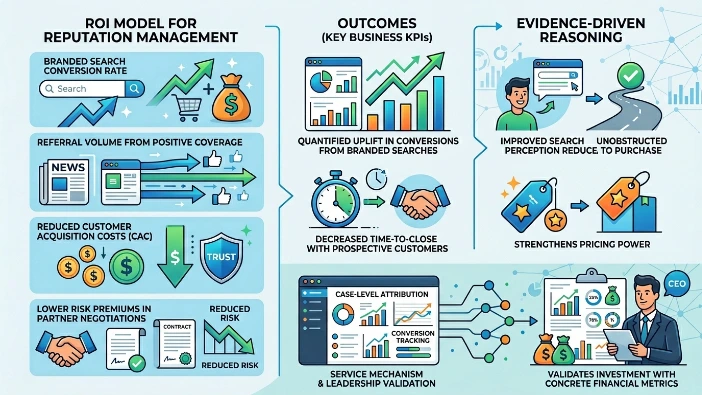
A clear ROI model demonstrates how reputation management translates into commercial results by linking search outcomes to business KPIs. The model tracks changes in branded search conversion rate, referral volume from positive coverage, reduction in customer acquisition costs driven by increased trust, and lower risk premiums in partner negotiations.
Outcomes include quantified uplift in conversions from branded searches and decreased time-to-close with prospective customers. Evidence-driven reasoning shows that improved search perception reduces friction in purchase decisions and strengthens pricing power. The service provides case-level attribution and conversion tracking so leadership validates the investment with concrete financial metrics.
Which operational features speed impact while maintaining quality?
A prioritised execution plan delivers rapid impact without sacrificing sustainable quality by combining triage for high-risk items with parallel content production and outreach. Operational features include immediate takedown triage, priority publishing on authoritative domains, and simultaneous review remediation for critical profiles. Measurable outcomes include shortened median time-to-first-improvement on SERPs and tracked recovery intervals for key queries. The plan relies on proven search perception influence: timely, authoritative responses to negative signals prevent amplification and restore control. The provider operates with clear SLAs and documented workflows to ensure predictable service delivery.
Service placement and validation occur when decision intent peaks when leadership needs a reliable partner to stabilise search perception and reduce commercial risk. For those ready to act, learn Reputation Management PR Agency delivers targeted corporate outcomes by visiting the Corporate Reputation Management page and reviewing the programme details and KPIs.
For additional context on how reputational control influences discoverability and decision-making, consult the informational resource:
How Online Reputation Management Shapes What People Find About You.
For a comparative perspective on approaches and expected outcomes, review:
Comparing Online Reputation Management Approaches for UK Businesses.
What is corporate reputation management and why does it matter for my UK business?
Corporate reputation management is the coordinated process of monitoring, correcting and promoting the information that appears about your organisation online to protect entity credibility and commercial standing. Effective management improves branded search results, reduces the visibility of harmful content and strengthens trust signals that decision-makers and customers rely on.
How quickly does corporate reputation management deliver visible results in search?
Initial improvements in SERP control and reduced prominence of specific negative pages are typically visible within weeks for targeted interventions, with sustained gains in entity credibility and branded rankings stabilising over three to six months. Speed depends on the complexity of negative assets, required legal actions, and the authority of promoted content.
Which actions does a corporate reputation management service use to suppress negative content?
A professional service issues removal or de-index requests where legal grounds exist, publishes high-authority owned content, applies technical SEO controls (canonical, noindex) and executes outreach to authoritative domains to dilute negative assets. These combined legal, editorial and technical steps reduce negative result share and strengthen positive signals in SERPs.
How is success measured for corporate reputation management campaigns?
uccess is measured by metrics such as percentage reduction in negative result visibility on page one, uplift in positive content impressions, branded search click‑through rate, average review rating and conversion changes from branded queries. These KPI-driven metrics provide clear evidence of improved search perception and commercial impact.