

Reputation management strategies differ based on the threat vector (negative reviews, defamatory content, search-visibility issues) and the organisation’s risk tolerance, resource horizon and entity footprint in search ecosystems. Online reputation control methods are evaluated through metrics that measure search ranking influence, sentiment distribution, entity credibility signals and measurable changes in SERP composition.
Content creation is the proactive generation of authoritative assets (blogs, profiles, press releases, long-form content) that establish positive signals and topical breadth; content creation operates by adding new indexed pages and entity associations to search graphs and increases the volume of reputation signals tied to the corporate entity.
The mechanism works in search ecosystems by producing relevance signals (topic coverage, internal linking, schema markup) and engagement signals (click-through rate, dwell time) which search engines correlate with entity credibility. Strengths include scalability, sustainability and low regulatory/legal friction; limitations include time-to-impact, resource cost for high-quality content, and the need for consistent topical mapping to avoid dilution. Content creation influences SERP composition by increasing the likelihood that owned assets occupy organic result slots and knowledge panels, thereby shifting sentiment distribution upward and improving perceived trust signals over time.
Content removal is a reactive suppression or elimination of undesired content via takedowns, DMCA, de-indexing requests or legal action; content removal operates by seeking direct removal of harmful nodes from search indices or web hosts, thus reducing visible negative reputation signals. The mechanism in search ecosystems involves legal or platform-level interventions (host takedown) or search-engine-specific removal requests that change index state and remove references from SERP features.
How does organic (proactive) reputation management compare with reactive (incident-response) approaches?
Organic reputation management is a long-term programme that builds topical authority and entity credibility through consistent content networks, internal linking strategies, and structured data; organic programmes operate by improving relevance vectors and accumulating historical signals that search engines trust for ranking decisions. The mechanism uses semantic content networks to occupy query intent clusters and to establish a positive distribution of content types (informational, transactional, branded) which search engines interpret as a stable indicator of entity reliability.
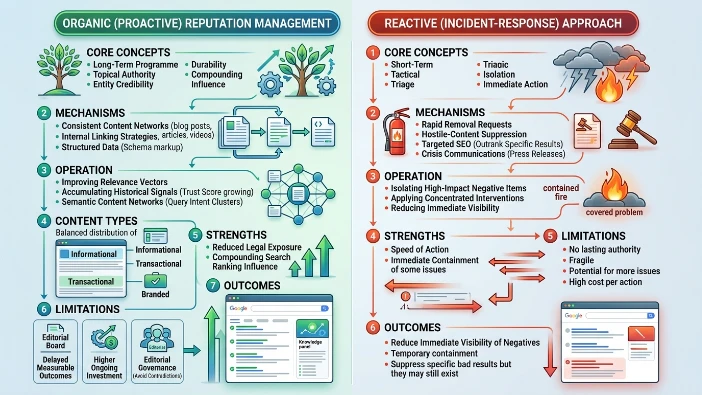
Strengths include durability, reduced legal exposure, and compounding search ranking influence; limitations include delayed measurable outcomes, higher ongoing investment, and the requirement for editorial governance to avoid contradictions in messaging. Organic approaches alter SERP composition by expanding owned presence, increasing the probability of positive result dominance and strengthening knowledge-graph associations.
Reactive incident-response is a short-term, tactical approach that focuses on triage: rapid removal requests, hostile-content suppression, targeted SEO to outrank specific results, and crisis communications; it operates by isolating high-impact negative items and applying concentrated interventions to reduce immediate visibility.
The mechanism leverages platform tools (reporting functions), paid amplification of positive responses, rapid content creation to outrank negatives, and legal escalations where appropriate. Strengths include speed of impact on individual items and clear prioritisation for high-severity risks; limitations include limited breadth (does not address systemic reputation gaps), recurring cost when incidents repeat, and potential to prioritise symptom removal over structural credibility building. Reactive measures change SERP composition quickly for targeted queries but produce limited change in overall sentiment distribution unless paired with organic strategies.
What are the trade-offs between content suppression and content enhancement in SERP control strategies?
Content suppression is the tactic of reducing the visibility of specific negative assets through de-indexing, takedowns, or aggressive SEO targeting to push negatives off page one; content suppression operates by directly altering index presence or by creating higher-ranking competing content for the same queries. The mechanism impacts search ranking influence by lowering negative item impressions and redirecting user attention to owned assets, thereby modifying perceived entity credibility for query-specific audiences. Strengths include precision and measurable changes for targeted keywords; limitations include resilience of third-party platforms, high resource and legal exposure, and possibility of fragmentation where suppressed content migrates to other domains or social feeds.
Content enhancement is the practice of enriching owned assets and third-party reference points (citations, partner mentions, expert content) to improve entity credibility and broaden positive sentiment distribution; content enhancement operates by strengthening contextual vectors and linking patterns that search engines use to assess topical authority. The mechanism increases the weight of positive signals across multiple queries and bolsters trust indicators such as authoritative backlinks and structured data, which enhance search ranking influence and visibility in SERP features. Strengths include long-term sustainability and improved resilience against future negative signals; limitations include slower realisation and dependency on third-party cooperation for citations or syndication.
Comparative analysis: suppression delivers fast, targeted SERP shifts but exposes scalability constraints and legal risk; enhancement yields robust entity credibility and wider search ranking influence but demands sustained investment and editorial discipline. Strategic balance requires assessing incident severity, query distribution, and resource horizon.
Dive Deeper With Our Expert Guides and Related Blog Posts:
A Breakdown of Online Reputation Management Services and Their Results
What to Look for When Choosing a Reputation Management Company
How do short-term and long-term reputation strategies differ in effectiveness, scalability and risk?
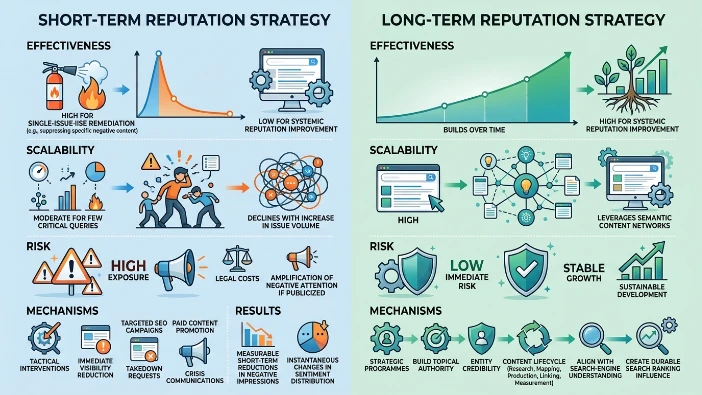
Short-term strategies are defined as tactical interventions that operate by prioritising immediate visibility reduction for high-impact items and delivering rapid adjustments in SERP composition. The mechanism includes targeted SEO campaigns, paid content promotion, takedown requests and crisis communications; these actions produce measurable short-term reductions in negative impressions and instantaneous changes in sentiment distribution for specific queries. Effectiveness is high for single-issue remediation but low for systemic reputation improvement; scalability is moderate for a few critical queries but declines with increase in issue volume; risk exposure includes legal costs and amplification of negative attention if interventions are publicised.
Long-term strategies are defined as programmes that build topical authority and entity credibility by operating across the content lifecycle research, semantic topical mapping, content production, internal linking, and continuous measurement. The mechanism leverages semantic content networks to align with search-engine understanding and to create durable search ranking influence.
Effectiveness is high for sustained trust-building and for shifting overall sentiment distribution across a broad set of queries; scalability is high when processes and editorial governance are standardised but requires more time and budget upfront. Risk exposure for long-term strategies is lower in legal terms but includes operational risk from inconsistent content quality and potential misalignment with evolving search algorithms.
Comparative evaluation: short-term delivers immediate tactical gains for crisis incidents; long-term secures entity credibility and SERP dominance over time. Effective programmes integrate both to measure immediate risk reduction and long-term sustainability.
How do search engines interpret reputation signals and how do different strategies influence SERP composition?
Search engines interpret reputation signals as a combination of content relevance, backlink authority, user interactions, entity co-occurrence, structured data and recency patterns; reputation signals are synthesised into ranking decisions that affect visibility and knowledge-graph associations. The mechanism in algorithms translates high-quality, topically consistent content and authoritative backlink patterns into elevated search ranking influence, while negative externalities (high-volume negative sentiment on third-party sites) reduce perceived entity credibility.
Content creation increases positive reputation signals by expanding topical coverage and improving engagement metrics that feed ranking models. Content suppression alters the index state by removing or demoting negative nodes, directly changing SERP composition for affected queries but not always altering underlying entity credibility metrics.
Comparative analysis: proactive enhancement shifts SERP composition by increasing the share of owned assets and positive third-party references, improving the distribution of trust signals over time; reactive suppression changes SERP composition rapidly for specific queries but leaves broader search-engine interpretation (entity credibility) less affected unless suppression is comprehensive. Measurement requires both SERP position tracking for target queries and entity-level metrics such as knowledge panel presence, brand-query share and sentiment distribution across indexed results.
Check the Complete Explanation:
Work With a Proven ORM Agency That Delivers Measurable UK Results
Key differences between approaches: content creation and organic programmes build topical authority and sustained search ranking influence but require time and editorial governance, while content removal and reactive interventions deliver immediate SERP changes for targeted queries but present scalability, jurisdictional and amplification risks. Strategic considerations: select an approach aligned to the severity and scope of negative signals, balance short-term incident response with long-term entity credibility programmes, and use measurable reputation signals SERP composition, sentiment distribution, backlink authority and knowledge-graph presence to evaluate outcomes and adjust resource allocation.
What is corporate reputation management and how does it work?
Corporate reputation management is the strategic process of monitoring, influencing and protecting how a business is perceived online and in the media. It works by aligning public messaging, crisis communications and digital presence to strengthen brand trust, search visibility and stakeholder confidence.
How does a reputation management PR agency help UK businesses?
A reputation management PR agency helps UK businesses by coordinating media relations, content strategy and crisis response to shape public perception and protect brand credibility. It also supports search‑driven reputation control by aligning PR efforts with online visibility and SERP narratives.
What is the difference between crisis PR and long‑term reputation management?
Crisis PR focuses on rapid response to damage, such as negative news or social‑media backlash, to limit immediate reputational harm and control messaging. Long‑term reputation management builds sustained brand trust through consistent communication, thought leadership and controlled digital narratives over time.
How long does it take to see results from corporate reputation management?
Early PR and messaging changes can show impact within weeks by improving media tone and stakeholder narratives around the brand. Visibility and sentiment shifts in search and digital channels typically appear over several months as reputation signals accumulate and content ranks.