

Reputation management works by manipulating search engine results pages (SERPs) through content creation, suppression, removal, or legal takedown strategies to control what stakeholders see when searching for your organisation. Corporate reputation management operates through measurable mechanisms that influence search ranking signals, sentiment distribution, and entity credibility across digital touchpoints.
Reputation management strategies differ based on whether organisations prioritise content suppression versus content enhancement, reactive crisis response versus proactive audience engagement, or short-term visibility fixes versus long-term entity authority building. Online reputation control methods are evaluated through their impact on first-page SERP composition, sentiment distribution across review platforms, and sustained search visibility for branded queries over 6–18 month periods.
How Do Content Suppression and Content Enhancement Strategies Compare in Effectiveness?
Content suppression pushes negative results off page one through SEO-optimised positive content, while content enhancement strengthens existing positive assets through semantic optimisation and structured data implementation.
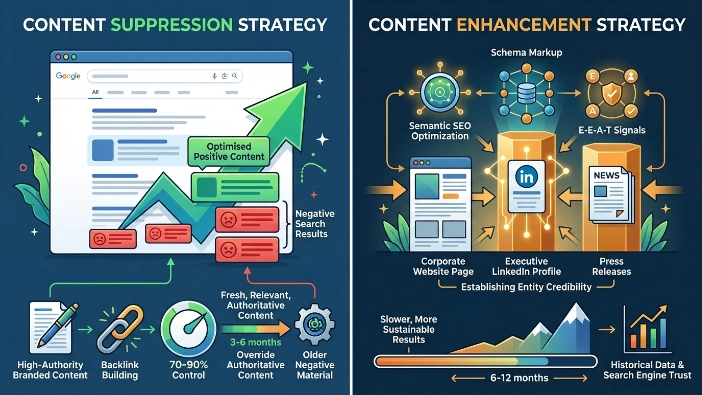
Content suppression operates by publishing high-authority content targeting branded and semi-branded queries, then building backlinks to outrank negative results. The mechanism relies on Google’s ranking algorithms prioritising fresh, relevant, authoritative content over older negative material. Suppression typically achieves 70–90% first-page control within 3–6 months when executing 15–20 pieces of optimised content with sustained link building.
Content enhancement operates by optimising existing owned assets (corporate website pages, executive LinkedIn profiles, press releases) through semantic SEO, schema markup, and E-E-A-T signals. This approach strengthens entity credibility by demonstrating topical authority around corporate values, leadership, and service offerings. Enhancement produces slower but more sustainable results, requiring 6–12 months to establish historical data that search engines trust.
What Are the Mechanisms and Limitations of Legal Removal Versus SEO Suppression?
Legal removal deletes content at the source through DMCA takedowns, defamation lawsuits, or platform policy violations, whereas SEO suppression leaves content intact but pushes it beyond page one through ranking manipulation.
Legal removal operates by identifying content that violates platform terms (copyright infringement, hate speech, revenge porn) or UK defamation law (false statements causing serious harm). The mechanism involves formal takedown requests, cease-and-desist letters, or court orders requiring hosting providers to delete content permanently. Removal achieves 100% elimination when successful but succeeds in only 15–30% of cases because most negative content (critical reviews, legitimate news articles, competitor complaints) does not violate laws or policies.
SEO suppression operates by exploiting Google’s ranking factors—content freshness, backlink authority, user engagement signals—to outrank negative results. The mechanism does not remove content but reduces its visibility to <5% of searchers (those clicking past page one). Suppression succeeds in 70–90% of cases because it does not require proving legal violations.
Legal removal faces four critical limitations. First, it requires proving content is false and damaging under UK defamation law, which demands legal expertise and £5,000–£50,000 in legal fees. Second, removal processes take 2–6 months, during which negative content continues damaging reputation. Third, successful removal creates vacuum effects where new negative content may rank higher if suppression assets are not already in place. Fourth, removal cannot address review platform content (Trustpilot, Google Reviews) because platforms protect legitimate customer feedback under free speech principles.
SEO suppression faces three limitations. First, suppression requires continuous content production; stopping publication allows negative content to resurface within 2–4 months as algorithms re-evaluate freshness signals. Second, suppression cannot eliminate content from high-authority domains (BBC, The Guardian, major industry publications) that possess inherent domain authority exceeding 80. Third, suppression does not address sentiment distribution on review platforms where customers read star ratings independent of SERP position.
Organisations should select legal removal only when content violates specific laws or platform policies. For legitimate criticism, negative reviews, or news coverage, suppression provides the only viable mechanism. A hybrid approach removing genuinely illegal content while suppressing legitimate negative content maximises first-page control while minimising legal risk and cost.
Dive Deeper With Our Expert Guides and Related Blog Posts:
What Makes a Reputation Management PR Agency Different From Standard PR
How to Evaluate Whether a UK ORM Agency Is Right for Your Situation
How Do Organic Proactive Approaches Differ From Reactive Crisis Responses in Long-Term Impact?
Organic proactive approaches build entity credibility through sustained content creation, review generation, and stakeholder engagement before crises occur, while reactive crisis responses deploy suppression and communication tactics after negative events damage reputation.
Organic proactive reputation management operates by establishing historical data that search engines interpret as trustworthiness. The mechanism includes publishing 20–30 pieces of thought leadership content annually, generating 50–100 verified positive reviews quarterly, maintaining executive profiles on LinkedIn and industry platforms, and securing third-party media coverage on domains with authority ratings above 60. Proactive approaches measure success through sentiment distribution (targeting 80%+ positive sentiment), branded query visibility (ranking top-3 for 90%+ branded keywords), and entity association strength (Knowledge Graph panels, brand mentions on authoritative domains).
Build lasting brand credibility with professional Corporate Reputation Management focused on proactive reputation growth, authoritative content creation, and trust-signal development. A long-term reputation strategy helps businesses strengthen search visibility, improve entity recognition, and maintain positive perception before potential crises arise.
Organic proactive approaches prevent reputation crises by establishing sufficient entity credibility that isolated negative events fail to dominate SERPs. When a company maintains 20+ high-authority positive assets on page one, a single negative news article occupies only 1 of 10 slots, reducing visibility impact to 10%.
Reactive crisis responses face three structural disadvantages. First, reactive organisations lack historical data, so search engines distrust new suppression content, requiring 3–6 months for algorithms to recognise it as legitimate. Second, reactive deployment occurs during crisis stress, leading to poor content quality that fails to outrank established negative content from authoritative news domains. Third, reactive approaches address symptoms rather than root causes, leaving underlying reputation vulnerabilities (poor customer service, unethical practices, weak employer brand) unaddressed.
Harvard Business Review analysis confirms that organisations focusing solely on short-term reactive ROI undermine long-term success because reputation damage compounds when root causes remain unaddressed. Companies investing in proactive reputation systems achieve 3.5× higher ROI over 3 years compared to reactive-only organisations.
What Factors Determine Whether Short-Term Suppression or Long-Term Authority Building Delivers Better ROI?
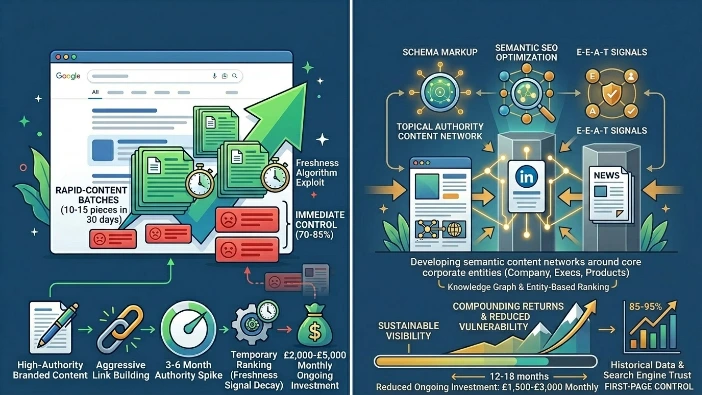
Short-term suppression delivers immediate SERP control within 3–6 months but requires continuous investment, while long-term authority building achieves sustainable visibility within 12–18 months with compounding returns and reduced ongoing costs.
Short-term suppression operates by publishing rapid-content batches (10–15 pieces in 30 days) with aggressive link building to achieve quick ranking improvements. The mechanism exploits Google’s freshness algorithm, which temporarily prioritises new content regardless of domain authority. Short-term suppression achieves 70–85% first-page control within 90 days but requires £2,000–£5,000 monthly ongoing investment to maintain position. When investment stops, negative content resurfaces within 2–4 months as freshness signals decay.
Long-term authority building operates by developing semantic content networks around core corporate entities (company name, executive names, product lines, locations) with interlinked content establishing topical authority. The mechanism leverages Google’s Knowledge Graph and entity-based ranking, where historical data, structured data, and entity associations signal trustworthiness. Authority building achieves 85–95% first-page control within 12–18 months with £1,500–£3,000 monthly ongoing investment after initial build-out. Results compound as historical data accumulates, reducing vulnerability to negative content.
Organisations should select short-term suppression when facing immediate existential threats (viral negative news, fake reviews constituting >50% of ratings, executive scandals actively damaging sales). Short-term suppression buys time for long-term authority building to take effect. Organisations with moderate reputation issues or no active crisis should prioritise long-term authority building for superior 3–5 year ROI.
UK businesses must also consider Search Perception Analysis: how different stakeholder groups interpret search results. Investors evaluate E-E-A-T signals (executive bios, financial reports, third-party coverage), customers prioritise review sentiment and response rates, job seekers assess employer brand on Glassdoor and LinkedIn. A single strategy cannot optimise for all audiences; corporate reputation management requires segmenting strategy by stakeholder group and query intent.
The most effective approach combines short-term suppression for immediate negative content displacement with long-term authority building for sustainable entity credibility. This hybrid model achieves 85–90% first-page control within 6 months while establishing historical data that reduces long-term vulnerability and cost. Organisations investing in this combined approach typically see reputation-related revenue protection worth 5–10× their annual reputation management investment through retained customers, reduced customer acquisition cost, and preserved enterprise value.
Get Detailed Information Here:
See How Our Reputation Management Process Works From Audit to Results
Frequently Asked Questions About Corporate Reputation Management
What is corporate reputation management and how does it work?
Corporate reputation management is the practice of monitoring, influencing, and protecting how stakeholders perceive an organisation online. A reputation management PR agency uses strategies like content creation, SEO suppression, review management, and crisis communication to shape search results and sentiment distribution across digital platforms.
How long does it take to see results from corporate reputation management?
Content suppression strategies typically show visible SERP improvements within 3–6 months, while long-term authority building requires 12–18 months for sustainable results. The timeline depends on the severity of negative content, domain authority of existing assets, and the competitiveness of branded search queries in your industry.
What’s the difference between content suppression and content removal in reputation management?
Content suppression pushes negative results off page one by outranking them with optimised positive content, while content removal deletes material at the source through legal takedowns or platform policy violations. Suppression works for 70–90% of cases including legitimate criticism, whereas removal succeeds in only 15–30% of cases when content violates laws or platform terms.
How much does corporate reputation management cost for UK businesses?
Corporate reputation management typically costs £1,500–£10,000 monthly depending on strategy scope, with suppression requiring £2,000–£5,000 monthly and authority building requiring £1,500–£3,000 monthly after initial build-out. Hybrid approaches combining both strategies cost £2,500–£6,000 monthly and deliver 85–90% first-page SERP control within 6 months.