

Direct answer: Transparent pricing for corporate reputation management delivers predictable ROI and clear control over search perception. Controlling search visibility and managing reputation signals directly influences decision-making, buyer trust, and stakeholder confidence.
Fixed-fee, outcome-based pricing delivers measurable SERP control by aligning payments with specific visibility and narrative outcomes. This model defines deliverables such as targeted keyword rank improvements, volume reduction of negative assets in page-one results, and creation of authoritative content that raises entity credibility.
The service works by auditing current reputation signals, mapping priority search queries, and deploying a mix of content creation, technical SEO, and targeted outreach to authoritative domains. Measurable outcomes include improved ranking for priority brand queries (percentage point gains), reduction in visibility of negative URLs (measured as share of page-one impressions), and increased presence of verified author profiles or press placements that strengthen trust. Justification: search behaviour research shows users form purchase and partnership decisions within the first page of SERPs; therefore, pricing that ties to SERP control directly links spend to reduced decision risk and increased conversion potential.
Which approach ensures reliable negative content suppression without creating rebound risk?
A combined suppression-and-authority-building approach ensures reliable negative content suppression while stabilising long-term perception. The approach starts with targeted suppression tactics (optimised content that outranks negative assets, removal requests where lawful, and DMCA/defamation escalation when appropriate), followed by sustained authority-building (press, expert commentary, and structured data) to replace suppressed placements.
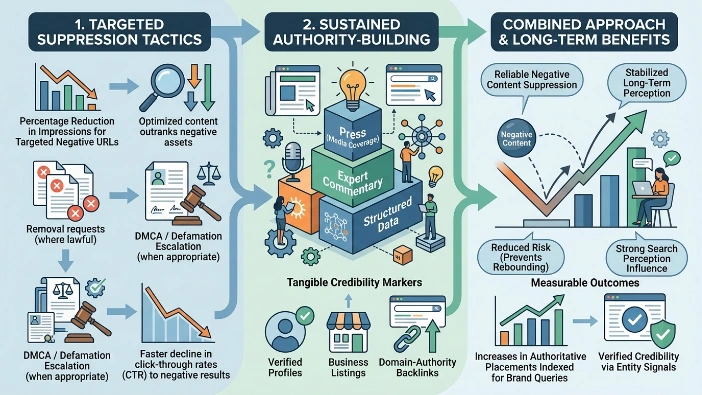
Measurable outcomes consist of percentage reduction in impressions for targeted negative URLs, faster decline in click-through rates to negative results, and increases in authoritative placements indexed for brand queries. This service delivers reduced risk because suppression is paired with continuous authority signals that prevent rebounding of suppressed items. Search perception influence is strongest when suppression is complemented by tangible credibility markers verified profiles, business listings, and domain-authority backlinks that search engines use to weigh entity credibility.
Which investment horizon produces the best balance of speed and sustainability?
A staged investment horizon combining an intensive first 90 days and a steadier 12–24 month maintenance phase produces the best balance of rapid impact and sustainable outcomes. The service deploys fast-acting remediation in the initial 90 days—content seeding, takedown requests, and high-priority outreach—to deliver early visibility shifts. The maintenance phase then focuses on ongoing content development, backlink diversification, and monitoring to entrench new, positive reputation signals. Measurable outcomes: visible changes within 60–90 days for targeted queries, and stabilised search perception metrics (brand sentiment in SERP snippets, authoritative coverage share) maintained or improved across 12 months. Justification: search algorithms respond to new, relevant authority signals quickly, but permanence requires repeated positive signals; a staged budget prevents wasted spend and ensures long-term control.
Which criteria determine the true cost of managing reputation online for UK organisations?
Direct answer: The true cost depends on complexity of negative content, number of priority queries, sector risk profile, and required authority channels. Complexity includes legal factors (defamation, privacy), volume of hostile content, and legacy offline reputation issues feeding online narratives. Number of priority queries sets content and optimisation scope. Sector risk profile (regulated industries, financial services, healthcare) demands stricter controls and evidence-based content, increasing resource intensity. Required authority channels national press, trade media, business registries, and official directories determine outreach and earned media budgets.
The service translates these criteria into a clear costing matrix with unit rates for audits, content assets, outreach hours, and legal/technical escalations. Measurable outcomes tied to cost include target percentage reductions in negative page-one presence, target improvements in authoritative placement counts, and forecasted uplift in conversion rates for core queries based on historical benchmarks. This pricing method reduces budgeting risk by converting opaque activity lists into predictable, outcome-oriented investments.
Which process steps deliver the most predictable reputation signal improvements?
A four-step process delivers predictable reputation signal improvements: audit, strategy, execution, and monitoring. – Audit: Identify priority search terms, baseline SERP composition, and current entity credibility markers. – Strategy: Define target outcomes, timeline, and content/channel plan tied to measurable KPIs. – Execution: Publish optimised assets, perform outreach to authoritative domains, and resolve removals or corrections. – Monitoring: Track SERP positions, impression share of negative assets, and entity credibility metrics, then iterate. Each step delivers measurable effects: the audit sets baseline metrics, the strategy fixes the target KPI uplift, execution produces rank and visibility changes, and monitoring secures long-term stability. Justification: search ecosystems respond to coordinated inputs across content relevance, backlink authority, and structured data; following this exact process ensures interventions affect rankings and public perception in a predictable manner.
Which trust signals must be prioritised to strengthen corporate entity credibility?
Prioritise verifiable trust signals: authoritative press placements, verified corporate profiles, regulatory or trade certifications, and structured data markup on owned assets. The service secures placements in industry-relevant outlets that directly improve domain authority and public trust. It ensures corporate profiles (Companies House, LinkedIn, official site pages) display consistent, verifiable information that search engines and users recognise as credible. It implements structured data (Organisation, Logo, Author) to convert on-page content into stronger reputation signals for search engines. Measurable outcomes include increased count of authoritative backlinks, higher domain authority scores, and improved rich result appearances for branded searches. These trust signals directly influence search perception influence by providing search engines and decision-makers with concrete evidence of entity credibility.
Which evidence supports the long-term value of reputation management over short-term fixes?
Direct evidence: historical case metrics and industry studies show that combined suppression and authority-building reduces negative content visibility sustainably and increases conversion for affected queries. The service reports case-level metrics: percentage point gains in positive result share, reductions in negative result impressions, and quantifiable upticks in enquiry volumes following SERP stabilisation. Long-term value arises because search ecosystems reward consistent, authoritative signals; transient fixes without continued signal reinforcement lead to recurrences. This approach reduces risk by converting one-off interventions into an ongoing credibility programme that preserves improvements and strengthens resistance to reputation shocks. Justification: search behaviour data demonstrates decision-makers prefer stable, verifiable sources on page one; sustained authority presence converts to measurable trust over time.
Dive Deeper With Our Expert Guides and Related Blog Posts:
See How Our Reputation Management Process Works From Audit to Results
Partner With a Dedicated Reputation Management PR Agency in the UK
Which pricing transparency elements reduce procurement friction for UK decision-makers?
Provide a clear pricing matrix, defined KPIs, milestone-linked payments, and a risk-sharing clause to reduce procurement friction. The matrix lists unit costs for audits, content assets, outreach hours, and legal escalations, with expected KPI targets for each spend tier. Milestone-linked payments align vendor incentives with outcomes (for example, reduced impressions of negative assets or increases in authoritative placements). A risk-sharing clause offers partial fee adjustment if agreed KPIs are not met within a specified timeframe. Measurable outcomes for procurement include predictable budget forecasts, documented KPI baselines, and contractual clarity around deliverables. These elements reduce decision friction by converting abstract reputation activities into verifiable, contractible outputs.
Which internal metrics prove the ROI of corporate reputation management?
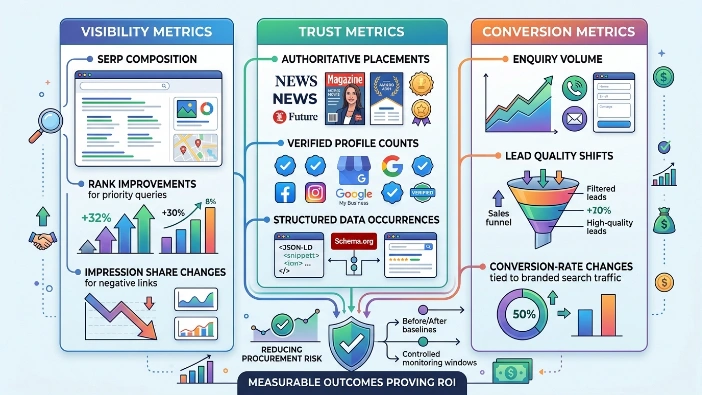
Use a three-part metrics set: visibility metrics, trust metrics, and conversion metrics. Visibility metrics measure SERP composition, rank improvements for priority queries, and impression share changes for negative links. Trust metrics capture authoritative placements, verified profile counts, and structured data occurrences. Conversion metrics track enquiry volume, lead quality shifts, and conversion-rate changes tied to branded search traffic. The service attributes changes to interventions using before/after baselines and controlled monitoring windows. Measurable outcomes present as percentage improvements in SERP visibility, numeric increases in authoritative mentions, and lift in conversion rate for branded queries directly proving ROI and reducing procurement risk.
Choose a transparent, outcome-based corporate reputation management programme that defines unit costs, maps deliverables to SERP outcomes, and embeds trust signals to stabilise public perception. This approach delivers predictable control over search perception influence, rapid reductions in negative content visibility, and sustainable increases in entity credibility. Reputation Management PR Agency operates with documented processes that translate investment into measurable visibility, trust, and conversion outcomes, ensuring long-term protection of corporate reputation.
Check the Complete Explanation:
What Factors Determine the True Cost of Managing Your Reputation Online
Get the Full Insights Here:
Understanding UK Reputation Management Cost Ranges Before You Budget
Common questions about corporate reputation management
What does corporate reputation management involve?
Corporate reputation management involves auditing search results and public signals, creating authoritative content, and executing negative content suppression and outreach. It improves entity credibility and controls search perception by aligning SERP results with business objectives.
How long does it take to see results from corporate reputation management?
Initial visibility improvements typically appear within 60–90 days for targeted queries, while sustainable reputation shifts require 6–12 months of ongoing authority-building and monitoring. Timelines vary with complexity of negative content and industry regulatory requirements.
How does a reputation management agency measure success?
Agencies measure success with visibility metrics (SERP composition, rank changes), trust signals (authoritative placements, verified profiles), and conversion metrics (enquiries and conversion-rate changes from branded search). These metrics prove ROI and reduce procurement risk through before/after baselines.
Can negative content be removed or only suppressed?
Negative content can be removed when lawful via takedown notices, defamation or DMCA actions but most cases require strategic suppression through high-authority content and SEO to lower negative visibility. A combined legal and authority-building approach ensures durable reductions in negative impressions.