

Requesting a custom pricing plan delivers a tailored corporate reputation management strategy that directly controls SERP visibility and restores entity credibility. Reputation management secures search perception influence by prioritising reputation signals and measurable outcomes.
Controlling search visibility matters because 90% of decision-makers inspect the first page; reputation signals on those pages determine trust and conversion. Reputation signals authoritative profiles, verified content, high-quality backlinks, and suppressed negative content drive public perception and commercial decisions.
Which reputation management approach delivers measurable results?
A targeted corporate reputation management plan delivers measurable SERP control and trust restoration.
A corporate reputation management service begins with an entity-audit that maps reputation signals across search results, social profiles, news, and third-party listings. The service implements a phased strategy: negative content suppression, authoritative content creation, technical SEO fixes, and proactive monitoring. Outcomes include improved first-page composition (increase in positive/neutral assets), reduced visibility of negative items, and strengthened entity credibility metrics such as knowledge panel accuracy and authoritativeness signals.
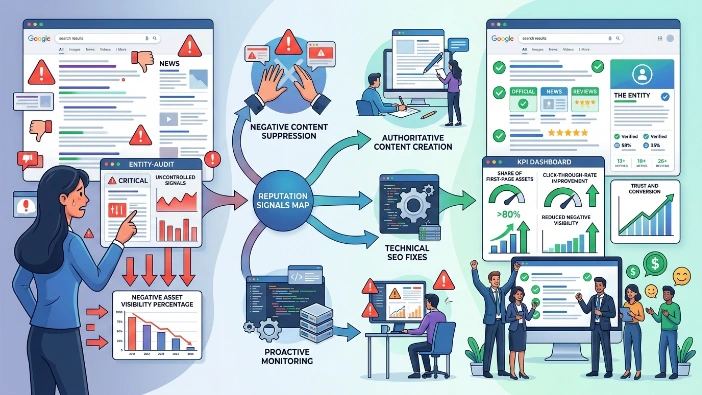
Users frequently rely on top-ranked pages and rich snippets to form judgements. By changing which assets occupy those positions, the service improves conversion likelihood for stakeholders and customers. Measurable KPIs include share of first-page assets (target uplift), click-through-rate improvement for branded queries, and reduction in negative-asset visibility percentage.
Which evidence proves reputation management improves rankings and visibility?
Robust evidence demonstrates that structured reputation work improves rankings, content visibility, and search perception influence.
Reputation management uses established SEO mechanisms content relevance, backlink authority, structured data, and suppression tactics to change ranking signals. For example, publishing authoritative corporate content with schema markup and securing links from industry publishers delivers improved relevance and authority, which search engines reward. Measurable effects include keyword rank gains for branded search phrases, increased impressions for brand-related queries, and higher placement of controlled assets in knowledge panels and SERP features.
Empirical outcomes track before-and-after SERP snapshots, rank progression reports, and traffic attribution to newly created, authoritative pages. These metrics demonstrate that reputation signals influence algorithmic and human evaluation of entities, stabilising perception and increasing trust among search users.
Which process ensures negative content suppression without legal overreach?
A compliant suppression process delivers reduced negative visibility while preserving legal and ethical standards.
The process begins with classification: identify defamatory content, situational negative content, and persistent third-party commentary. Then apply proportional techniques: publishing targeted positive assets to outrank negative pages, submitting takedown requests where content violates policy or law, and using technical measures such as canonicalisation and indexed replacements. Each step includes documented justification and escalation paths to minimise legal risk.
Measurable outcomes include a quantified reduction in impressions for negative URLs, removal or delisting where valid, and improved ranking share for controlled assets. This approach ensures search perception influence while reducing reputational risk and avoiding unnecessary legal exposure.
Which investment delivers the best long-term value: one-off fixes or a custom plan?
A custom pricing plan delivers superior long-term value by aligning interventions with business risk, search dynamics, and measurable reputation signals.
One-off fixes temporarily remove or suppress specific items but do not stabilise entity credibility or prevent recurrence. A custom plan builds sustainable defences: continuous monitoring, content pipelines, authority-building campaigns, and governance procedures for future incidents. Outcomes include persistent control of first-page assets, consistent trust metrics across stakeholder groups, and lower incremental cost per avoided incident over time.
Calculate cost per percentage-point reduction in negative asset visibility and project lifetime value gained from improved conversion rates due to higher entity credibility. This analysis shows that upfront investment in a tailored plan reduces cumulative reputation repair spending and stabilises public perception.
Which timelines produce visible impact and which sustain results?
Focused interventions deliver visible impact within weeks; sustained programmes stabilise results over months to years.
Initial suppression and content-promotion activities produce visibility shifts in 4–12 weeks for many search results, evidenced by rank tracking and impression changes. Authority-building (earned links, editorial placements) requires 3–12 months to materialise in durable ranking improvements. A maintenance phase—monitoring, reactive content creation, and governance—ensures stability beyond 12 months.
Measurable outcomes at each stage: short-term—reduction in negative URL impressions and improved branded click-through rates; medium-term—increased number of authoritative assets on page one and improved organic traffic to brand pages; long-term—sustained knowledge panel accuracy, stable sentiment in SERPs, and reduced incidence of new negative assets reaching prominence.
Which trust signals strengthen commercial credibility fastest?
Targeted trust signals deliver immediate credibility improvements and strengthen conversion funnels.
Implementing verified profiles (Google Business Profile, director/company pages), authoritative content (industry guides, press releases on trusted outlets), and structured data (organisation schema, author markup) improves both algorithmic entity recognition and user trust. Securing high-quality backlinks from recognised publications strengthens domain authority and signals endorsement to search engines.
Measurable outcomes include increased rich result appearances, higher dwell time on authoritative pages, and improved conversion rates from branded search. These trust signals directly improve entity credibility and reduce perceived risk among prospective customers and partners.
Dive Deeper With Our Expert Guides and Related Blog Posts:
Transparent Reputation Management Pricing Built Around Your UK Goals
See How Our Reputation Management Process Works From Audit to Results
Which risks are reduced by choosing a professional reputation management service?
Engaging a professional service reduces operational, legal, and perceptual risks by applying proven methodologies and oversight.
A professional service implements risk controls: documented escalation procedures, compliance checks for takedown requests, transparent reporting, and measurable remediation plans. This approach prevents missteps that can amplify negative visibility or create legal liability. Outcomes include reduced incidence of retaliatory publicity, fewer compliance breaches, and faster resolution times for emergent reputation incidents.
Reduce reputational, operational, and compliance risks with Reputation Management PR Agency that delivers structured remediation plans, transparent reporting, and proven crisis-response strategies. Professional reputation management helps businesses protect stakeholder trust, minimise negative visibility, and maintain stronger long-term brand credibility.
Which comparison criteria prevent being misled by pricing differences?
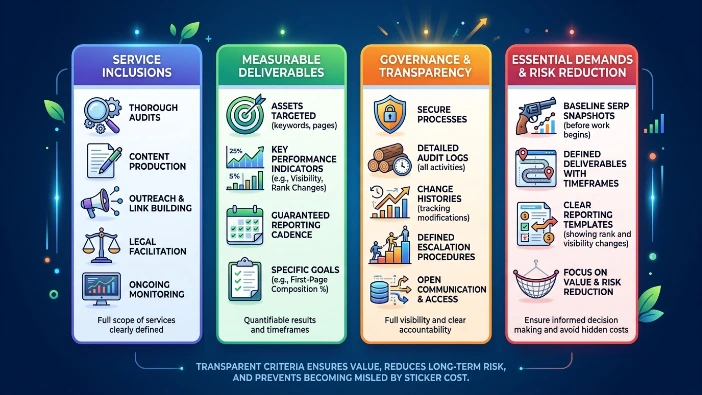
Transparent criteria prevents misunderstanding and ensures informed decisions when comparing agency pricing. Identify whether price includes audits, content production, outreach, legal facilitation, and ongoing monitoring. Assess measurable deliverables: number of assets targeted, guaranteed reporting cadence, and specific KPIs (first-page composition, visibility reduction percentages). Verify governance and transparency: audit logs, change histories, and escalation procedures. Cheaper options omit key reputation signals work and increase long-term risk; transparent plans specify mechanisms and outcomes.
Demand baseline SERP snapshots, defined deliverables with timeframes, and a clear reporting template showing rank and visibility changes. This ensures price comparison emphasises value and risk reduction rather than sticker cost.
Learn Everything About It Here:
Why Reputation Management Pricing Varies So Much Across UK Agencies
Get Detailed Information Here:
How to Compare Reputation Management Pricing Without Getting Misled
A custom corporate reputation management plan delivers controllable SERP outcomes, restores entity credibility, and reduces long-term reputational risk through proven reputation signals and measurable processes. Choose a structured plan that specifies deliverables, timelines, and KPIs to ensure predictable outcomes and sustained search perception influence.
Common questions about corporate reputation management
What is corporate reputation management and how does it affect my business online?
Corporate reputation management is the practice of controlling and improving how your organisation appears in search results, news, and social channels. It affects customer trust, partner decisions, and conversion rates by shaping the reputation signals that search engines and users rely on.
How long does it take for corporate reputation management to improve search results?
Initial visibility improvements often appear within 4–12 weeks after targeted suppression and authoritative content publication, while durable ranking and authority gains typically require 3–12 months of ongoing optimisation and outreach. Timelines depend on existing negative content severity, competitive signals, and link acquisition speed.
What metrics should I track to measure success in corporate reputation management?
Track percentage of positive/neutral first‑page assets, branded query click‑through rate, organic traffic to controlled pages, and reduction in impressions for negative URLs. Supplement SEO metrics with business outcomes like lead conversion rate from branded search and stakeholder sentiment.
Can a corporate reputation management service legally remove negative content from third‑party sites?
Removal is possible only when content violates platform policies or law; otherwise professional services focus on negative content suppression through outranking, takedown requests where justified, and technical strategies. Legal takedowns require documented evidence and often coordination with legal counsel.