

Reputation management is a specialised subset of search-orientated optimisation that focuses on how entities are perceived across search ecosystems. Online reputation refers to the aggregate of indexed content, review signals, and algorithmic evaluations that together form an entity’s public standing in search results.
Reputation Management SEO is a discipline that defines strategies to shape entity perception within search ecosystems; Traditional SEO refers to tactics that increase traffic and rankings for query intent. Reputation management SEO prioritises controllable reputation signals over volume metrics. Traditional SEO targets keyword-driven visibility; reputation SEO targets perception-driven visibility.
Reputation Management SEO operates by identifying reputation signals, mapping their sources, and altering the content and technical structures that contribute to those signals. The mechanism includes auditing indexed assets, adjusting metadata to alter snippet presentation, and orchestrating content distribution to change SERP composition. The impact on search visibility is measured by shifts in SERP evaluation, changes in snippet content, and movement in the prominence of favourable versus unfavourable entities on results pages.
Reputation management SEO changes search outcomes by reweighting the types of content that appear in search results (profiles, news, reviews, and knowledge panels). Traditional SEO improves rank for target queries; reputation management modifies which entity representations rank and how they are framed to query users, thus directly influencing entity perception.
How is reputation formed within search engines?
Reputation is the emergent aggregate of indexed content, backlink topology, review metadata, and structured data that search systems evaluate to determine entity standing. Reputation refers to the composite signal that algorithms derive from those discrete inputs within search ecosystems.
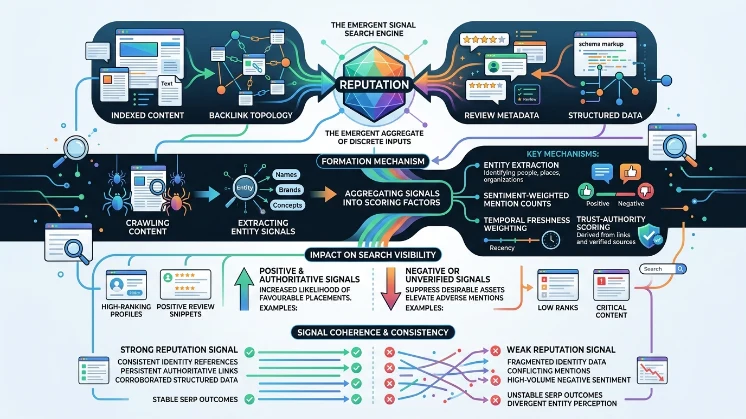
Search engines form reputation by crawling content, extracting entity signals, and aggregating signals into scoring factors used during ranking. The mechanism includes entity extraction, sentiment-weighted mention counts, temporal freshness weighting, and trust-authority scoring derived from link networks and verified sources. The impact on search visibility is that positive, authoritative signals increase the likelihood of favourable placements (e.g. high-ranking profiles, positive review snippets), while negative or unverified signals suppress desirable assets and elevate adverse mentions.
Reputation formation depends on signal coherence: consistent identity references, persistent authoritative links, and corroborated structured data produce stronger reputation signals. Fragmented identity data, conflicting mentions, and high-volume negative sentiment create divergent entity perception and unstable SERP outcomes.
How do algorithms interpret trust and credibility for reputation signals?
Search algorithms evaluate trust and credibility through defined heuristics that quantify provenance, corroboration, and authority. Trust is a score derived from source authority, link endorsement patterns, and verified metadata; credibility is a composite of content accuracy indicators and corroborative references.
Algorithms extract trust signals by measuring domain authority proxies, schema presence (e.g. organisation, person), cross-source citation, and historical content stability. Mechanistically, systems compute entity graphs linking mentions to authoritative nodes; they apply weightings for known publishers, verified accounts, and review platforms. The impact on search visibility is that higher trust and credibility scores increase the probability of content being surfaced in primary SERP features (e.g. knowledge panels, featured snippets) and reduce the visibility of uncorroborated or low-trust content.
Search systems penalise contradictory identity signals by downgrading content when entity attribution is unclear. Algorithms favour content with explicit provenance, verifiable claims, and consistent schema markup, thereby elevating assets that demonstrate credibility across multiple independent sources.
How does content influence entity perception in search results?
Content is the primary medium through which entity attributes are signalled to search ecosystems; content defines topical context, sentiment orientation, and explicit descriptive attributes that feed entity perception. Content refers to indexed text, multimedia, review entries, and structured metadata within search ecosystems.
Content influences perception by providing the signals that algorithms index: keyword context establishes topical relevance; sentiment-laden language contributes to polarity assessments; anchor text and surrounding links contribute to endorsement context. The mechanism includes natural language processing (NLP) for entity recognition, sentiment analysis engines for polarity scoring, and entity-cooccurrence metrics for contextual association. The impact on search visibility is that well-structured, authoritative content raises the prominence of desired narratives, while poorly structured or adversarial content increases the visibility of undesired narratives.
Search systems integrate content signals into entity profiles; repeated, consistent messaging across high-authority sources consolidates desired attributes into the entity’s searchable representation, altering SERP evaluation and snippet composition in favour of those attributes.
How do review signals and sentiment interpretation affect search reputation?
Review signals are explicit user-generated endorsements that feed sentiment analysis models; sentiment interpretation defines polarity scores that alter aggregate reputation. Review signals refer to star ratings, textual reviews, and platform-level metadata within search ecosystems.
Search engines parse reviews to extract structured ratings and natural language sentiment. The mechanism includes extracting rating values (numeric), deriving sentiment vectors from review text, and correlating temporal review velocity with signal credibility. Engines weight verified reviews and reputed platforms more heavily than anonymous, low-trust sources. The impact on search visibility is that consistently positive review signals increase the likelihood of positive review snippets appearing in SERPs and elevate associated content; sustained negative review signals promote adverse assets and reduce trust-related placements.
Search systems also evaluate review authenticity signals (reviewer history, review diversity, and IP/geolocation consistency). Reviews that demonstrate high authenticity increase their influence on reputation scoring; low-authenticity signals receive minimal weight or trigger trust filters, reducing their effect on SERP evaluation.
What role do authority and trust signals play in search reputation?
Authority and trust signals are quantifiable indicators that determine the weight of content and references in algorithmic ranking; authority refers to endorsement strength from other entities, and trust refers to provenance and verification quality. Authority and trust signals refer to link profiles, domain reputation, verified metadata, and publication provenance within search ecosystems.
Mechanistically, search engines compute link-based authority via network analysis algorithms that assess link quality, topical relevance, and anchor text semantics. Trust is computed via provenance verification (e.g., schema.org verification, backlinks from verified sources) and historical consistency of entity references. The impact on search visibility is significant: high-authority and high-trust signals accelerate content indexing into primary SERP features and increase resistance to demotion by competing negative signals.
Strengthen brand credibility with professional Corporate Reputation Management that enhances authority and trust signals across search ecosystems. By building credible content, authoritative references, and verified digital assets, businesses can improve SERP visibility, reinforce entity trust, and maintain a stronger online reputation.
How do SERP evaluation and content indexing determine what users see?
SERP evaluation is the process by which search systems rank and present result items based on query intent and entity scoring; content indexing is the technical ingestion and parsing of content that supplies those signals. SERP evaluation refers to ranking heuristics, feature allocation, and snippet generation within search ecosystems.
Content indexing begins with crawling, followed by canonicalisation, entity extraction, and metadata parsing. The mechanism includes content classification into topical clusters, entity resolution against knowledge graphs, and snippet selection based on relevance scoring. SERP evaluation uses combined scores—relevance, authority, trust, and sentiment—to allocate positions and features. The impact on search visibility is that indexed content with optimal metadata and clear entity signals is more likely to appear in high-visibility SERP features, while unindexed or poorly indexed content remains absent or demoted.
Search systems adjust SERP composition dynamically, emphasising freshness for time-sensitive queries and stability for evergreen reputational queries. Accurate indexing and clean canonical signals therefore directly increase the chance that desired representations surface prominently.
Dive Deeper With Our Expert Guides and Related Blog Posts:
Why Search Result Reputation Management Starts With Understanding What Ranks
How SEO Is Used to Push Down Negative Search Results for Names and Brands
How does a digital footprint contribute to brand or entity reputation?
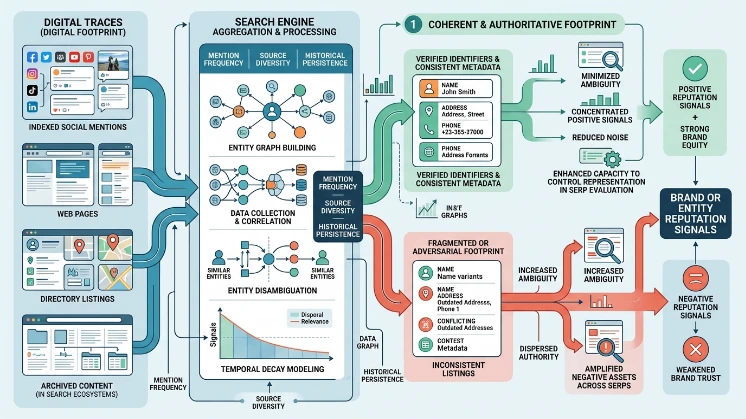
A digital footprint is the collection of publicly available digital traces that reference an entity; it forms the substrate from which reputation signals are extracted. Digital footprint refers to indexed social mentions, web pages, directory listings, and archived content within search ecosystems.
Search engines aggregate the digital footprint into entity graphs that capture mention frequency, source diversity, and historical persistence. The mechanism includes cross-source correlation, entity disambiguation, and temporal decay modelling. The impact on search visibility is that a coherent, authoritative footprint concentrates positive signals and reduces noise, while a fragmented or adversarial footprint disperses authority and amplifies negative assets across SERPs.
Systems value footprints with verified identifiers and consistent metadata; inconsistent listings (name variants, outdated addresses) increase ambiguity and decrease the entity’s capacity to control representation in SERP evaluation.
What constitutes brand/entity credibility in search ecosystems?
Brand credibility is a measurable composite of verified identity, corroborative authority, and consistent, accurate public information. Brand/entity credibility refers to the presence of corroborated facts, high-quality third-party references, and persistent authoritative content within search ecosystems.
Credibility manifests through mechanisms such as schema-verified profiles, persistent backlinks from reputable domains, and positive review patterns. Search engines evaluate credibility by cross-checking claimed facts against trusted sources and weighting corroborative evidence heavily. The impact on search visibility is direct: high credibility yields elevated placement in knowledge features and decreases the visibility of contradictory content during SERP evaluation.
Entities with clear, verifiable identifiers (structured data, verified profiles) produce stronger credibility signals. Lack of verification, conflicting public records, and uncorroborated claims weaken credibility and amplify the effect of negative or ambiguous assets.
Get the Full Insights Here:
What Reputation Management SEO Involves Across Content Links and Technical Setup
Reputation Management SEO is an analytical discipline that defines and manipulates the signals search engines use to form entity perception. It focuses on indexed content, authority and trust signals, review sentiment, digital footprint coherence, and structured data integrity. Algorithms interpret these inputs through entity graphs, credibility heuristics, and sentiment models to produce SERP evaluation outcomes that shape public perception. Understanding these mechanisms allows practitioners to evaluate which assets influence reputation, prioritise signal consolidation, and forecast changes in search visibility without relying on generic tactics orientated solely to traffic.
Answers to Key Questions
How does Corporate Reputation Management differ from general PR?
Corporate Reputation Management focuses on shaping entity perception across search ecosystems and digital channels, while general PR targets media relations and public messaging. It prioritises reputation signals, content indexing, and SERP evaluation to protect and enhance online credibility.
What core components make Corporate Reputation Management effective?
Effective Corporate Reputation Management combines content optimisation, structured data (schema), review management, backlink quality control, and entity resolution. These components create coherent reputation signals that improve search visibility and authoritative presence.
How long does it take to see changes in search visibility from reputation work?
nitial indexing and snippet changes can appear within weeks, while measurable SERP evaluation shifts and authority gains generally require three to six months. Timeframes depend on baseline trust signals, content quality, and the velocity of authoritative endorsements.
Which online signals most influence corporate reputation in search engines?
The most influential signals are verified structured data, high-quality backlinks from reputable sites, consistent NAP and identity metadata, and aggregated review sentiment. Search algorithms evaluate these signals together to compute entity perception and ranking weight.
How should organisations prioritise content to improve online credibility?
Organisations should prioritise authoritative pages with clear entity identifiers, corroborative third-party references, and well-structured content targeting relevant reputation keywords. Prioritisation of high-trust assets accelerates positive SERP placements and reduces exposure to adverse mentions.