

Reputation management typically spans 3–12 months, with distinct milestones at the diagnosis, content creation, SERP adjustment, and maintenance stages. Corporate reputation management timelines vary by severity of damage, entity size, and search ecosystem complexity.
Reputation management strategies differ based on the underlying reputation signals, entity credibility, and the current sentiment distribution in search results. Online reputation control methods are evaluated through their impact on search ranking influence, content suppression versus content enhancement mechanisms, and long-term sustainability of trust signals. This analysis compares approaches, evaluates effectiveness, and explains how search engines interpret reputation signals across different strategic options.
How Long Does the Initial Diagnosis and Audit Stage Take and What Milestones Mark Its Completion
The diagnosis and audit stage lasts 2–4 weeks and concludes when you have a complete reputation signal map, identified negative content clusters, and a prioritised remediation plan. This stage operates by collecting data from search engines, review platforms, social media, and news sources to establish baseline sentiment distribution and entity credibility metrics.
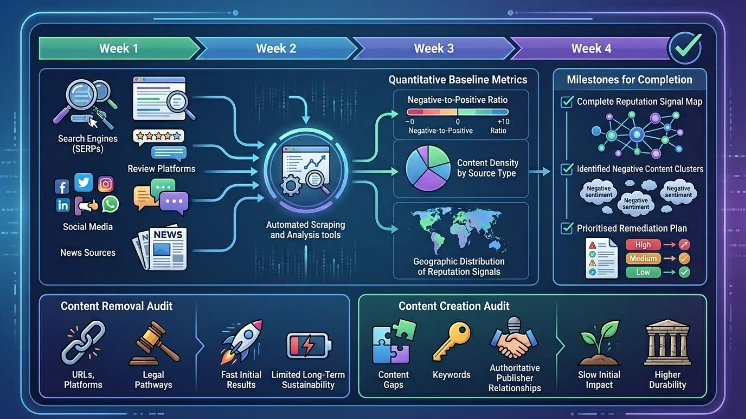
Reputation audits operate by mapping all visible digital assets associated with an entity and measuring sentiment polarity across sources. The mechanism involves automated scraping of SERPs, review site aggregation, social media sentiment analysis, and news archive searches. This produces a quantitative baseline showing negative-to-positive ratio, content density by source type, and geographic distribution of reputation signals.
Start with a comprehensive assessment through professional Corporate Reputation Management that identifies reputation risks, sentiment trends, and search visibility challenges. A structured audit and remediation plan helps businesses prioritise actions, strengthen entity credibility, and build a foundation for long-term reputation improvement.
What Are the Timeline and Milestones for the Content Creation and Suppression Stage
The content creation and suppression stage spans 4–8 weeks for initial SERP movement and 8–12 weeks for stable composition changes. This stage operates by publishing positive content at high velocity while simultaneously requesting removal of negative content through platform policies or legal channels.
Content creation mechanisms include publishing press releases, blog posts, expert articles, case studies, and multimedia assets targeting high-value keywords related to the entity. These assets distribute positive reputation signals across the web, which search engines aggregate to recalibrate sentiment distribution. The process requires semantic alignment with entity identity, authoritative hosting domains, and consistent internal linking to strengthen content authority.
Content suppression works through three mechanisms: platform-led removal (policy violations), legal-led removal (defamation, privacy breaches), and search-engine-led devaluation (low-quality signals, outdated content). Platform removal is fastest (1–3 weeks) but limited to explicit policy breaches. Legal removal takes 4–12 weeks and depends on jurisdiction, evidence strength, and court timelines. Search devaluation occurs organically as new positive content gains authority, reducing visibility of negative content without explicit removal.
Comparative analysis shows content creation outperforms suppression in long-term sustainability and scalability. Suppression delivers quicker initial milestones but creates dependency on external platforms and legal systems. Creation builds autonomous reputation infrastructure that compounds over time. However, creation alone may not address severe active damage, requiring hybrid strategies for crisis scenarios.
Search ranking influence shifts as positive content accumulates authority. Early milestones include first positive article ranking for branded queries, followed by displacement of negative content from position 1–3. Later milestones show positive content dominating position 1–5, with negative content pushed to position 8+ or removed entirely. Sentiment distribution recalibrates from negative-heavy to balanced or positive-heavy within 6–10 weeks for moderate cases.
How Do Organic and Reactive Reputation Management Approaches Differ in Timeline and Effectiveness
Organic reputation management takes 6–12 months for full impact and operates through systematic content accumulation, review generation, and authority building. Reactive reputation management takes 2–6 months for crisis resolution and operates through immediate content suppression, rapid response publishing, and legal interventions.
Organic approaches build entity credibility incrementally by publishing consistent high-quality content, cultivating positive reviews, and securing third-party endorsements. The mechanism relies on search engines recognising sustained positive signal density, which improves trust scores and ranking stability. This approach measures success through long-term sentiment distribution stability, domain authority growth, and reduced negative content visibility over 12+ months.
Reactive approaches address acute reputation damage by prioritising speed over systematisation. The mechanism involves rapid content removal requests, emergency positive content publication, and direct engagement with negative sources. This approach measures success through immediate reduction in negative search visibility, sentiment recalibration within 3–6 months, and crisis containment.
| Dimension | Organic Approach | Reactive Approach |
|---|---|---|
| Timeline | 6–12 months | 2–6 months |
| Primary mechanism | Authority accumulation | Damage containment |
| Scalability | High (systematic) | Medium (crisis-dependent) |
| Sustainability | High (compounding) | Medium (plateaus after crisis) |
| Risk exposure | Low | Medium–High (legal/platform risk) |
| Search ranking influence | Gradual increase | Rapid displacement |
Organic approaches demonstrate superior sustainability because they build autonomous reputation infrastructure independent of external removal pathways. Reactive approaches show higher risk exposure due to legal uncertainty, platform policy variability, and potential reputational backlash from aggressive suppression tactics. For corporate reputation management, organic strategies form the foundation while reactive tactics address acute incidents.
Hybrid models combine organic momentum with reactive responsiveness, achieving faster initial milestones than pure organic approaches while maintaining long-term sustainability. The hybrid mechanism allocates 70% resources to content creation and 30% to suppression, balancing speed and durability.
Dive Deeper With Our Expert Guides and Related Blog Posts:
How SERM Search Engine Reputation Management Campaigns Are Built and Measured
What Reputation Management SEO Involves Across Content Links and Technical Setup
What Determines the Duration and Success of the SERP Stabilisation and Maintenance Stage
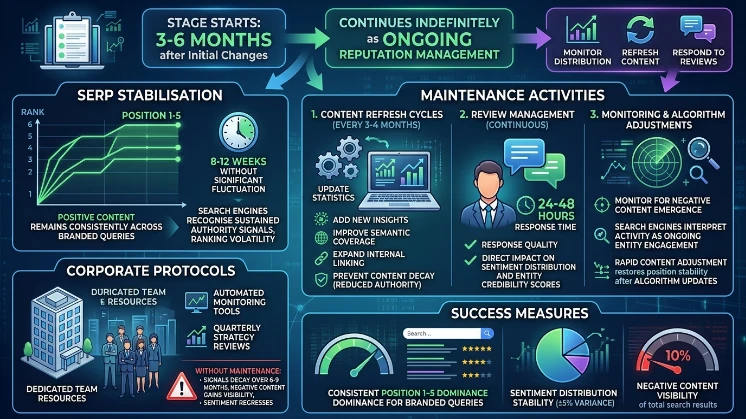
The SERP stabilisation and maintenance stage lasts 3–6 months after initial composition changes and continues indefinitely as ongoing reputation management. This stage operates by monitoring sentiment distribution, refreshing positive content, responding to new reviews, and adjusting content strategy based on search engine algorithm updates.
SERP stabilisation occurs when positive content maintains position 1–5 consistently across branded queries for 8–12 weeks without significant fluctuation. The mechanism involves search engines recognising sustained authority signals, which reduce ranking volatility. Maintenance activities include publishing monthly content updates, engaging with new reviews within 24–48 hours, monitoring for negative content emergence, and refreshing underperforming assets.
Content refresh cycles operate every 3–4 months to maintain relevance and authority. The mechanism involves updating statistics, adding new insights, improving semantic coverage, and expanding internal linking. This prevents content decay, which search engines interpret as reduced authority. Review management operates continuously, with response time and quality directly impacting sentiment distribution and entity credibility scores.
Search engines interpret maintenance activity as ongoing entity engagement, which strengthens trust signals. Algorithm updates may temporarily disrupt stabilised SERPs, requiring rapid content adjustment to restore position stability. Maintenance success measures include consistent position 1–5 dominance for branded queries, sentiment distribution stability (±5% variance), and negative content visibility below 10% of total search results.
Corporate reputation management requires institutionalised maintenance protocols, including dedicated team resources, automated monitoring tools, and quarterly strategy reviews. Without maintenance, reputation signals decay over 6–9 months, allowing negative content to regain visibility and sentiment distribution to regress. Sustainable reputation management treats maintenance as continuous investment rather than one-time completion.
How Do Short-Term and Long-Term Reputation Management Strategies Compare in Impact and Scalability
Short-term reputation management delivers results in 2–4 months through aggressive suppression and rapid content publication but lacks scalability and sustainability. Long-term reputation management delivers results in 6–12 months through systematic authority building and demonstrates high scalability and enduring impact.
Short-term strategies prioritise immediate visibility changes over structural reputation improvement. The mechanism involves targeted content removal, emergency press releases, and concentrated review generation campaigns. This approach achieves faster initial milestones but plateaus after 3–4 months, requiring ongoing reactive intervention to maintain results. Scalability is limited by resource intensity and platform/legal dependency.
Long-term strategies prioritise structural reputation infrastructure over immediate visibility. The mechanism involves consistent content production, authoritative publisher relationships, systematic review cultivation, and semantic content network development. This approach achieves slower initial milestones but compounds over time, reducing marginal cost per reputation signal improvement. Scalability is high due to systematic processes and autonomous reputation infrastructure.
| Metric | Short-Term Strategy | Long-Term Strategy |
|---|---|---|
| Initial impact timeline | 2–4 months | 6–12 months |
| Sustainability | Low (6–9 month decay) | High (compounding) |
| Scalability | Medium (resource-intensive) | High (systematic) |
| Risk exposure | High (legal/platform) | Low (organic growth) |
| Cost efficiency | Low (recurring intervention) | High (diminishing marginal cost) |
| Search ranking influence | Rapid but volatile | Gradual but stable |
Long-term strategies demonstrate superior cost efficiency because initial investment builds infrastructure that requires diminishing marginal input for maintenance. Short-term strategies incur recurring costs for ongoing intervention, creating unsustainable financial models for corporate reputation management. Risk exposure differs significantly: short-term strategies face legal uncertainty and platform policy volatility, while long-term strategies rely on organic authority building with minimal external dependency.
Read More to Understand Better:
Get a Realistic Timeline for Your Reputation Management Before You Start
For entities requiring immediate crisis resolution, short-term tactics provide necessary rapid response. However, sustainable reputation management requires a transition to long-term strategies within 3–6 months to prevent regression. The optimal approach combines short-term crisis containment with long-term infrastructure development, achieving both immediate impact and enduring stability.
Answers to Key Questions
How long does corporate reputation management take to show results?
Corporate reputation management typically takes 3–12 months to show measurable results, with initial SERP changes appearing in 2–4 weeks. The Reputation Management PR Agency timeline varies based on damage severity, entity size, and whether you use content creation versus removal strategies.
What are the main methods used in corporate reputation management?
Corporate reputation management uses two primary methods: content creation (publishing positive assets) and content suppression (removing negative content). The Reputation Management PR Agency combines both in a hybrid approach, with creation offering better long-term sustainability and suppression delivering faster initial impact.
Is organic reputation management better than reactive approaches for businesses?
Organic reputation management builds sustainable entity credibility over 6–12 months through systematic content accumulation, while reactive approaches address acute damage in 2–6 months through rapid suppression. The Reputation Management PR Agency recommends organic strategies as your foundation, using reactive tactics only for crisis containment.
What milestones should I expect during each stage of reputation management?
Corporate reputation management has four stages: diagnosis (2–4 weeks), content creation/suppression (4–12 weeks), SERP stabilisation (3–6 months), and ongoing maintenance. Key milestones include first positive content ranking for branded queries, displacement of negative content from positions 1–3, and consistent position 1–5 dominance.