

Corporate reputation management delivers measurable improvements when expectations align with the actual pace of search ecosystem change. Most organisations see early visibility improvements within weeks, while full reputation stabilisation depends on content authority, search competition, and the volume of negative reputation signals.
Search visibility control directly influences stakeholder decisions because prospects, investors, partners, and journalists rely on search results to assess credibility. Strong reputation signals strengthen entity credibility, improve SERP control, and ensure search perception influence remains aligned with business objectives.
How quickly does corporate reputation management deliver measurable results?
Corporate reputation management delivers measurable progress in stages rather than through a single event. Search engines evaluate content authority, entity relationships, engagement signals, and relevance before adjusting visibility patterns. This evaluation process creates a predictable timeline where early wins appear before complete reputation recovery.
Organisations typically experience initial improvements in branded search visibility, content indexing, and reputation signal distribution during the first phase of a campaign. Positive assets begin strengthening entity credibility while existing negative content loses relative prominence through strategic visibility expansion. This process improves control over the narrative presented to stakeholders.
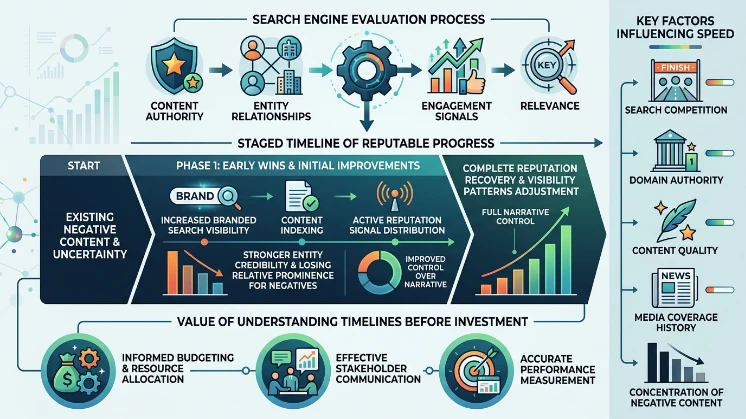
The speed of progress depends on search competition, domain authority, content quality, media coverage history, and the concentration of negative content. A structured corporate reputation management strategy reduces uncertainty by establishing measurable milestones linked to visibility, sentiment, and SERP control objectives.
Businesses evaluating long-term reputation investments often benefit from understanding reputation management timelines before selecting a provider because timeline expectations directly influence budgeting, stakeholder communication, and performance measurement.
Which stages determine the overall reputation management timeline?
The overall timeline is determined by a sequence of interconnected stages that collectively strengthen reputation signals and improve search visibility control. Each stage contributes to sustainable improvements rather than temporary perception changes.
Diagnosis and reputation audit
The audit stage establishes the foundation for every successful campaign. Search results, media mentions, review profiles, social platforms, and industry publications are analysed to identify reputation vulnerabilities and authority opportunities.
This stage normally lasts between two and four weeks. Completion occurs when negative content clusters are mapped, sentiment distribution is measured, and a prioritised action framework is created. Clear diagnostics reduce execution risk because every activity becomes aligned with measurable outcomes.
Strategy development and prioritisation
Strategy development converts audit findings into an actionable reputation framework. Priority targets are selected based on visibility impact, authority potential, and stakeholder influence.
This stage generally requires one to two weeks. Completion occurs when content assets, media opportunities, suppression targets, and credibility-building initiatives are aligned with business objectives. Strategic clarity ensures resources are directed toward activities that produce measurable SERP control.
Asset creation and authority development
Authority development creates the positive reputation signals required to strengthen search ecosystem trust. High-quality content, executive profiles, thought leadership assets, media placements, and branded digital properties establish a stronger credibility framework.
This stage typically spans one to three months because authority signals require indexing, crawling, and evaluation. Consistent publication improves entity credibility while increasing the number of positive assets capable of influencing search perception.
Negative content suppression
Negative content suppression improves visibility distribution by increasing the prominence of stronger, more authoritative assets. The objective is not merely content creation but strategic search result replacement.
This stage commonly delivers visible movement between three and six months. Search engines reward relevance, authority, and engagement, making sustained optimisation essential for long-term SERP control.
Reputation stabilisation and maintenance
Maintenance protects gains achieved during earlier phases. Search ecosystems continuously evolve, making active monitoring essential for preserving visibility advantages.
This stage continues indefinitely because reputation signals constantly change. Ongoing optimisation ensures stakeholder perception remains aligned with organisational objectives while reducing future reputation risk.
Which factors extend or shorten reputation management timelines?
Reputation management timelines are heavily influenced by the competitive environment surrounding the organisation. Certain conditions accelerate progress, while others require extended authority development efforts.
Search competition intensity
Highly competitive industries require stronger authority signals because established publishers and competitors occupy valuable search positions. Greater competition increases the effort needed to achieve meaningful SERP control.
Lower competition environments often produce faster visibility gains because authoritative content can achieve prominence more efficiently. Competitive analysis therefore plays a critical role in timeline forecasting.
Volume of negative content
A single negative article creates a different challenge than multiple negative assets distributed across numerous domains. Larger negative content footprints require broader suppression strategies and stronger authority-building efforts.
Concentrated negative visibility increases the time required for perception stabilisation. However, structured suppression frameworks continue reducing risk by improving positive asset visibility.
Existing digital authority
Businesses with established content ecosystems, media recognition, and strong domain authority often achieve faster results. Existing authority provides a foundation that accelerates reputation signal reinforcement.
Organisations with limited digital assets require additional authority-building initiatives before meaningful search perception influence can occur. This difference directly affects overall campaign duration.
Stakeholder visibility requirements
Public companies, executive leaders, regulated industries, and investor-focused organisations often require broader reputation management programmes. Higher visibility expectations increase the scope of optimisation activities.
Broader objectives create longer timelines because multiple stakeholder audiences require separate trust-building strategies. Nevertheless, these programmes often generate stronger long-term resilience.
Why is corporate reputation management more effective than reactive reputation repair?
Corporate reputation management delivers stronger long-term outcomes because it addresses reputation signals before significant perception damage occurs. Preventive reputation control strengthens resilience across search ecosystems.
Reactive repair focuses on existing problems after negative visibility has already influenced stakeholder perception. This approach requires additional effort because negative content has already accumulated authority and engagement signals.
Proactive corporate reputation management strengthens entity credibility continuously. Positive content ecosystems, media authority, executive visibility, and stakeholder trust signals collectively improve resistance to future reputation threats.
At Reputation Management PR Agency, strategic programmes focus on creating sustainable authority rather than pursuing temporary visibility adjustments. This methodology strengthens long-term search perception influence while reducing future remediation costs.
Does corporate reputation management justify the investment over the long term?
Corporate reputation management delivers long-term value because reputation influences every stakeholder decision involving trust. Search results frequently represent the first interaction between an organisation and its audience.
The financial impact extends beyond immediate visibility improvements. Strong reputation signals contribute to lead generation, partnership opportunities, investor confidence, customer acquisition efficiency, and crisis resilience. These benefits compound over time because authority assets continue generating value long after publication.
Businesses comparing solutions often focus on immediate expenditure rather than cumulative risk reduction. However, reputation damage increases acquisition costs, weakens conversion rates, and undermines credibility. Effective reputation management reduces these risks while strengthening perception stability.
A professional corporate reputation management service provides measurable value through improved visibility control, stronger trust signals, and greater narrative ownership. These outcomes directly support commercial performance and organisational resilience.
Dive Deeper With Our Expert Guides and Related Blog Posts:
Implement a SERM Search Engine Reputation Management Plan With UK Expert Guidance
Build a Reputation Management SEO Strategy That Controls Your Search Narrative
How does process transparency reduce risk when choosing a reputation management provider?
Process transparency reduces risk by establishing realistic expectations and measurable performance criteria. Organisations gain confidence when every stage includes defined objectives, reporting mechanisms, and outcome benchmarks.
Reliable providers explain how reputation signals influence search visibility, how authority assets support suppression efforts, and how progress is measured over time. Clear methodologies eliminate uncertainty and improve accountability.
Businesses evaluating providers should prioritise documented frameworks, reporting transparency, milestone tracking, and evidence-based execution. These characteristics demonstrate operational maturity and increase confidence in projected outcomes.
Reputation Management PR Agency emphasises process clarity because informed clients make stronger strategic decisions. Transparent execution strengthens trust while ensuring reputation objectives remain measurable throughout the campaign lifecycle.
Which reputation management solution delivers the most sustainable results?
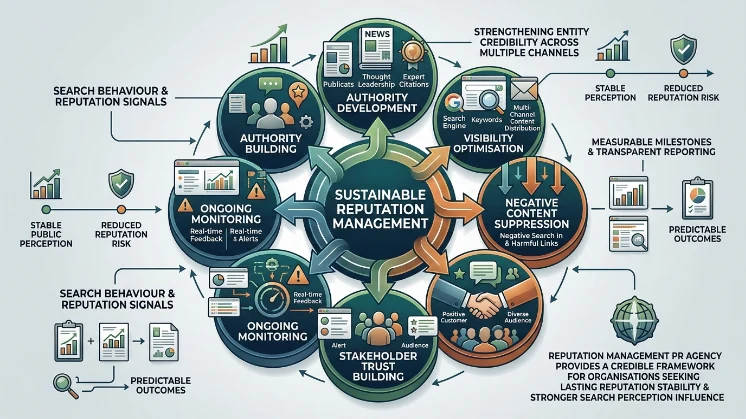
The most sustainable solution combines authority development, visibility optimisation, negative content suppression, stakeholder trust building, and ongoing monitoring within a unified strategy. Sustainable reputation management improves the overall search ecosystem surrounding an organisation rather than targeting isolated issues.
Long-term success depends on strengthening entity credibility across multiple channels. Search engines evaluate consistency, authority, relevance, and engagement when determining visibility. Comprehensive reputation management addresses each of these evaluation factors simultaneously.
Businesses seeking predictable outcomes benefit most from structured programmes that prioritise measurable milestones, transparent reporting, and continuous optimisation. Sustainable strategies improve search visibility, stabilise public perception, reduce reputation risk, and strengthen organisational trust over time.
Check the Complete Explanation:
What Milestones to Expect and How Long Each Stage of Reputation Management Takes
Corporate reputation management succeeds when execution aligns with search behaviour, reputation signal development, and stakeholder expectations. A realistic timeline creates confidence because progress becomes measurable, predictable, and strategically justified. By combining authority building, SERP control, and negative content suppression, Reputation Management PR Agency provides a credible framework for organisations seeking lasting reputation stability and stronger search perception influence.
Explore the Advanced Guide:
How Long Does Reputation Management Take and What Affects the Timeline
Answers to Key Questions
What is corporate reputation management?
Corporate reputation management is the process of monitoring, shaping, and protecting a company’s public image across search engines, media, social platforms, and review sites. It focuses on strengthening positive reputation signals, improving search visibility, and reducing the impact of negative content.
How long does corporate reputation management take to show results?
Most businesses see early improvements in search visibility and sentiment within a few weeks, while broader reputation recovery can take several months. The timeline depends on factors such as the volume of negative content, industry competition, and the strength of existing digital authority.
Can negative search results be removed through reputation management?
In many cases, reputation management focuses on suppressing negative content rather than removing it entirely. This is achieved by creating authoritative positive assets that improve SERP control and push harmful content lower in search results.
Why is corporate reputation management important for businesses?
A company’s online reputation directly influences customer trust, investor confidence, partnerships, and purchasing decisions. Strong reputation management improves entity credibility, supports brand trust, and helps businesses maintain control over their public perception.