

Search visibility control determines how stakeholders evaluate a company before engagement, investment, partnership, or purchase. A structured SERM strategy ensures positive reputation signals dominate search results while reducing the influence of harmful content.
Corporate reputation management delivers measurable control over brand perception by strengthening entity credibility, improving SERP composition, and ensuring decision-makers encounter trusted information at every stage of evaluation.
Which corporate reputation management approach delivers measurable SERM results?
A structured corporate reputation management strategy delivers measurable results because it focuses on search visibility, entity optimisation, and reputation signal enhancement simultaneously.
Search engines act as perception gateways. Prospective customers, investors, journalists, suppliers, and employees form opinions based on the content displayed across branded search queries. When negative articles, complaints, outdated information, or misleading content dominate search results, search perception influence shifts against the organisation. Effective SERM programmes correct this imbalance through strategic content deployment, authority building, and SERP control mechanisms.
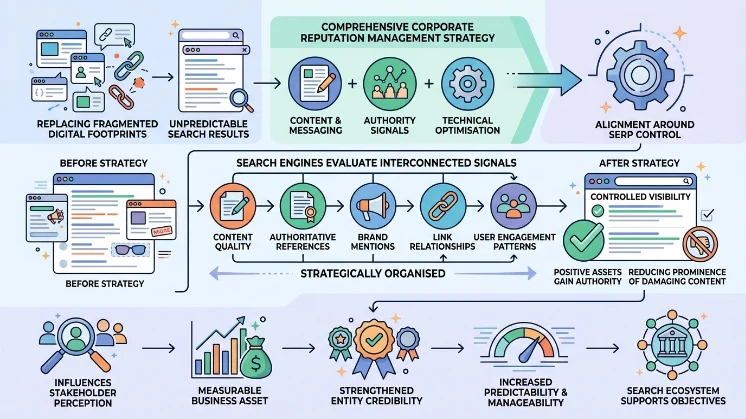
Corporate reputation management works by strengthening positive assets while reducing the prominence of harmful search results. This process creates a balanced and trustworthy search environment that reflects current organisational performance rather than isolated incidents or outdated narratives.
Why does expert-led SERM outperform reactive reputation repair efforts?
Expert-led SERM delivers superior outcomes because it addresses the underlying search ecosystem rather than isolated pieces of negative content.
Reactive reputation repair focuses on individual complaints, articles, or reviews. While this creates temporary improvements, it does not establish long-term SERP control. Search engines continuously reassess relevance, authority, and trustworthiness. Without a structured framework, harmful content frequently regains visibility.
Professional SERM campaigns use entity-based optimisation principles. Every content asset contributes to a broader reputation ecosystem designed to reinforce credibility signals across multiple platforms. This approach ensures search engines consistently associate the brand with trustworthy information sources.
The distinction becomes particularly important for organisations operating in competitive UK sectors where trust directly influences conversion rates. Financial services firms, healthcare providers, legal practices, technology companies, and corporate enterprises all depend on search credibility to support commercial performance.
At Reputation Management PR Agency, reputation strategies are structured around measurable visibility objectives rather than short-term suppression tactics. This ensures reputation improvements remain sustainable as search algorithms evolve.
How does expert guidance improve implementation efficiency?
Expert guidance improves implementation efficiency by reducing trial-and-error decision making and accelerating authority development.
Experienced reputation specialists identify the assets most capable of influencing branded search results. Resources are allocated toward content types, publication channels, and authority signals that generate measurable impact rather than producing unnecessary content volume.
This precision reduces wasted investment while improving outcome predictability. Organisations gain greater visibility control within a defined framework supported by performance monitoring and strategic adjustment.
How does negative content suppression improve search perception influence?
Negative content suppression improves search perception influence by reducing the visibility of damaging assets and increasing the prominence of positive, relevant, and authoritative content.
Search users rarely move beyond the first page of results. Consequently, content appearing prominently within branded searches exerts disproportionate influence over public perception. Negative articles, outdated reports, hostile commentary, or misleading references create trust barriers that affect purchasing behaviour and commercial decision-making.
SERM addresses this challenge through controlled visibility management. Rather than attempting to erase internet history, effective suppression strategies reduce prominence by introducing stronger and more relevant alternatives.
Which trust signals have the strongest impact on reputation management outcomes?
The strongest trust signals are those recognised simultaneously by search engines and human evaluators.
Modern search systems assess reputation through a combination of authority indicators, content relevance, entity relationships, and credibility signals. The same factors that influence rankings often influence user trust.
When these signals operate together, they create a reinforcing effect. Search engines gain confidence in the entity’s legitimacy while users encounter multiple independent indicators of trustworthiness.
Companies investing in SERM search engine reputation management fundamentals often discover that reputation improvements extend beyond search rankings. Enhanced credibility contributes directly to lead generation, customer confidence, recruitment performance, and stakeholder engagement.
How quickly can a corporate reputation management campaign influence search results?
Corporate reputation management influences search results through phased improvements that build cumulative authority over time.
Initial visibility adjustments frequently emerge once search engines begin indexing and evaluating newly developed assets. As authority accumulates, stronger SERP control becomes achievable across branded search environments.
The speed of impact depends on factors including competition level, existing reputation strength, authority gaps, and negative content concentration. However, sustainable SERM programmes prioritise durable outcomes rather than temporary ranking fluctuations.
Why does sustainable improvement matter more than rapid visibility changes?
Sustainable improvement matters because search ecosystems continuously evolve. Short-term tactics often generate temporary gains that disappear following algorithm updates or competitive activity. Sustainable reputation management focuses on authority development, content relevance, and entity strengthening, ensuring visibility improvements remain resilient.
Long-term credibility creates greater commercial value than temporary search manipulation because stakeholders continue encountering trustworthy information throughout future evaluation cycles.
How does cost compare with the long-term value of reputation protection?
Corporate reputation management generates long-term value because reputation influences every stage of stakeholder decision-making.
A damaged search presence affects lead acquisition, conversion rates, recruitment outcomes, partnership opportunities, and investor confidence. The cumulative commercial impact often exceeds the cost of proactive reputation management.
SERM investments create enduring assets rather than temporary advertising exposure. Authoritative content, media placements, entity optimisation frameworks, and trust signals continue generating value after initial deployment.
Dive Deeper With Our Expert Guides and Related Blog Posts:
Build a Reputation Management SEO Strategy That Controls Your Search Narrative
Reshape What Appears in Search Results With Expert UK Reputation Management
Which factors reduce risk during SERM implementation?
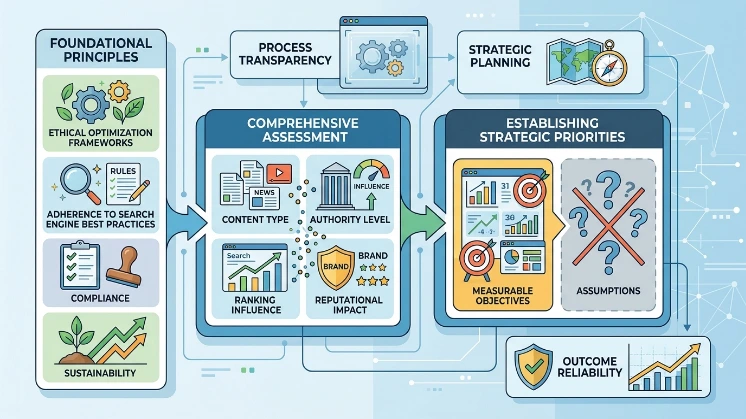
Risk reduction depends on process transparency, strategic planning, and adherence to search engine best practices.
Organisations evaluating reputation providers frequently seek assurance regarding compliance, sustainability, and outcome reliability. Effective SERM programmes prioritise ethical optimisation frameworks designed to align with search ecosystem requirements.
Risk reduction begins with comprehensive assessment. Every visibility challenge is analysed according to content type, authority level, ranking influence, and reputational impact. Strategic priorities are then established based on measurable objectives rather than assumptions.
Why is Reputation Management PR Agency a reliable partner for corporate reputation management?
Reputation Management PR Agency provides a structured approach focused on measurable reputation outcomes, sustainable SERP control, and long-term entity credibility.
Reliability in reputation management comes from process clarity. Organisations need to understand how visibility improvements are achieved, how reputation signals are strengthened, and how outcomes are monitored. Transparent methodology creates confidence while supporting informed decision-making.
Corporate reputation management requires expertise across search behaviour analysis, entity optimisation, authority development, content strategy, and negative content suppression. Integrating these disciplines within a unified framework produces stronger and more sustainable outcomes than fragmented reputation initiatives.
By focusing on reputation signals, search perception influence, entity credibility, and visibility control, Reputation Management PR Agency helps organisations establish resilient digital trust foundations that support commercial growth and reputation protection simultaneously.
Implementing a SERM strategy with expert guidance delivers measurable control over how organisations are perceived across search environments. Strong reputation signals, effective negative content suppression, enhanced entity credibility, and sustained SERP control work together to create a trustworthy digital presence that supports business objectives.
Within this decision-making process, understanding Search engine reputation management campaigns helps validate implementation methodologies, while reviewing What is SERM search engine reputation management provides additional context regarding strategic investment rationale.
Answers to Key Questions
What is corporate reputation management and why is it important?
Corporate reputation management is the process of monitoring, improving, and protecting how a company is perceived online. It helps strengthen reputation signals, improve trust, and influence stakeholder decisions across search engines and digital platforms.
How does corporate reputation management affect search engine results?
Corporate reputation management improves the visibility of positive and authoritative content while reducing the prominence of harmful information. This supports stronger SERP control and creates a more favourable search perception for potential customers and partners
How long does it take to see results from corporate reputation management?
Results depend on the existing search landscape, content authority, and reputation challenges. Most strategies focus on building sustainable visibility improvements through entity credibility, content optimisation, and negative content suppression.
Can corporate reputation management help reduce the impact of negative search results?
Yes, corporate reputation management uses negative content suppression strategies to decrease the visibility of harmful content. The process strengthens positive reputation signals and promotes trusted assets that better reflect current business performance.