

Reputation management is the systematic practice of shaping an entity’s public perception within digital information systems. Online reputation refers to the composite of indexed content, user-generated signals, and algorithmic assessments that determine how an entity appears in search ecosystems.
Burying negative search results is the deliberate process of reducing the search visibility of specific undesirable items by altering the indexed content mix and ranking signals. It defines an objective: lower the SERP evaluation score and ranking position of targeted pages relative to other content associated with the same entity. Practitioners create and promote alternative content, modify on-site metadata, optimise authoritative pages, and influence external linking patterns so search engines re-evaluate relevance and authority signals.
Successful burying changes the top-ranked snippets, reduces click-through to negative items, and shifts entity perception by exposing searchers primarily to neutral or positive content in the top ten results.
How is reputation formed in search engines?
Reputation in search engines is the aggregate outcome of indexed content, linking structures, and user interaction metrics that together constitute reputation signals. Reputation signals refer to measurable attributes content relevance, authority of referring domains, review sentiment, and structured data that algorithms use to rank entity-related content. Index content and extract entity mentions, knowledge graph associations, and sentiment cues ranking algorithms weight these signals to produce SERP placement; user engagement metrics then feed back into ranking adjustments.

The indexed combination of signals determines which aspects of an entity are visible, which in turn defines entity perception during SERP evaluation by users and secondary systems (e.g., aggregators, social platforms).
How do algorithms interpret trust and credibility?
Algorithms interpret trust and credibility as quantifiable signals derived from provenance, linking behaviour, content consistency, and user interaction patterns. Trust is defined as the degree to which source provenance and link context align with established authority indicators; credibility refers to the presence of corroborating signals across independent domains.
Algorithms evaluate domain authority (link profiles, historical uptime), content authority (citation patterns, topical depth), and behavioural trust signals (click-through rates, dwell time, bounce metrics). Pages with higher trust and credibility scores gain preferred SERP positions, thereby reinforcing favourable entity perception and decreasing visibility of lower-trust negative items.
How does content influence perception in search ecosystems?
Content influences perception by supplying the textual and structural evidence that indexing systems use to map entity attributes and sentiment. Content is defined as any indexed document, snippet, multimedia asset, or structured markup that references an entity.
Content that aligns with target queries, uses consistent entity descriptors, and contains endorsement signals (citations, references, schema) will be prioritised during content indexing and SERP evaluation. High-quality, well-structured content elevates desirable narratives in visible slots (featured snippets, knowledge panels), thereby altering the entity perception presented to searchers while reducing prominence of negative items.
Which search ranking dynamics matter when attempting to bury results?
Ranking dynamics that matter include relevance scoring, authority weighting, freshness factors, and engagement feedback loops. Relevance is defined as the match between query intent and content semantics; authority weighting refers to the credit assigned via link graphs and domain reputation; ‘freshness’ evaluates recency of content updates; and ‘engagement feedback’ quantifies user interaction signals.
Ranking algorithms combine these dynamics into composite scores for each candidate result during SERP generation; practitioners manipulate these inputs by publishing optimised content, building contextual links, refreshing pages, and improving meta-level signals. Shifting any of these dynamics for competing content influences which pages occupy prime SERP positions, thereby displacing negative results from high-visibility slots.
How do review signals and sentiment interpretation affect result prominence?
Review signals and sentiment interpretation are treated as structured and unstructured inputs that contribute to overall reputation scoring. Review signals refer to aggregated ratings, review volume, and review recency; sentiment interpretation is the algorithmic assessment of tone within reviews and other user-generated content.
Search systems parse structured review markup and natural language text to compute sentiment indices and trust modifiers; high-volume, positive review clusters increase entity credibility metrics, while consistent negative sentiment reduces them. Aggregated positive review signals raise the ranking probability of associated pages and can trigger prominence features (review snippets), thereby burying pages that present persistent negative sentiment.
What role does entity resolution and the knowledge graph play?
Entity resolution is the process by which systems identify and link references to the same real-world subject across disparate documents; the knowledge graph defines the structured network of those resolved entities and their attributes. Entity resolution is defined as the disambiguation and consolidation of references; the knowledge graph refers to the indexed graph that stores canonical entity attributes.
Search engines connect mentions, metadata, and structured data to form an entity node; ranking systems use the node’s attribute set and inter-entity relationships as reputation signals. Accurate entity resolution concentrates reputation signals into a canonical representation, which enables targeted elevation or suppression of specific narratives; incorrect resolution can amplify negative items or scatter positive signals, complicating burying efforts.
How do link profiles and external referencing affect suppression efforts?
Link profiles are the aggregate inbound and outbound references to a page or domain and are treated as primary authority signals. External referencing refers to the context and anchor semantics surrounding links from third-party sites. Link profile strength is defined by link quality, topical relevance, and anchor diversity.
Ranking systems evaluate link profiles to attribute authority; high-authority, contextually relevant inbound links increase a page’s ranking potential. Constructing superior link profiles for alternative content elevates those pages in SERP evaluation and displaces negative results; conversely, consistent negative mentions from authoritative domains sustain the visibility of negative items.
How long does it take to bury negative search results?
Time to bury negative search results is measured in months to years, depending on signal disparity and competitive indexing conditions. It is defined as the period required for alternative content and signal adjustments to produce a stable shift in SERP rankings for targeted queries.
Initial indexing and ranking changes occur within weeks for new content; durable ranking shifts require consistent signal reinforcement content authority, link accrual, and user engagement over multiple algorithmic re-evaluations. Modest displacements (moving a result from top three to page two) can occur within 1–3 months; substantive suppression (removing visibility within top 10 for primary queries) typically requires 6–18 months; cases with strong incumbent negative signals or high-authority sources can extend beyond 24 months.
Which metrics evaluate progress when attempting to bury results?
Use discrete metrics that quantify ranking, visibility, and sentiment. Rank position measures SERP slot for a target query; search visibility quantifies estimated impression share across target queries; sentiment index aggregates sentiment-weighted mention counts; authority score measures domain-level link equity.
Track ranking fluctuations, impression and click estimates, backlink acquisition velocity, and sentiment trend lines to evaluate intervention impact. Consistent improvement in these metrics demonstrates reduced exposure of negative items and a shift in entity perception as reflected in SERP evaluation.
Dive Deeper With Our Expert Guides and Related Blog Posts:
Why Suppressing Negative Google Results Is Often More Effective Than Removal
What Happens After You Submit a Google Content Removal Request Online
What risks or constraints limit the effectiveness of burying tactics?
Risks and constraints are algorithmic inertia, third-party publishing independence, legal boundaries, and knowledge graph persistence. Algorithmic inertia is defined as the resistance of ranking systems to rapid narrative change; third-party publishing independence refers to external sites’ control over content they host; legal boundaries assign the permissible scope of content modification.
Algorithms prioritise historically reinforced signals, external publishers maintain negative content unaffected by other parties, and legal frameworks restrict removal requests to specific lawful grounds. These constraints limit the speed and completeness of burying efforts and require long-term, systematic signal management rather than one-off actions.
Manage online reputation challenges with professional Healthcare Reputation Management that focuses on long-term authority building, trust enhancement, and sustainable search visibility improvement. By strengthening credible healthcare signals and strategic content assets, organisations can reduce the impact of negative narratives and maintain stronger digital trust over time.
How do healthcare-specific reputation considerations alter burying timelines?
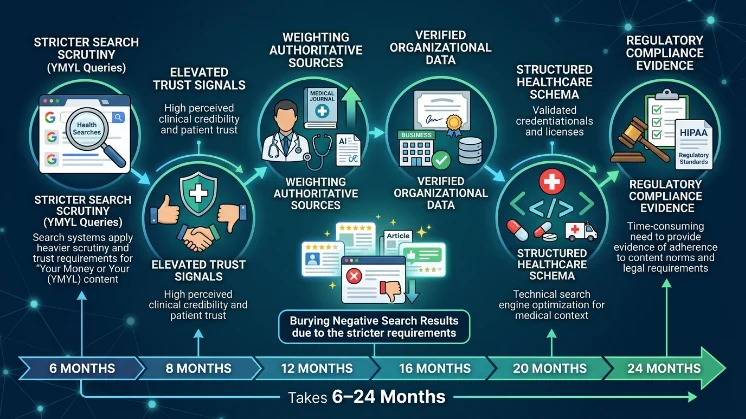
Healthcare reputation in search ecosystems demands elevated trust signals, compliance with regulatory content norms, and sensitivity to review authenticity. Healthcare reputation is defined as the entity’s perceived clinical credibility and patient trust as presented in search contexts.
Search systems apply stricter scrutiny to health-related queries, weighting authoritative medical sources, verified organisational data, and structured healthcare schema more heavily. Burying negative search results for healthcare-related entities typically requires stronger authoritative corroboration, validated citations, and compliance evidence, which lengthens timelines commonly towards the higher end of the 6–24 month range.
Explore the Complete Guide:
How Businesses Bury Negative Search Results Using Proven Digital Tactics
Burying negative search results is a technical process that reconfigures indexed content and ranking signals to change what searchers encounter. It defines a strategic mixture of content creation, link building, structured data, and sentiment management applied over sustained periods. Algorithms interpret trust through provenance, linking, and engagement, so durable suppression requires persistent signal reinforcement, accurate entity resolution, and attention to domain-specific constraints particularly in healthcare contexts where credibility thresholds are higher. Progress is measurable through rank positions, visibility estimates, sentiment indices, and authority scores; timelines vary from a few months for modest displacements to multiple years for durable suppression of well-established negative items.
Answers to Key Questions
What is healthcare reputation management and why does it matter?
Healthcare reputation management is the practice of monitoring, shaping, and improving how a healthcare provider or organisation is perceived online. It matters because patients heavily rely on search results, reviews, and trusted content when choosing doctors, clinics, or hospitals, making online credibility a direct factor in patient acquisition and trust.
How does Reputation Management PR Agency help healthcare clients protect their reputation?
A Reputation Management PR Agency works with healthcare clients to build authoritative content, manage review signals, respond professionally to patient feedback, and address negative narratives through strategic communications. This systematic approach strengthens trust signals and improves how search engines interpret the organisation’s credibility.
What are the main risks to a healthcare provider’s online reputation?
Key risks include negative patient reviews, unaddressed complaints on social media, outdated or inaccurate information in search results, and low-quality content that undermines authority. These factors can reduce search visibility, lower patient confidence, and negatively impact SERP evaluation for.SelectCommand-related queries.
How long does it take to improve healthcare reputation in search results?
Improving healthcare reputation in search typically requires 6 to 18 months of consistent effort, including content creation, review management, link building, and structured data optimisation. Timeframes vary based on the strength of existing negative signals, domain authority, and the competitiveness of local healthcare search markets.