

Reputation management strategies differ based on control goals (suppression, displacement, or removal), the origin of negative content, and regulatory context. Online reputation control methods are evaluated through search ranking influence, entity credibility signals, sentiment distribution, and legal or platform-based removal mechanics.
How do content creation and content removal strategies compare for suppressing negative search results?
Content creation is an enhancement strategy that operates by producing and optimising new, authoritative assets to dominate SERP slots; content removal is a suppression strategy that operates by eliminating or de-indexing specific negative assets at source.
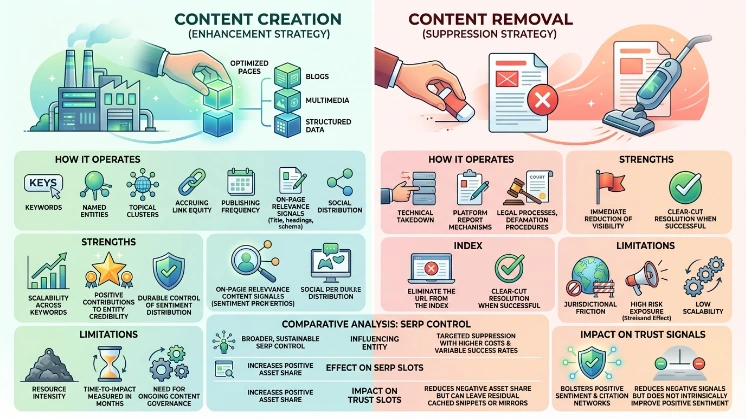
Content creation is defined as the deliberate production of optimised pages, blogs, multimedia, and structured data that target the same keywords, named entities, and topical clusters as the negative content. It operates by accruing link equity, publishing frequency, on-page relevance signals (title, headings, schema) and social distribution to increase search ranking influence for preferred assets. Strengths include scalability across keywords, positive contributions to entity credibility, and durable control of sentiment distribution when maintained. Limitations include resource intensity, time-to-impact measured in months, and the need for ongoing content governance to prevent erosion of rankings.
Content removal is defined as actions to take down, de-index, or legally compel removal of a negative asset from its hosting environment. It operates through technical takedown (host contact, DMCA or equivalent notices), platform report mechanisms, and legal processes (court orders, defamation procedures) that change SERP composition by eliminating the negative URL from the index. Strengths include immediate reduction of visibility for specific assets and clear-cut resolution when successful. Limitations include jurisdictional friction for cross-border hosts, high risk exposure if removal requests trigger Streisand-effect amplification, and low scalability for multiple or replicated instances across platforms.
Comparative analysis: content creation provides broader, sustainable SERP control through content enhancement that influences entity credibility and search ranking influence across multiple queries, while content removal provides targeted suppression with higher legal and operational costs and variable success rates. Creation increases positive asset share across SERP slots; removal reduces negative asset share but can leave residual cached snippets or mirrored copies. Impact on trust signals: creation bolsters positive sentiment distribution and citation networks; removal reduces the immediate negative signals but does not intrinsically improve positive sentiment without accompanying enhancement.
How do organic optimisation approaches compare with reactive paid tactics for SERP control?
Organic optimisation is a long-term authority-building approach that operates by improving on-page relevance, backlinks, technical SEO, and entity structured data; reactive paid tactics are immediate displacement methods that operate by purchasing visibility (paid search, sponsored content, and PR amplification) to push down negative entries.
Organic optimisation is defined as sustained SEO practices that improve domain authority and topical relevance. It operates by generating natural backlinks, optimising internal linking for entity prominence, and implementing schema to clarify entity attributes to search engines. Strengths include persistent search ranking influence, low per-impression cost over time, and strong contribution to entity credibility signals. Limitations include slower time-to-impact, susceptibility to algorithmic fluctuation, and dependence on high-quality editorial signals.
Reactive paid tactics are defined as short-term paid media placements, PPC campaigns, and sponsored content designed to occupy SERP real estate immediately. They operate by bidding on branded queries, commissioning advertorials on high-authority sites, and promoting positive or neutral narratives through paid distribution channels. Strengths include rapid SERP displacement, control over messaging in ad snippets, and measurable short-term traffic diversion. Limitations include ephemeral effect that ends when campaign budget stops, reduced impact on organic trust signals (ads carry different credibility weighting), and potential visibility conflicts with organic assets.
Comparative analysis: organic optimisation increases long-term search ranking influence and entity credibility, while reactive paid tactics produce immediate displacement but produce limited gains in organic sentiment distribution. Impact on search visibility: organic leads to durable SERP composition changes; paid tactics temporarily occupy prime positions but do not alter the organic index. Impact on trust signals and perception: organic assets accrue natural citations and trust; paid placements signal prominence but weaker editorial endorsement.
How effective are legal takedowns versus platform-based reporting for removing defamatory or false content?
Legal takedowns are a formal enforcement approach that operates by securing judicial orders or statutory takedown notices to compel hosts to remove content; platform-based reporting is an administrative compliance approach that operates via platform policies and moderation workflows to remove policy-violative content.
Legal takedowns are defined as court-issued orders or statutory procedures that force removal or compel host action under defamation, privacy, or copyright statutes. They operate by presenting evidence to judicial bodies or leveraging statutory notice-and-takedown frameworks that obligate hosts to act. Strengths include authoritative resolution, potential for injunctive relief, and deterrent effect. Limitations include jurisdictional complexity for content hosted in other countries, extended timelines, legal costs, and public-record outcomes that can create secondary visibility.
Platform-based reporting is defined as the use of platform-specific abuse, harassment, or terms-of-service complaint mechanisms to request removal. It operates by matching the content against policy criteria and invoking platform moderation or automated filtering. Strengths include lower cost, faster resolution for clear policy violations, and scalability for repeated violations. Limitations include inconsistent enforcement across platforms, opaque moderation processes, and the inability to address lawful but reputationally damaging content.
Comparative analysis: legal takedowns provide durable, enforceable removal where jurisdiction and prima facie legal harm are present, but present higher risk exposure via procedural visibility and cost. Platform reporting provides faster, lower-cost suppression for content that violates terms but lacks the legal finality and can be reversed. Impact on search visibility: successful legal takedowns remove URLs from indexes permanently when hosts comply; platform removals take content out of public view but risk reappearance via reposts. Impact on entity credibility: legal remedies can vindicate reputational claims but generate public records that influence sentiment distribution; platform removals reduce immediate negative signals without altering third-party perception networks.
How do content suppression and content enhancement strategies compare in scalability and sustainability?
Content suppression is defined as targeted reduction of negative asset visibility (removal, de-indexing, legal action) ‘content enhancement’ is defined as bolstering positive or neutral assets to overshadow negatives.
Content suppression operates through takedowns, de-indexing requests, and targeted removal of individual URLs. It scales poorly when negative content proliferates across multiple domains, mirrored sites, or social networks that replicate content automatically. Strengths include surgical reduction of specific risks and immediate SERP changes where successful. Limitations include high operational cost per asset, escalating legal exposure when cross-jurisdictional, and potential for adversarial amplification.
Content enhancement operates through portfolio expansion of optimised assets blogs, press releases, authoritative pages, knowledge panels, and structured entity records. It operates by increasing positive asset density and relevance signals to displace negative results through content creation and link acquisition. Strengths include high scalability across keywords and queries, improvement of long-term entity credibility, and lower marginal cost per asset after initial systems are in place. Limitations include time-lag to measurable impact, ongoing maintenance requirements, and vulnerability to algorithmic reweighting of signals.
Strengthen long-term digital trust with professional Healthcare Reputation Management that combines strategic content enhancement, authority building, and search visibility optimisation. By increasing positive healthcare signals and credible content assets, organisations can achieve sustainable reputation growth while reducing the prominence of negative search results.
Dive Deeper With Our Expert Guides and Related Blog Posts:
How to Suppress Negative Google Results Using Content and SEO Strategy
How to Strengthen a Google Content Removal Request to Improve Acceptance Rates
How do algorithmic signals interpret reputation signals and affect strategy choice?
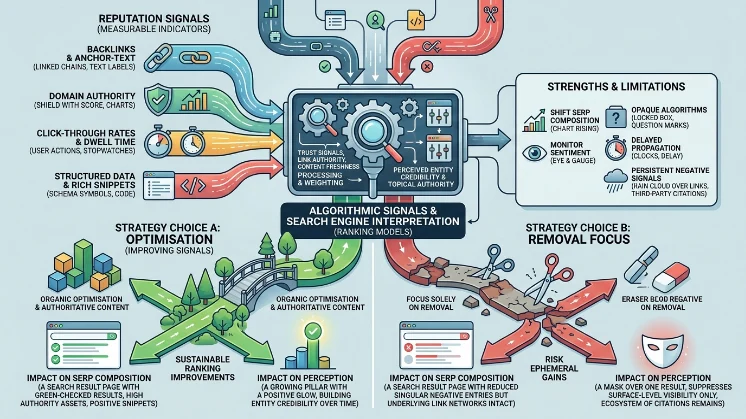
Search engines interpret reputation signals as aggregated relevance, authority, and user engagement metrics tied to an entity; these signals influence ranking by weighting trust signals, link authority, content freshness, and user behaviour.
Reputation signals are defined as measurable indicators backlinks, anchor-text relevance, domain authority, click-through rates, dwell time, and structured data associated with an entity. They operate by feeding ranking models that adjust search result composition based on perceived entity credibility and topical authority. Strengths of leveraging these signals include the ability to shift SERP composition through measurable optimisation actions and to monitor sentiment distribution via query-level analytics. Limitations include opacity of ranking algorithms, delayed propagation of signal changes, and the potential for negative signals from third-party citations to persist despite remediation efforts.
Strategies that prioritise improving reputation signals (organic optimisation, authoritative content) align with search engines’ preference for robust relevance and authority and therefore deliver sustainable ranking improvements; strategies focused solely on removal neglect the ongoing influence of third-party citations and user behaviour metrics and therefore risk ephemeral gains. Impact on SERP composition: improved reputation signals increase the density of high-authority assets and positive snippets removal reduces singular negative entries but leaves underlying citation networks intact. Impact on perception: enhancing signals builds entity credibility over time; suppression only addresses surface-level visibility without altering the ecosystem of citations that shapes perception.
What are the risk exposures and sustainability trade-offs between short-term tactical fixes and long-term reputation programmes?
Short-term tactical fixes are immediate interventions (PPC displacement, emergency takedowns, reactive PR pushes) that operate by temporarily altering the visible mix of results or narratives; long-term reputation programmes are systemic interventions (content ecosystems, governance policies, citation acquisition) that operate by changing the underlying entity credibility and signal distribution.
Short-term fixes operate quickly to mitigate acute visibility issues and recalibrate sentiment distribution in the immediate term. They measure effectiveness by immediate SERP position shifts and traffic changes. Strengths include speed and measurable short-term impact. Limitations include temporal limitations, high continuing cost, and weak contribution to organic entity credibility.
Long-term programmes operate by building a sustained portfolio of authoritative content, backlink acquisition strategies, structured data implementation, and policy-driven media engagement. They measure effectiveness through progressive improvements in organic share-of-voice, knowledge panel accuracy, and link profile quality. Strengths include durability, lower marginal cost over time, and resilience against recurrence. Limitations include upfront resource investment, governance overhead, and exposure to algorithmic shifts.
Short-term fixes reduce immediate reputational damage but increase recurring cost and reliance on paid or legal levers; long-term programmes reduce frequency of crises and increase search ranking influence but require governance and content investment. Impact on scalability: tactical fixes scale poorly under repeated incidents; long-term programmes scale effectively as content ecosystems grow. Impact on sustainability: tactical responses are unsustainable as primary strategy; programme-led approaches provide sustainable reputation resilience.
Explore More Expert Insights:
Bury Negative Search Results Permanently With an Expert-Led UK Campaign
Content creation (enhancement) and organic optimisation provide the most sustainable pathways to shift SERP composition by increasing entity credibility and long-term search ranking influence. Content removal and legal takedowns supply targeted suppression with faster impact but impose scalability limits, legal exposure, and potential amplification risks. Paid displacement and reactive PR deliver immediate visibility control but contribute limited gains to organic trust signals. Strategic choice requires evaluation of effectiveness, scalability, risk exposure, and sustainability: choose suppression for critical, high-risk singular items; choose enhancement and organic authority-building for systemic reputation control and durable sentiment distribution.
Answers to Key Questions
What is healthcare reputation management and why is it essential for medical practices?
Healthcare reputation management is the strategic process of monitoring, influencing, and maintaining perceptions about a healthcare provider online. It directly impacts patient trust, appointment volume, and long-term practice success because patients rely on Google reviews, Healthgrades, and Yelp before choosing providers.
How do healthcare providers respond to negative patient reviews without violating HIPAA?
Providers must de-identify patients by avoiding any information that could reveal their medical situation and stick to general statements about quality care. For detailed feedback involving protected health information, direct patients to private channels like secure portals and respond within 24 hours to increase removal chances.
What are the best practices for managing online reviews for healthcare organisations?
Respond to reviews promptly, prioritise negative feedback, and centralise response ownership under one team. Maintain accurate, consistent listings across Google Business Profile, Yelp, Healthgrades, Facebook, and Vitals with consistent NAP details, hours, services, and provider bios.
Can fake or defamatory patient reviews be removed from review websites?
Yes, providers can report reviews to the website for terms-of-service violations when they are inaccurate, misleading, or fake. Where appropriate, flag the content and request removal by the platform, or consult an attorney specializing in internet defamation for legal removal options.