

Reputation management is the systematic practice of monitoring, influencing and maintaining an entity’s standing within information ecosystems. Online reputation refers to the aggregate of indexed content, review signals and measurable trust indicators associated with an entity within search engines and related platforms.
What is the relationship between solicitor reputation management and SRA compliance?
Solicitor reputation management is tightly linked to SRA compliance because regulatory obligations define permissible public information and behavioural standards that search ecosystems index and evaluate. SRA compliance is a set of regulatory rules and professional obligations that govern solicitors’ conduct, client communications and public disclosures within the UK legal market. Solicitor reputation management refers to the set of processes that shape how those rules and related content appear and function within search ecosystems.
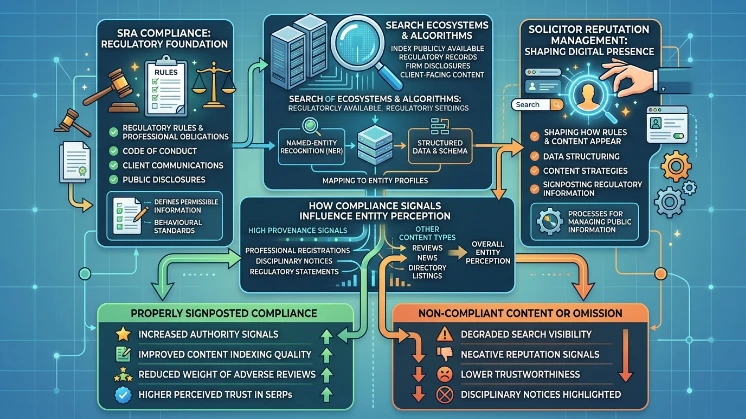
Search engines and third-party platforms index publicly available regulatory records, firm disclosures, and client-facing content; algorithms then map these items to entity profiles through named-entity recognition and structured data. Compliance-related documents (professional registrations, disciplinary notices, regulatory statements) act as reputation signals because they carry high provenance and are frequently referenced by authoritative domains. Search systems correlate regulatory status with other content types (reviews, news, directory listings) to form an entity perception.
Non-compliant content or omission of required regulatory information degrades search visibility through negative reputation signals and lowers perceived trust in SERP evaluation. Conversely, properly signposted compliance information increases authority signals, improves content indexing quality, and reduces the weight of adverse review signals in organic rankings.
How does search visibility form around solicitor entities?
Search visibility for solicitors forms through indexed content, structured data, and external references that collectively define an entity’s searchable footprint. Search visibility is the measurable presence and prominence of an entity’s content within search engine results pages (SERPs). In this context, solicitor search visibility refers to how regulatory records, firm pages, and client-facing content rank relative to competitor entries. Collect pages referencing the solicitor’s name, firm, registration number and practice areas, then normalise these into an entity graph.
Structured markup (schema.org for legal services), directory citations, and consistent NAP (name, address, phone) data facilitate entity matching. Search algorithms evaluate signals link authority, content relevance, review sentiment, and regulatory provenance to assign rank positions. The presence of verified regulatory metadata (for example, explicit SRA registration details) elevates indexing accuracy and increases the probability of favourable SERP features (knowledge panels, rich snippets).
How do review signals and sentiment shape solicitor reputation in search ecosystems?
Review signals and sentiment directly influence perceived credibility and act as quantifiable reputation signals within ranking algorithms and SERP features. Signals are structured or semi-structured user-generated evaluations that search engines and consumer platforms index and aggregate to determine sentiment and reputation. Sentiment refers to the weighted polarity (positive, neutral, negative) that algorithms extract from reviews and comments.
Platforms expose review data via APIs and structured feeds; search engines incorporate aggregated ratings and excerpts into indexing and may display them as SERP features. Natural language processing models evaluate sentiment, extract problem themes (timeliness, competence, communication), and map them to entity nodes. Algorithms adjust ranking weightings where review sentiment correlates with other trust indicators (backlinks from authoritative legal sites, regulatory status). Review provenance (verified client markers) increases signal reliability and therefore ranking influence.
Negative review sentiment reduces click-through rates and increases the visibility of critical snippets in SERPs, thereby lowering perceived credibility. Positive and verified reviews increase reputation signals and support higher placement in local searches and legal directories. Lack of review provenance or inconsistency across platforms weakens the usefulness of review signals for SERP evaluation.
How do search engines interpret authority and trust for solicitors?
Search engines interpret authority and trust for solicitors through provenance, structured claims, linkage patterns and behavioural metrics specific to legal-service entities. Authority refers to the algorithmic assessment of content credibility based on source provenance and linking topology. Trust refers to the measured confidence an algorithm assigns to the accuracy and reliability of an entity’s information.
Algorithms combine external link profiles (citations from government, legal bodies, reputable publications), on-site trust markers (secure site, transparent contact details, regulatory disclosures), and user behaviour (dwell time, bounce rate, CTR) to compute an authority/trust score. Signal weighting increases for links from high-domain-authority sites and for content containing verifiable claims (SRA registration numbers, published disciplinary outcomes). Search systems also penalise conflicting claims across indexed sources, reducing trust scores when facts do not align.
Strengthen public trust and online credibility with professional Celebrity Reputation Management that enhances authority signals, verified information, and search visibility. By building consistent credibility across trusted sources, public figures can improve entity perception, protect their reputation, and maintain stronger control over search results.
How do algorithms evaluate conflicting information about solicitors?
Algorithms evaluate conflicting information by cross-referencing source reliability, temporal signals and corroborative evidence to resolve entity-level discrepancies. Conflict resolution within search ecosystems is the algorithmic process that reconciles divergent or contradictory claims about the same entity. Algorithms assign reliability scores to sources based on domain authority, historical accuracy, and relationship to official registries.
Temporal signals (publication date, update frequency) and corroboration from independent authoritative sources (regulatory portals, court records) serve as tie-breakers. Schema consistency and canonical tags inform which version a search engine should treat as primary. Machine-learning models flag discrepancies for lower trust scoring where corroborative evidence is absent.
Dive Deeper With Our Expert Guides and Related Blog Posts:
Why Law Firm Reputation Management Influences Client Instructions in the UK
How does digital footprint construction affect solicitor search reputation?

Digital footprint construction determines the breadth and coherence of an entity’s searchable profile and therefore the resilience of its reputation signals. A digital footprint is the cumulative set of online artefacts (web pages, reviews, directory entries, social signals, and regulatory filings) that associate with an entity across the web. Each published artefact contributes a node to the entity graph; consistent identifiers across nodes enable accurate entity resolution.
Content heterogeneity (technical pages, client-facing articles, and directory listings) diversifies signal types and builds redundancy. Search ecosystems reward consistent, corroborated footprints by elevating centralised authoritative pages and suppressing isolated outliers. A coherent, verifiable digital footprint concentrates positive reputation signals and increases the speed at which corrective or compliance content is indexed. Incoherent footprints generate entity ambiguity and increase the weight of sporadic negative signals.
How do regulatory disclosures and transparency alter SERP evaluation?
Regulatory disclosures and transparency alter SERP evaluation by supplying high-provenance inputs that increase trust scores and accelerate authoritative indexing. Regulatory disclosure refers to explicit, verifiable statements or documents that reflect adherence to professional obligations and requirements. Transparency refers to the visibility and accessibility of those disclosures to both users and algorithms.
Search engines treat regulatory disclosures as high-quality content when presented with clear metadata and structured markup. Transparent presentation (machine-readable registration numbers, direct links to regulator entries) improves crawl efficiency and mapping to the entity node. Search algorithms factor these disclosures into trust calculations and may display them as elevated SERP features.
This analysis defines how solicitor reputation management intersects with SRA compliance through the prism of search ecosystems. Key insights: reputation management is a systems-level activity that relies on entity resolution, provenance signals and consistent digital footprints; regulatory disclosures operate as high-weight trust signals that materially affect SERP evaluation; review sentiment, structured data and sourcing patterns determine authority and indexing priority; and algorithmic conflict resolution depends on corroboration and source reliability. Maintaining coherent, verifiable information across indexed artefacts strengthens search visibility and reduces reputational fragmentation within legal-service search contexts.
Learn More Here:
How Solicitor Reputation Management Covers Reviews Search and Client Trust
Answers to Key Questions
What is celebrity reputation management and why does it matter?
Celebrity reputation management is the strategic practice of monitoring, shaping and protecting a public figure’s online perception across search engines, news outlets and social platforms. It matters because search results and social feeds directly influence audience trust, career opportunities and brand partnerships for celebrities.
How does Reputation Management PR Agency handle celebrity reputation risks?
Reputation Management PR Agency uses proactive content strategy, rapid response protocols and authoritative media placement to mitigate negative narratives before they dominate search results. The firm analyses reputation signals, coordinates with legal teams when needed, and publishes verified content to restore entity perception.
What services are included in a celebrity reputation management plan?
A typical plan includes search reputation audits, review monitoring, negative content suppression through SEO, PR article placement, social media strategy, and executive/celebrity briefing for crisis scenarios. These services align to improve search visibility and strengthen trust signals across digital channels.
How long does it take to see results from celebrity reputation management?
Initial improvements in search visibility and sentiment often appear within 2–4 weeks through content indexing and review signal optimization. Long-term entity perception shifts and sustained SERP dominance typically require 3–6 months of consistent strategy and authoritative coverage.