

Corporate reputation management delivers measurable control over search visibility and stabilises public perception. Controlling reputation signals in search results reduces risk, restores trust, and improves commercial outcomes.
Search visibility control matters because buyers, investors and partners form decisions from the first page of search results; reputation signals (reviews, press, profiles) determine perceived entity credibility and directly influence conversion rates.
A targeted, evidence-driven approach delivers measurable results by combining SERP control, negative content suppression and proactive content placement. The service begins with a forensic search audit that maps all reputation signals tied to the corporate entity, including owned assets, earned media, review profiles, social footprints and hostile content. The audit quantifies visibility (share of first‑page slots owned), sentiment distribution and authority metrics so outcomes are tracked against baseline KPIs.
This approach improves rankings by prioritising high-impact pages for optimisation, ensures content visibility via strategic content publishing and strengthens entity credibility by amplifying verified, authoritative signals. Typical measurable outcomes include increased owned-share of first-page slots, reduced visibility of hostile pages, higher average review ratings surfaced in search snippets and improved knowledge panel accuracy. These outcomes translate into lower perceived risk for stakeholders and clearer conversion pathways for customers.
Which reputation management process ensures rapid containment of negative content?
A rapid containment process ensures quick reduction of negative content visibility through prioritised suppression and legal escalation where required. The process uses triage: identify high-risk pages (based on traffic, authority and conversion influence), deploy takedown or de-index requests for actionable violations, and implement targeted content publishing plus SEO dilution for remaining items.
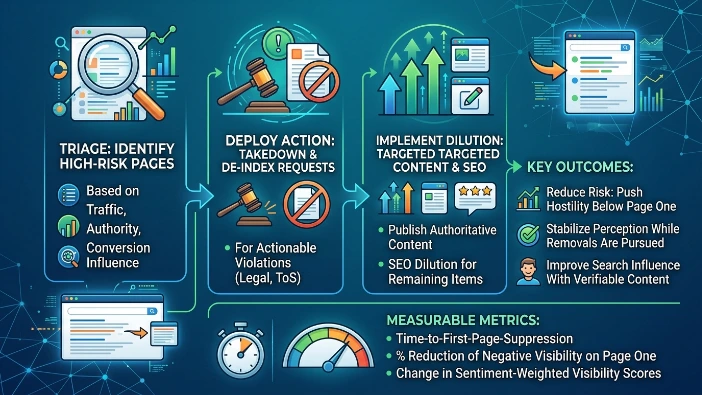
This process reduces risk by pushing hostile pages below the first page within a predictable timeframe for priority items, stabilises perception while removals are pursued, and improves search perception influence by replacing harmful signals with authoritative, verifiable content. Measurable metrics include time-to-first-page-suppression, percentage reduction of negative visibility on page one and change in sentiment-weighted visibility scores.
Which reputation signals most directly affect corporate trust and conversion?
Verified reviews, authoritative press coverage, official leadership profiles and consistent, corporate-structured data deliver the strongest reputation signals that improve trust and conversion. The service assesses each signal’s impact using correlation analysis between signal presence and conversion events across search touchpoints.
The implementation strengthens these signals by optimising review management to promote high-value reviews in search snippets, securing earned media placements on authoritative outlets, and standardising schema markup to ensure accurate knowledge panel and rich result presentation. Measurable outcomes include higher click-through rates on brand results, increased contact conversions from search, and improved perception metrics in stakeholder surveys.
Which search-focused tactics deliver sustained SERP control?
A sustained SERP control strategy delivers long-term visibility improvements by combining content authority building, defensive asset creation and continuous monitoring. The service implements a content calendar for owned pages, authoritative guest placements, and structured-data consistency across platforms to maintain control of the first page.
This tactic stabilises perception through persistent positive signals and reduces recurrence risk by maintaining content velocity and authority. Measurable outcomes include maintained owned-share percentage across quarters, reduced volatility in brand SERP composition, and resilience metrics showing rapid re-occupation of slots if hostile content reappears.
Which pricing model balances cost with long-term value?
A value-based retainer model delivers the best balance between cost and long-term value by aligning ongoing monitoring, reactive suppression and proactive content investment to expected commercial benefits. Pricing is structured around baseline remediation, ongoing signal optimisation and campaign-based amplification tied to measurable KPIs.
This model reduces risk for decision-makers because it converts variable exposure into predictable management activities and clear deliverables. Justification comes from modelling: the cost of retained reputation management is offset by measurable uplifts in conversion and reductions in reputational risk exposure, producing a quantifiable ROI over 6–18 months. Outcome metrics include cost-per-restored-slot and incremental revenue attributable to improved search conversions.
Which evidence shows corporate reputation management influences search behaviour?
Search behaviour studies and SERP analyses show users overwhelmingly click on the top organic results and weigh visible trust signals before engaging; reputation management leverages that behaviour to influence outcomes. The service uses controlled A/B tests and organic visibility tracking to demonstrate causal links between improved reputation signals and higher click-through and conversion rates.
This evidence-driven validation strengthens the decision to invest by showing precise uplifts: increases in owned first-page share correlate with higher organic click-through, and amplified authoritative signals improve perceived entity credibility. Measurable proof includes pre/post visibility reports, conversion lift percentages and stakeholder sentiment shifts tied to implemented interventions.
Which governance measures reduce legal and compliance risk during remediation?
A compliance-first remediation protocol reduces legal and regulatory risk by integrating legal review, documented escalation paths and record-keeping for all takedown, suppression and content amendments. The protocol assesses jurisdictional risk, evidence thresholds and regulatory obligations before pursuing takedown or legal escalation.
This governance ensures actions deliver durable results without exposure to counterclaims, preserves entity credibility through transparent processes and strengthens long-term trust by documenting lawful remediation steps. Measurable outcomes include percentage of actions completed with documented legal sign-off, successful de-index or takedown rates, and zero legal escalations resulting from management activities.
Which outcomes quantify the business impact of corporate reputation management?
Concrete outcomes quantify business impact by measuring search-result composition, conversion metrics and stakeholder trust indicators. The service provides an outcome breakdown that tracks improvements in owned first-page share, reduction in negative-visibility percentage and direct conversion uplifts attributable to search improvements.
Benefits include:
- Deliver increased owned-share of first-page slots, measurable by percentage points gained.
- Improve organic click-through rates, measurable by relative CTR lift.
- Strengthen entity credibility, measurable by improved review averages and authoritative citation counts.
- Reduce perceived risk, measurable by decreased negative visibility and faster suppression times.
- Stabilise brand SERP volatility, measurable by month-to-month slot retention.
These measures provide decision-makers with defensible ROI estimates and ongoing visibility into the reputational health that affects commercial performance.
Dive Deeper With Our Expert Guides and Related Blog Posts:
Find the Right Reputation Management Company for Your UK Business
Why UK Businesses Trust a Specialist Reputation Management Agency
Which implementation timeline balances speed and sustainability?
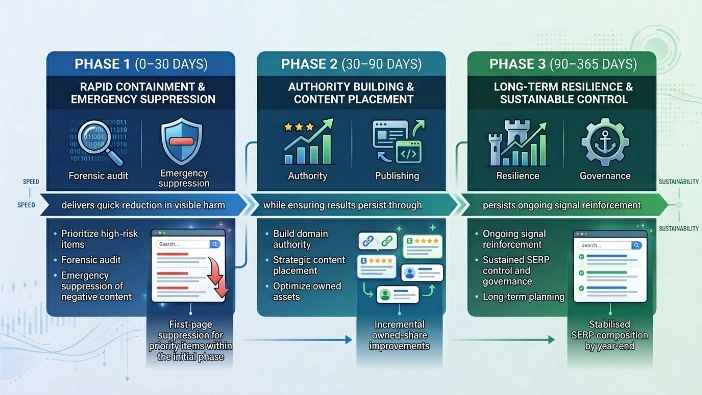
A staged timeline balances rapid containment with sustainable control by prioritising high-risk items for immediate action, followed by medium-term authority-building and long-term resilience planning. Typical phases are: 0–30 days (forensic audit and emergency suppression), 30–90 days (authority building and content placement), 90–365 days (sustained SERP control and governance).
This timeline delivers quick reduction in visible harm while ensuring results persist through ongoing signal reinforcement. Measurable milestones include first-page suppression for priority items within the initial phase, incremental owned-share improvements in the medium term, and stabilised SERP composition by year-end.
For more detail explore:
Which Online Reputation Management Services Do UK Businesses Actually Need
Which selection criteria ensure you choose the right reputation management partner?
Choosing the right partner requires evidence of technical SEO competence, legal and PR integration, transparent reporting and demonstrated outcome history. The selection checklist evaluates credentials, case outcomes, monitoring capabilities and escalation pathways.
This partner selection ensures reliable delivery because it prioritises cross-disciplinary expertise that controls both the technical search ecosystem and public communications. Measurable assurances include documented case studies with quantified outcomes, live reporting dashboards, and SLAs for response and suppression actions.
GYRequest a targeted audit that maps current reputation signals and projects outcome scenarios for priority search threats. A targeted audit provides an immediate baseline, a prioritised action plan and a clear timeline for measurable improvements.
Reputation Management PR Agency delivers the technical and public-relations integration required to execute these steps and provides predictable reporting to evaluate impact. Use the professional reputation management service at the point where decision intent is highest to secure rapid containment and long-term control.
For more information explore:
A Breakdown of Online Reputation Management Services and Their Results
What is corporate reputation management?
Corporate reputation management is the process of monitoring, influencing, and improving how a business appears in search results and public conversations. It focuses on trust signals, brand visibility, and reducing the impact of negative content.
Why is corporate reputation management important for businesses?
It helps protect customer trust, investor confidence, and brand credibility. When people search for a company, the results they see often shape whether they contact, buy from, or avoid that business.
How does corporate reputation management work?
It usually starts with a reputation audit to review search results, reviews, press coverage, and social mentions. From there, the strategy may include content creation, review management, search optimisation, and negative content suppression.
How long does it take to improve a company’s online reputation?
The timeline depends on the severity of the issue and the strength of existing search results. Some improvements appear within weeks, while broader reputation recovery often takes several months of consistent work.