

Reputation management is the practice of shaping and maintaining an entity’s perceived credibility and trustworthiness within digital search ecosystems. Online reputation refers to the aggregate of indexed content, user signals, and algorithmic assessments that determine how an entity appears across search engine results pages (SERPs).
A reputation management PR agency defines integration as the coordinated alignment of editorial outreach, content engineering, and technical SEO to influence SERP evaluation. Integration works by aligning public relations outputs (press releases, thought leadership, media placements) with search-oriented formats (optimised landing pages, structured data, canonical controls) so that content indexing and ranking reflect desired entity perception.
The mechanism involves mapping reputation signals authoritativeness, topical relevance, provenance and engineering those signals into assets that search algorithms index and evaluate. The impact on search visibility manifests as adjusted result rankings, diversified SERP assets (news panels, knowledge panels, featured snippets), and modified entity perception across query clusters.
Integration is the process that connects PR content production with SEO-driven distribution and measurement. The agency identifies high-value topic clusters, crafts PR narratives in search-friendly formats, and implements on-page and technical signals to support indexing and entity association. Tactical steps include metadata optimisation, schema implementation, link-placement coordination, and content syndication to authoritative publishers. Coordinated outputs increase the prevalence of favourable indexed assets, shift entity-linked query results, and improve the prominence of positive reputation signals during SERP evaluation.
How does a reputation management PR agency define and classify reputation signals in search ecosystems?
A reputation management PR agency defines reputation signals as discrete, observable data points that search systems use to evaluate entity credibility and relevance. Classification works by grouping signals into content signals (text relevance, sentiment), link signals (referring domains, citation context), behavioural signals (click-through rate, dwell time), and structured signals (schema, verified profiles).
The mechanism translates these groups into measurable inputs for algorithms that perform entity perception and ranking. The effect on SERP evaluation emerges through aggregated signal weighting, which alters the score an algorithm assigns to an entity for specific queries.
Reputation signals are measurable indicators that influence algorithmic assessments of entity authority. The agency audits existing content and inbound signals, then maps gaps where positive signals are absent or negative signals dominate.
Improve online credibility with professional Corporate Reputation Management designed to strengthen reputation signals, entity authority, and search visibility across digital ecosystems. Strategic reputation management helps businesses optimise trust indicators, reduce negative signal impact, and build stronger long-term SERP perception.
How does content creation influence entity perception and indexing within search systems?
Content creation defines the narrative and topical scope that algorithms associate with an entity. Content operates by providing text and semantic context that algorithms index, parse, and connect to entity records. Mechanisms include use of entity-centric vocabulary, topical depth, and co-occurrence of named entities to establish semantic associations. Content quality signals originality, topical authority, and corroboration across independent sources alter indexing priority and ranking likelihood. The outcome is a rewritten association map that search systems use to match queries to entity-related content.
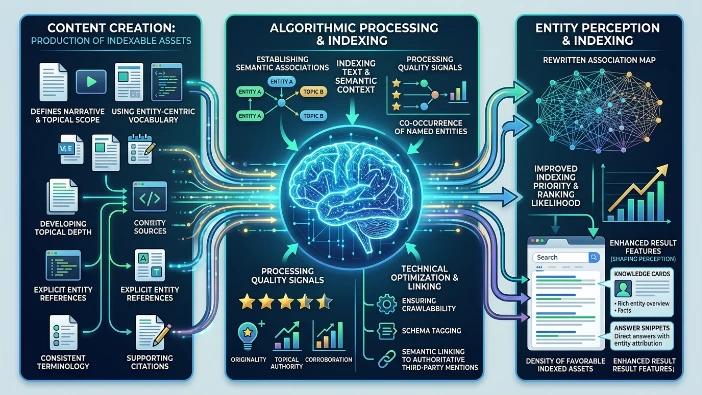
Content creation is the production of indexable assets that articulate an entity’s domain of expertise and attributes. The agency composes assets with explicit entity references, consistent terminology, and supporting citations; it then ensures crawlability and schema tagging to aid content indexing. Semantic linking between assets and authoritative third-party mentions reinforces entity association. Well-structured content increases the density of favourable indexed assets and improves the entity’s chance of appearing in result features that shape public perception, such as knowledge cards and answer snippets.
How do algorithms interpret trust and credibility signals for reputation evaluation?
Algorithms define trust as a composite score derived from signal types that indicate provenance, consistency, and authority. Interpretation occurs through signal aggregation models that weigh source reputation, topical relevance, and behavioural endorsement. Mechanisms include authority scoring (based on link profiles and domain reputation), citation analysis (contextual relevance of mentions), and machine-learned patterns that detect coherency across independent sources. The impact on perception results from algorithmic prioritisation: entities with higher computed trust scores gain improved ranking positions and enhanced SERP features.
Search systems parse signals such as cross-domain corroboration, publication history, structured identity signals (verified profiles, official domains), and user engagement metrics to compute trust. Advanced models incorporate semantic consistency and temporal stability to reduce the effect of isolated or manipulated signals. Elevated trust scores increase the visibility of trusted assets; conversely, signals indicating inconsistency or manipulation reduce prominence and can relegate content to lower-ranking positions.
How are review signals and sentiment interpreted as part of reputation scoring?
Mechanisms parse review metadata (ratings, timestamps, reviewer authority) and apply natural language processing to determine sentiment intensity and topic-specific sentiment. Search systems contextualise reviews within a broader signal set to avoid over-weighting individual outliers. The combined effect on SERP evaluation determines whether review-related assets elevate or depress an entity’s perceived credibility in query results.
Reviews with verified provenance and consistent positive sentiment increase reputation signals; negative sentiment concentrated in topical clusters lowers perceived trust. Algorithms normalise ratings across platforms and examine reviewer signals (reputation, history) to assess reliability before incorporating them into ranking functions. Aggregated positive review signals produce richer result features (review snippets, star ratings) and can boost localised SERP prominence. Negative review aggregates create negative snippets and influence the ranking of critical assets during SERP evaluation.
How does entity resolution and knowledge graph association affect corporate reputation in search?
Entity resolution is the process that links disparate mentions, URLs, and identifiers to a single canonical entity within a search knowledge graph. Knowledge graph association defines the relationships and attributes connected to that entity. Mechanisms include structured markup, authoritative mentions, and consistent naming conventions that enable disambiguation. Search systems use resolved entities to synthesise entity-centric result panels and to propagate attributes across related query intents. Correct entity resolution concentrates reputation signals, while fragmentation disperses them across multiple records and weakens perceived authority.
Agencies ensure canonical domains, consistent use of entity descriptors, and presence in authoritative directories and datasets so search systems link mentions to the correct entity node. Persistent mismatches, conflicting identifiers, or inconsistent metadata produce fragmented entity graphs. Consolidated entity graphs strengthen the aggregation of reputation signals and improve the accuracy of knowledge panels and entity-specific SERP features; fragmentation dilutes signal strength and reduces clarity in SERP evaluation.
Dive Deeper With Our Expert Guides and Related Blog Posts:
What an ORM Agency Does and How It Protects Your Brand in the UK
Which Online Reputation Management Services Do UK Businesses Actually Need
How do technical SEO and indexing controls contribute to reputation outcomes?
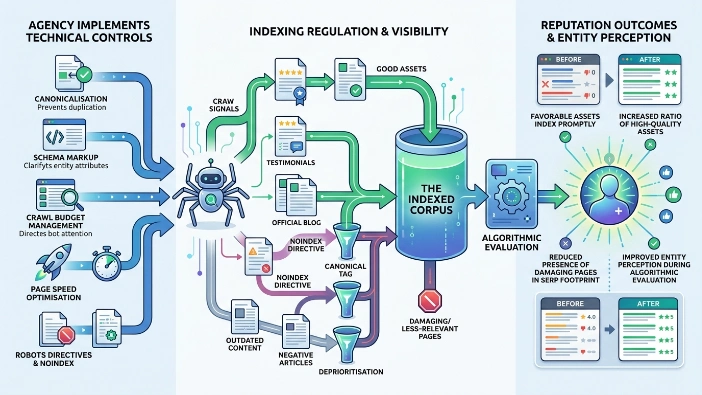
Technical SEO defines the structural measures that control how assets are crawled, indexed, and displayed in search results. Indexing controls refer to directives that permit or restrict inclusion of assets in search indices.
Mechanisms include robots directives, canonical tags, structured data, crawl budget management, and page speed optimisation. These controls regulate the visibility of assets that carry reputation signals and determine which pages contribute to entity perception. Proper technical controls ensure favourable assets index promptly and less-relevant or harmful assets remain deindexed or deprioritised during ranking.
The agency implements canonicalisation to prevent duplication, uses noindex for low-value pages, applies schema to clarify entity attributes, and optimises load times to preserve behavioural signals. These interventions shape the corpus of indexed assets associated with an entity. Effective technical controls increase the ratio of high-quality indexed assets and reduce the presence of damaging pages in the SERP footprint, leading to improved entity perception during algorithmic evaluation.
How does monitoring and measurement evaluate search-based reputation changes?
Mechanisms use query-based tracking, share-of-voice metrics in SERPs, sentiment trend analysis, and backlink audit pipelines to quantify shifts in entity perception. Measurement frameworks implement baselines and event detection to detect ranking shifts, emergent negative content, or changes in knowledge graph attributes. The outcome is an evidence-based evaluation of how reputation initiatives alter search visibility and entity authority.
The agency configures alerting on new indexed mentions, tracks feature prevalence (snippets, panels), and analyses correlation between content interventions and ranking movements. Statistical analyses identify causal relationships between signal changes and SERP outcomes. Timely monitoring and precise measurement enable rapid correction of indexing anomalies and validate which content interventions produce sustained improvements in entity perception and search prominence.
Learn More Here:
What Makes a Reputation Management PR Agency Different From Standard PR
This analysis defines reputation management as the set of observable signal flows and interventions that produce an entity’s indexed presence and perceived authority within search ecosystems. The mechanisms that form reputation include content production, signal engineering, entity resolution, review interpretation, and technical indexing controls. Algorithms interpret a weighted mix of these signals to compute trust and rank assets during SERP evaluation. Understanding these components clarifies how coordinated PR and digital strategy alter the corpus of indexed assets and the entity’s search visibility without assuming outcomes; each intervention changes the signal landscape that algorithms evaluate.
What is Corporate Reputation Management?
Corporate Reputation Management refers to the process of shaping how a business is perceived across search results, reviews, media coverage, and public references. It focuses on building trust signals, reducing negative visibility, and strengthening entity credibility in search ecosystems.
What makes a Reputation Management PR Agency different from standard PR?
A Reputation Management PR Agency combines media relations with search visibility strategy, so public coverage also supports how a brand appears in Google. Standard PR focuses more on awareness and publicity, while reputation-led PR also considers SERP impact, content indexing, and reputation signals.
How does corporate reputation affect search results?
Corporate reputation affects which pages, reviews, and media mentions appear when people search for a business name. Search engines evaluate authority, relevance, sentiment, and consistency, which influences ranking and overall entity perception.
Why are reviews important for corporate reputation management?
Reviews are important because they act as public trust signals that search engines and users can both interpret. Positive, consistent reviews support credibility, while negative review patterns can influence brand perception and click behaviour in SERPs.
How is a digital footprint connected to brand reputation?
A digital footprint is the full set of content, mentions, and indexed pages associated with a brand online. It shapes reputation because search engines use that content to build an entity profile, assess credibility, and display results that influence public perception.