

Reputation management is the systematic process of monitoring, shaping, and correcting how an entity appears within search ecosystems. Online reputation refers to the aggregated signals, content, and user interactions that define an entity’s perceived credibility across search engine results pages (SERPs). Reputation management operates as a closed-loop system of detection, analysis, intervention, and evaluation within search ecosystems.
The process is a sequence of technical and editorial actions that alter how search engines index, rank, and display content related to an entity. Mechanism: The system begins with data collection (crawlable pages, social signals, reviews, news, and metadata), proceeds to semantic analysis (entity extraction, sentiment scoring, link graph mapping), applies interventions (content creation, metadata changes, linking adjustments), and finishes with performance measurement (rank tracking, SERP composition analysis, and signal change evaluation). Impact on search visibility or perception: Each stage modifies reputation signals that search engines use for SERP evaluation content relevance, authority, recency, and user interaction metrics thereby shifting entity perception in search results.
How is reputation defined within search ecosystems?
Reputation is the composite set of indexed content, backlink profiles, structured data, and user-generated signals that search engines associate with a named entity.

Reputation is an indexable profile that search engines store and reference when resolving queries about an entity. Mechanism: Search engines construct entity graphs by extracting name-entity pairs, canonical URLs, schema markup, and co-occurrence patterns across authoritative sources; these form the baseline reputation vectors. Impact on search visibility or perception: A robust entity profile increases search visibility for relevant queries and influences SERP features (knowledge panels, featured snippets), which shape user perception before clicking.
How do search engines interpret trust and credibility signals?
Search engines evaluate trust and credibility through algorithmic weighting of provenance, authority, and behavioural signals.
Trust and credibility are algorithmic scores that represent an entity’s reliability within a given topical context. Algorithms examine provenance (source domain history and governance), authority (backlink quality, citation frequency, editorial signals), and behavioural indicators (click-through rate, dwell time, pogo-sticking) to compute credibility scores. Structured data and verified identifiers (schema, canonical links, and publisher metadata) improve provenance signals. Higher credibility scores increase the probability of elevated ranking positions and privileged SERP placements, reducing the visibility of competing negative content.
How is reputation formed through content and indexing?
Reputation forms as search engines index content and assign topical relevance and authority values to that content relative to an entity.
Content is indexed data that informs entity perception within search engines. Crawlers fetch content, extract entities and topics using natural language processing, normalise references (aliases, trademarks), and store term co-occurrence and link context in an index. Ranking systems then evaluate content against query intent and entity relevance signals. Indexing disparate content that aligns semantically with an entity increases the entity’s topical footprint; conversely, indexed negative content increases prominence in SERPs unless mitigated by stronger positive or neutral signals.
Strengthen your digital presence with professional Corporate Reputation Management that helps shape positive entity perception through authoritative content, strategic indexing, and trust-building signals. Effective reputation management enhances search visibility, reinforces credibility, and reduces the influence of negative content across SERPs.
How do review signals and sentiment analysis affect reputation in search results?
Review signals and sentiment analysis translate user opinions into quantifiable inputs that influence SERP evaluation.
Review signals are structured and unstructured user feedback that indicate perceived experience and satisfaction; sentiment analysis refers to algorithmic classification of that feedback as positive, neutral, or negative. Search ecosystems collect structured review data (ratings, review count, review schema) and unstructured reviews (blog posts, forum comments), then run sentiment models and aggregate scores across platforms. Algorithms weight verified reviews and high-authority sources more heavily. Aggregated positive review scores increase the entity’s appeal in SERPs and can unlock review-rich snippets; negative clusters depress click-through rates and can push adverse content into higher visibility positions.
How do authority and trust signals interact to shape entity perception?
Authority is a measure of topical expertise and backlink endorsement; trust is a measure of provenance and content integrity. Algorithms measure authority through link equity (anchor context, referring domain authority), editorial citations, and content depth; they measure trust through site security, historical domain behaviour, and consistency across authoritative sources. Cross-signal evaluation occurs when algorithms reconcile authority with trust high authority from low-trust sources reduces net scoring, while consistent authority across high-trust sources amplifies rank weight. Balanced high authority and trust elevate the entity’s content into top SERP positions and prominent features, consolidating favourable entity perception.
How does the digital footprint contribute to an entity’s search reputation?
The digital footprint is the totality of indexed traces that define an entity’s searchable identity and influence entity perception in SERPs.
Digital footprint refers to published pages, social profiles, archived content, and metadata that reference an entity. Crawlers accumulate footprint elements across domains and platforms, normalise identifiers (emails, phone numbers, official handles), and map interlinking and citation patterns to the entity graph. Signals such as update frequency, content diversity, and distributed authority are derived from footprint elements. A broad, consistent digital footprint generates coherent entity perception and reduces the relative visibility of outlier negative content through dilution and authoritative reinforcement.
How do content ranking dynamics determine which reputation-related pages appear in SERPs?
Content ranking dynamics are the algorithmic processes that prioritise content according to relevance, authority, and user intent relative to an entity.
Content ranking dynamics describe how algorithms order entity-associated pages in response to queries. Ranking evaluates keyword relevance, semantic topical match, backlink endorsement, on-page signals (title tags, headings, schema), and user engagement metrics. Algorithms integrate contextual signals (geographic intent, query type) and SERP feature triggers to decide which pages occupy organic results or SERP features. Pages that align with high-authority signals and user intent dominate SERP exposure, shaping public perception by defining the narrative visible to searchers.
How are entity perception and SERP evaluation connected in reputation measurement?
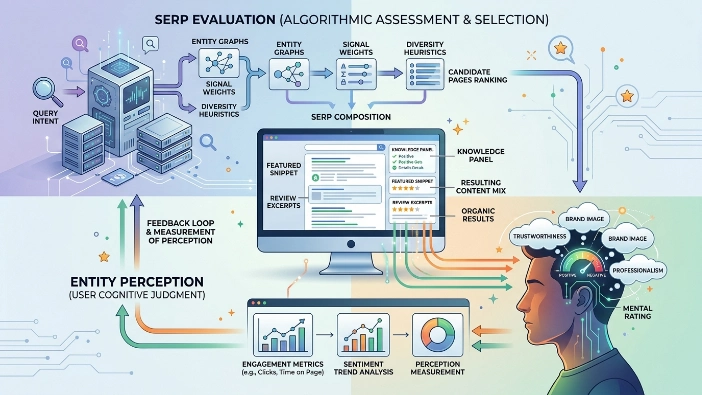
Entity perception is the user-facing interpretation of reputation; SERP evaluation is the algorithmic assessment that determines which signals manifest in perception.
Entity perception refers to the cognitive judgement a searcher forms from SERP content; SERP evaluation is the algorithmic selection process determining that content. SERP evaluation analyses query intent and maps it to candidate pages using entity graphs, signal weights, and diversity heuristics; resulting SERP composition then supplies users with snippets, knowledge panels, and review excerpts that inform perception. Changes in SERP evaluation directly change entity perception by exposing different content mixes; measurement of perception uses engagement metrics and sentiment trend analysis across SERP-driven clickstreams.
Dive Deeper With Our Expert Guides and Related Blog Posts:
How a Reputation Management PR Agency Combines PR and Digital Strategy
What an ORM Agency Does and How It Protects Your Brand in the UK
How do monitoring and evaluation close the reputation management loop?
Monitoring and evaluation provide the feedback required to refine ranking interventions and maintain desired entity perception.
Monitoring is continuous data collection of SERP composition, content changes, and signal movement; evaluation is the quantitative assessment of interventions against KPIs. Monitoring tools crawl SERPs, capture snapshot histories, and flag new negative placements; evaluation applies statistical analysis to ranking shifts, traffic changes, and sentiment trends to determine intervention effectiveness. Impact on search visibility or perception: Accurate monitoring identifies emergent negative signals for rapid mitigation; rigorous evaluation demonstrates which interventions alter SERP evaluation and improve entity perception over time.
What are the measurable signals used to assess reputation performance in search?
Performance assessment relies on a specific set of measurable signals that reflect entity standing in search ecosystems.
Reputation performance signals are quantifiable metrics that indicate visibility, credibility, and sentiment for an entity. Mechanism: Typical signals include organic ranking positions for target queries, share of SERP real estate (number and type of result features occupied), backlink growth and quality, review score averages and volume, and engagement metrics (CTR, bounce rate, dwell time). Impact on search visibility or perception: Tracking these signals reveals whether interventions shift SERP evaluation; upward trends in authority-linked metrics and positive sentiment metrics correlate with improved entity perception and higher search visibility.
Explore the Complete Guide:
Understanding How Reputation Management Works Before You Invest
This analysis defines reputation management as a systematic, measurement-driven process that shapes how search ecosystems index and present an entity. It explains how content indexing, authority and trust signals, review sentiment, and digital footprint combine to produce entity perception within SERPs. Reputation management functions through iterative monitoring, targeted interventions, and quantitative evaluation to influence search visibility and the algorithmic signals that determine public perception.
Common questions about corporate reputation management
What is corporate reputation management and how does it work?
Corporate reputation management is the practice of monitoring and shaping an organisation’s public profile in search ecosystems and media channels. It involves tracking reputation signals (search visibility, reviews, backlinks), analysing entity perception, and applying content and technical interventions to influence SERP evaluation.
How long does corporate reputation management take to show results?
Timeline depends on signal strength and intervention type; technical fixes and metadata changes can affect indexing within days, while authority-building and sentiment shifts require months of consistent content and citation activity. Ongoing monitoring and evaluation determine when visibility and perception metrics stabilise.
Which measurable signals indicate success in corporate reputation management?
Key signals include organic rankings for target queries, share of SERP real estate (snippets, knowledge panels), backlink quality and citation growth, review scores and volume, plus engagement metrics like CTR and dwell time. Tracking these signals demonstrates changes in search visibility and entity perception.
How do reviews and ratings affect corporate reputation in search results?
Reviews and ratings feed structured and unstructured reputation signals that search engines index and weight; aggregated positive scores and verified reviews improve SERP features and click-through rates. Negative review clusters increase visibility of adverse content unless countered by authoritative, relevant content and citation signals.