

Insurance Reputation Management UK
Insurance runs on a promise most customers hope they never have to test. When a claim gets disputed, delayed, or declined, that promise suddenly becomes very public, very fast, and insurance reputation management exists precisely for this moment, when trust built over years can be shaken by a single contested claim playing out publicly across reviews, social media, and regulatory channels. We help UK insurers, brokers, and intermediaries repair and rebuild that trust when it matters most.
Why Insurers Face a Uniquely Transparent Kind of Scrutiny
Few sectors operate under as much built in public transparency as UK insurance. The FCA publishes firm specific complaints data twice a year, giving anyone, including journalists, competitors, and prospective customers, direct visibility into exactly how many complaints a firm receives and how they’re resolved. Insurance reputation management has to account for this baked in transparency, since the numbers themselves become part of the public record, not just customer-generated reviews.
Insurance and pure protection complaints rose over 10% in the second half of 2025 compared to the first, with motor insurance remaining the single largest category. This regulatory level trend data means industry wide reputation pressure is rising even before you factor in any individual firm’s specific situation.
Understanding the Financial Ombudsman Service’s Role in Your Reputation
The Financial Ombudsman Service adds another layer most other industries simply don’t have. When a customer remains unhappy after a firm’s internal complaint process, which must respond within eight weeks under FCA rules, they can escalate to the FOS, where a case handler issues an initial assessment before the matter potentially moves to a final, binding decision. Every stage of this process can become visible publicly, through the customer’s own account, through FOS published decisions, or through subsequent press coverage, meaning insurance reputation management increasingly has to plan for scrutiny that extends well beyond your own website and review platforms.
Common Reputation Risks Facing UK Insurers
Several patterns show up consistently across the sector: insurance claims disputes that escalate publicly before internal resolution processes have run their course, insurer Trustpilot reviews clustering around specific, recurring themes like claims delays or unclear policy wording, rising FCA complaint figures that become a searchable, citable data point independent of any single incident, and broker level reputation issues that reflect back on the underlying insurer even when the broker, not the insurer, was actually responsible for the problem.
How We Approach Insurance Reputation Management Recovery
Our process begins with a full audit of your current public complaints picture, published FCA data, FOS decision patterns, review platform sentiment, and press coverage, giving a complete view of where your reputation currently stands and what’s actually driving it. From there, we help build clearer, more transparent claims communication that reduces the friction driving complaints in the first place, alongside a structured response strategy for reviews and public commentary that demonstrates accountability without overstepping into commentary on specific, ongoing disputes.
Our guide to financial reputation management covers the broader regulatory sector principles that apply here too, alongside insurance specific considerations around claims handling and FOS process transparency that don’t apply the same way to other financial services.
Rebuilding Trust After a Difficult Complaints Period
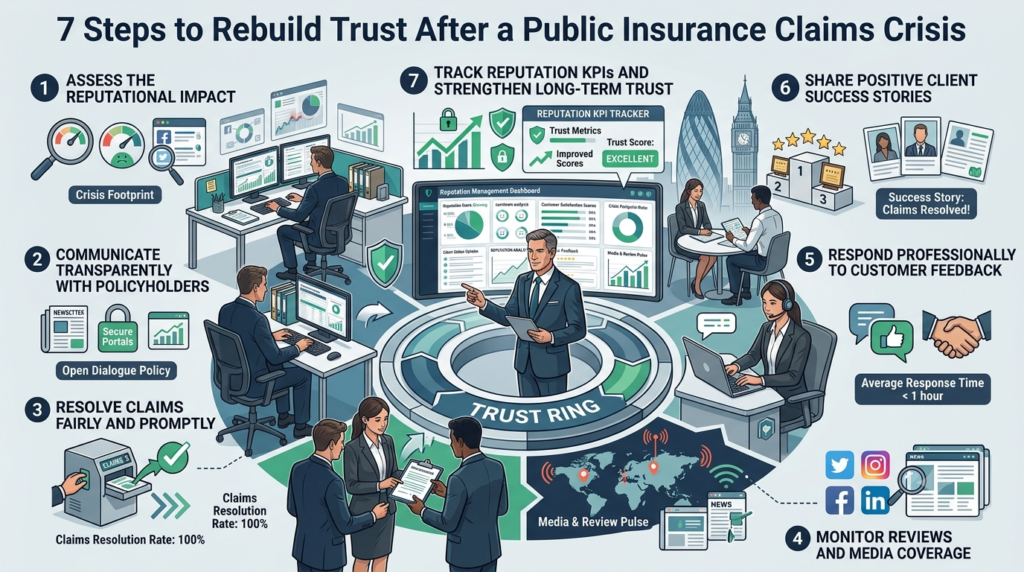
Insurance reputation management recovery after a genuinely difficult period, a spike in complaints, a public FOS decision, a wave of negative claims related reviews, requires the same core principle that applies across any reputation recovery: genuine, visible improvement matters more than messaging alone. This means demonstrably faster claims handling, clearer policy communication that reduces future disputes, and consistent, transparent public response to reviews and complaints rather than defensive silence. Our guide to rebuilding reputation after a mistake or scandal covers this broader recovery arc in more depth, directly applicable to a firm working through a difficult complaints period.
Handling a Public Claims Dispute Without Making It Worse
When a specific claims dispute goes public, speed and care matter more than a defensive statement. Confidentiality obligations often limit exactly what can be said about an individual policyholder’s case publicly, which makes a calm, general acknowledgement the safer approach rather than engaging point by point in public. Our guide to reputation damage control in the first 48 hours covers the response framework we apply to fast moving disputes, adapted specifically to the confidentiality constraints insurance cases carry.
Building Long-Term Insurance Customer Trust Proactively
The strongest position for any insurer isn’t recovering from a crisis well, it’s never needing to. Proactive insurance reputation management builds cumulatively through consistently transparent policy communication, a genuinely fast and fair claims process reflected honestly in reviews over time, and proactive publication of service standards and complaint handling improvements rather than waiting for regulatory data to tell the story first. Our guide to building a positive content strategy covers the foundational work behind this longer term trust building approach.
Frequently Asked Questions
Why is insurance reputation management different from general financial services reputation work?
It has to account for the FCA’s published firm specific complaints data and the Financial Ombudsman Service’s public dispute resolution process, two layers of built in transparency that most other financial sectors don’t have to the same degree.
Can a firm’s published FCA complaints data actually be improved?
Yes, over time, by genuinely reducing complaint volume and improving resolution speed, since the data reflects real operational performance rather than something that can be managed through messaging alone.
Should an insurer respond publicly to a review about a declined claim?
With a calm, general response only, since confidentiality obligations limit what can be said about a specific policyholder’s case publicly, even when the firm believes its decision was entirely correct.
How does a Financial Ombudsman Service decision affect a firm’s public reputation?
Published FOS decisions and subsequent press coverage can become part of a firm’s visible public record, meaning reputation strategy increasingly needs to account for scrutiny beyond a firm’s own website and review platforms.
What’s the fastest way for an insurer to start improving its reputation?
Start with a full audit connecting published complaints data, review sentiment, and internal claims process performance, since effective insurance reputation management always starts by identifying the operational root causes, not just the visible symptoms.