
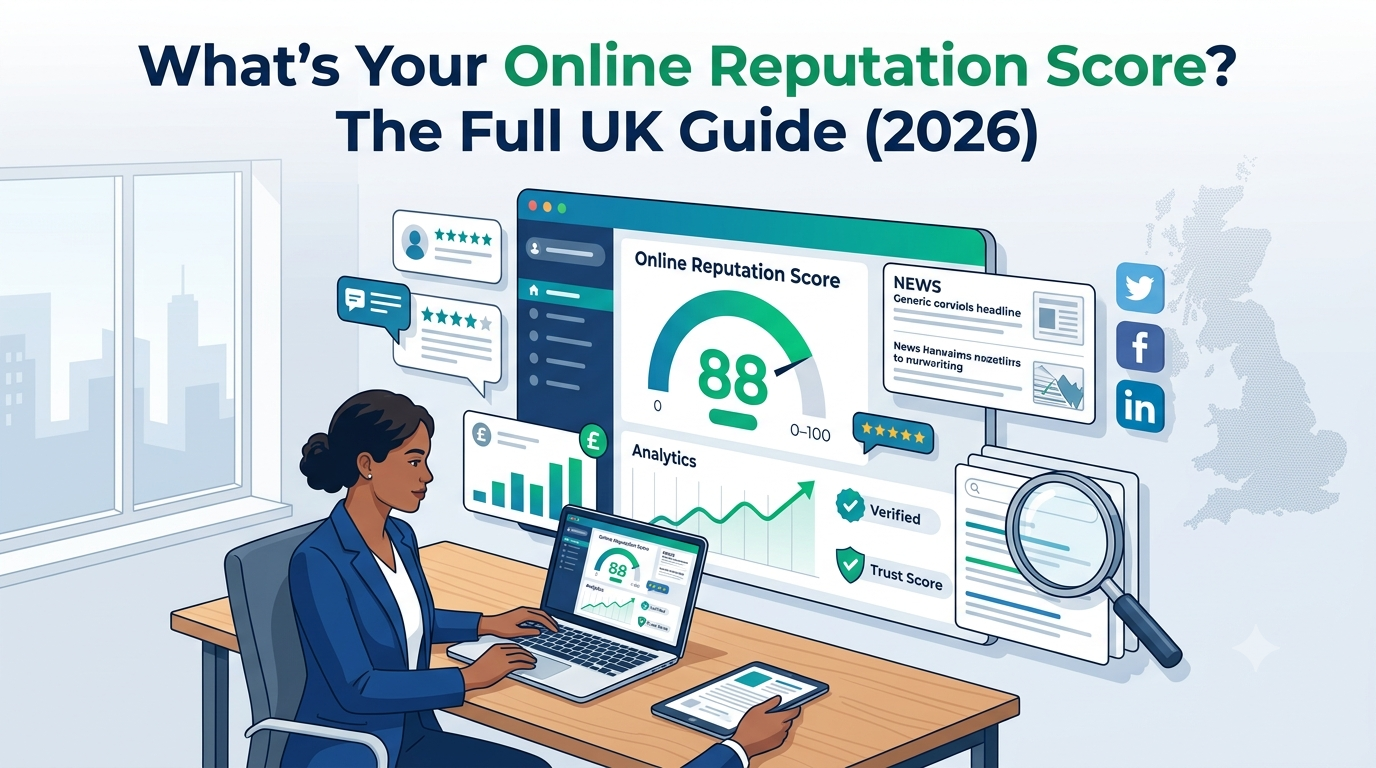
Online Reputation Score
Search your name or your business on Google right now. What comes up in the first ten results says more about your credibility than almost anything else you control online. That combined impression, built from reviews, search results, social mentions, and news coverage, is what’s known as your reputation score, and in the UK it’s becoming one of the most searched-for ways to understand how you’re really perceived online.
This guide breaks down what a reputation score actually is, how it’s calculated, and what UK businesses and individuals can do to improve theirs.
Reputation Score: What It Means
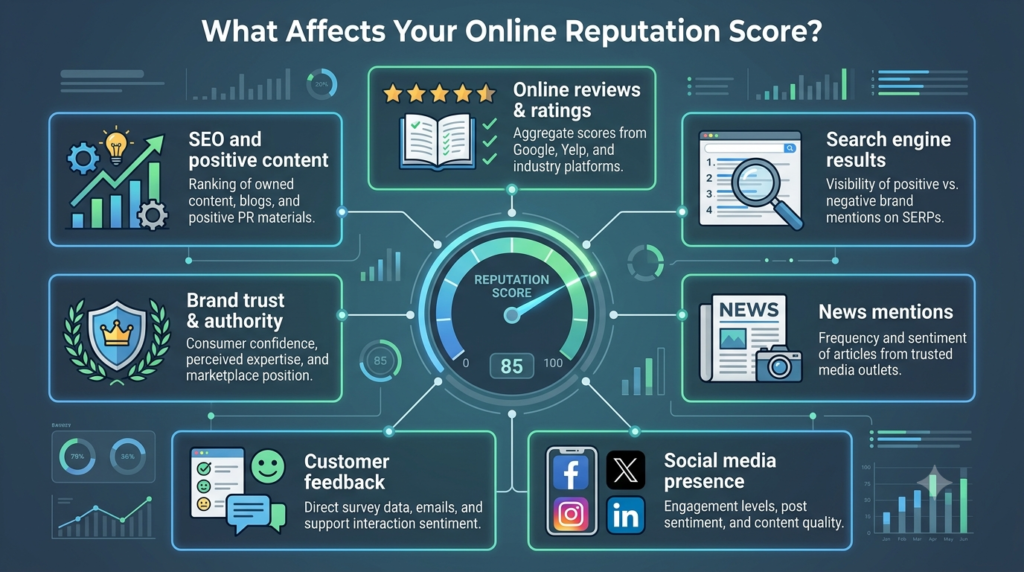
A reputation score is a single number, usually somewhere between 1 and 100, that summarises how positively (or negatively) a person or brand appears across the internet. It typically pulls together several signals:
- Star ratings and review volume across platforms like Google, Trustpilot, and Yelp
- The tone and sentiment of what appears in search results
- How quickly and professionally negative feedback is handled
- The presence of positive versus negative news coverage
- Consistency and completeness of business listings and social profiles
Think of it as a rough credit score for your digital presence. It’s not an official or universal metric (different tools calculate it differently) but it gives a useful snapshot of where you currently stand.
Online Reputation Score: How It’s Calculated
Most tools that generate an online reputation score weigh a mix of the following:
- Review sentiment and volume – a high star rating with hundreds of reviews carries more weight than a perfect score from just three people
- Search visibility – whether you or your business controls the first page of Google, or whether negative content is ranking instead
- Response behaviour – businesses that reply to reviews (especially negative ones) tend to score higher, since it signals active management
- Social and media mentions – consistent, professional presence across platforms and any earned media coverage
- Listing accuracy – correct, up-to-date business details across Google Business Profile and other directories
Because there’s no single industry-standard formula, your score can vary slightly from tool to tool. What matters more than the exact number is the trend: is it improving, stable, or declining over time?
Brand Reputation Score: Why It Matters for UK Businesses
For UK businesses, your brand reputation score has a direct link to revenue. Customers routinely check reviews and search results before making a purchasing decision, and a business with a low or declining score is quietly losing customers to competitors who never get the chance to prove themselves.
A strong brand reputation score also supports:
- Higher conversion rates from organic search traffic
- Stronger trust signals for Google’s ranking algorithms
- Better outcomes when applying for finance, partnerships, or tenders that involve due diligence
- Resilience if negative content or a review crisis does appear, since a strong foundation is harder to knock down
Business Reputation Score vs Company Reputation Score
These terms are often used interchangeably, but there’s a subtle distinction worth knowing:
- A business reputation score usually refers to the customer-facing side: reviews, ratings, and how the business is perceived by people actively considering buying from it.
- A company reputation score tends to be broader, factoring in things like media coverage, leadership perception, employer reviews (such as Glassdoor), and overall corporate standing, not just customer sentiment.
A small local business might only need to focus on the former. A larger UK company, especially one with public-facing leadership, usually needs to manage both.
How to Check Your Online Reputation Score in the UK
There’s currently no dedicated, UK-specific reputation scoring standard, which means most free tools available are US-built and may not fully reflect UK-relevant platforms like Trustpilot, Yell, or Checkatrade. To get an accurate picture in the UK, it’s worth combining:
- A manual search of your name or business name in an incognito browser window
- A review of your Google Business Profile rating and review volume
- A check of any UK-specific review platforms relevant to your industry
- A look at what appears in Google News for your name or brand
For a more precise, UK-contextualised assessment, working with a reputation management specialist who understands the local review landscape and search environment will give a far more accurate read than a generic international tool.
How to Improve a Low Reputation Score
If your score is lower than you’d like, the good news is that it’s rarely permanent. The most effective steps include:
- Respond to every review, positive and negative, professionally and promptly
- Actively request reviews from satisfied customers rather than waiting for them organically
- Publish consistent, positive content such as case studies, expert articles, and updates that reinforce credibility
- Address negative content directly where appropriate, rather than ignoring it
- Keep listings accurate and complete across every platform your customers use
Improvement is usually gradual. Most UK businesses see measurable movement within three to six months of consistent effort, with more significant, lasting change over six to twelve months.
Frequently Asked Questions
What is a good reputation score?
Generally, a score of 80 or above is considered strong, 60 to 80 is fair with room for improvement, and anything below 60 signals the reputation needs active attention.
Can I improve my reputation score myself?
Yes, particularly for straightforward issues like review volume and response consistency. More complex cases, such as negative press or coordinated fake reviews, usually benefit from professional support.
How often should I check my online reputation score?
Quarterly is a sensible baseline for most businesses, with more frequent checks during or after a period of public attention, a product launch, or a known dispute.
Does a reputation score affect SEO rankings?
Indirectly, yes. Review signals and search sentiment both feed into how Google evaluates trustworthiness, which can influence visibility for branded and local searches.