

Reputation management is the process of shaping how an entity is understood through search results, reviews, and indexed mentions. Online reputation refers to the total set of reputation signals that influence how users and search engines evaluate trust and credibility.
What makes a Google review fake in reputation systems?
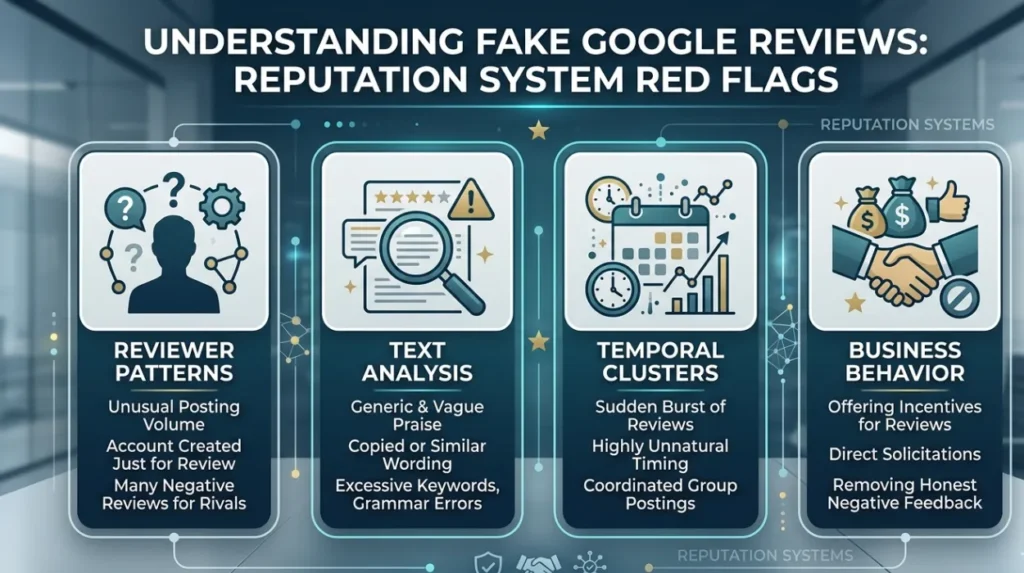
A fake Google review is a review that does not reflect a genuine customer experience. It refers to a manipulated reputation signal within search ecosystems, where the review exists to distort entity perception, sentiment distribution, or ranking trust rather than to report authentic feedback.
Dive Deeper With Our Expert Guides and Related Blog Posts:
Get Fake Google Reviews Removed Legally With UK Expert Assistance
Remove Fake Google Reviews Quickly and Legally With Our UK Service
Fake reviews appear in different forms. Some are written by accounts with no transaction history. Some are posted in bulk across short time windows. Some reuse the same sentence pattern across unrelated businesses. Search systems interpret these behaviours as abnormal because they break the usual distribution of organic review activity. That abnormality affects content indexing and the reputation profile attached to the business name.
Google evaluates reviews as part of a wider trust environment. It does not treat review text in isolation. It also considers account behaviour, timing, repetition, and platform history. A fake review can therefore influence perception even when it is short or vague, because the ranking system reads the review as one element in a broader credibility pattern. This is why fake reviews are a search visibility issue, not only a customer service issue.
How do search engines interpret review signals?
Search engines interpret review signals by analysing volume, timing, wording, account behaviour, and consistency across the wider entity profile. SERP evaluation uses these signals to determine whether the review pattern looks credible, coordinated, or manipulated.
Review signals have more weight when they cluster in a short period. A sudden rise in negative ratings often changes sentiment distribution more than a steady pattern of mixed feedback. Search engines also evaluate the account that posted the review. A new account with no profile history carries less trust than an established account with normal activity. These patterns affect how the review contributes to the reputation record.
Search visibility changes because reviews can appear in snippets, maps results, and business profile summaries. Even a small number of fake reviews can influence entity perception when the profile has limited review volume. The system reads that data as evidence of quality or risk. That means fake reviews influence ranking trust indirectly as well as visually. The result is a stronger negative association around the business name.
What evidence supports a fake review report?
Evidence is the set of observable facts that shows a review lacks authenticity or violates platform rules. It refers to timestamps, account details, review patterns, and content markers that demonstrate inauthentic behaviour within the search ecosystem.
Useful evidence includes profile age, posting frequency, language duplication, and mismatched activity. A review from an account created the same day as the post carries different weight from a long standing account with normal activity. Repeated wording across multiple reviews also matters because it suggests scripted content. The stronger the evidence, the clearer the reporting case becomes.
Evidence matters because review removal requests are evaluated against platform standards. A report with no supporting detail often fails to change the review’s visibility. A report with factual indicators creates a more credible challenge to the content’s authenticity. That improves the chance of action and reduces the time the fake review continues to shape public perception.
How does the reporting process work?
The reporting process works by identifying the review, documenting the issue, and submitting a policy based challenge to the platform. It defines a structured path from evidence collection to review evaluation, which helps reduce harmful visibility and clarify the reputation impact.
The first step is to locate the review and capture the exact text, date, and account name. The second step is to compare the review against the business record and the reviewer profile behaviour. The third step is to decide whether the issue concerns spam, conflict of interest, harassment, or inauthentic activity. The fourth step is to submit the report through the platform’s review flagging process or support route.
After submission, the system evaluates the report against policy and behaviour patterns. Some reviews disappear quickly. Others remain live until more evidence or a stronger policy link appears. The outcome affects search visibility because the review no longer contributes to the public sentiment pattern if it is removed. That change can improve trust signals around the business profile.
Why does fake review removal affect digital footprint?
Fake review removal affects digital footprint because it changes what remains searchable, visible, and associated with the business name. Digital footprint refers to the searchable record of reviews, mentions, and indexed content that shapes brand and entity reputation across search ecosystems.
A business with fake reviews has a distorted footprint. The distortion appears in star ratings, summary text, and map visibility. Removing the fake review does not erase all reputation risk, but it reduces the amount of harmful evidence attached to the profile. That matters because users scan the footprint quickly before deciding whether to trust the business.
Search systems also read the footprint as a pattern. If negative reviews appear without corresponding signals of service failure, the review mix looks unstable. Once the fake signal is removed, the balance of sentiment distribution becomes more accurate. That creates a cleaner reputation record and a more credible digital identity.
How do trust and authority signals shape review visibility?
Trust and authority signals shape review visibility by influencing how much weight the system assigns to the reviewer, the platform, and the business profile. Authority signals are indicators of source strength, while trust signals are indicators of reliability and consistency within the search environment.
A review from a low trust account has less legitimacy than one from a long standing profile with normal behaviour. A business profile with strong authority signals also handles criticism differently because the wider record provides context. Search systems combine these cues to decide whether a review looks organic or suspicious. That evaluation affects how the review contributes to ranking and perception.
Authority and trust also affect user judgement. A profile that shows stable ratings, complete information, and normal activity looks more credible than one with sudden review spikes. This is why fake review removal matters beyond moderation. It helps restore the signal balance that supports online credibility. The cleaner the signal balance, the stronger the perceived trust.
What happens when fake reviews stay visible?
Fake reviews stay visible when the report lacks evidence, the policy route is unclear, or the platform does not classify the review as removable. When this happens, the harmful review continues to influence search perception, trust signals, and the public reading of the business profile.
Visible fake reviews affect behaviour quickly. Users often give disproportionate attention to recent negative feedback. That means one fake review can damage decision making even when the overall profile is positive. Search engines also keep displaying the review in result layers, which extends its impact. The review then functions as a persistent negative reputation signal.
The issue becomes more serious when fake reviews cluster together. A cluster creates a false sentiment pattern that changes the appearance of quality. That can reduce click confidence, lower conversion intent, and create a trust gap. Fake review removal therefore serves both perception management and search control. It reduces the persistence of the harmful signal.
How does sentiment distribution affect online credibility?
Sentiment distribution affects online credibility by showing whether the overall review environment appears balanced, unstable, or manipulated. It refers to the mix of positive, neutral, and negative reputation signals that shape how algorithms and users interpret trust.
A natural sentiment pattern usually contains variation. A manipulated pattern often contains sudden peaks, repeated wording, or clusters from low history accounts. Search systems use that pattern to assess credibility. When the pattern looks artificial, the review’s trust value falls. That can lead to reduced weight, moderation, or removal.
Sentiment distribution also influences human judgement. Users do not calculate exact review ratios, but they do notice imbalance. A profile with a few highly suspicious negative reviews can feel less trustworthy than one with a larger but more natural mix. This is why fake review control matters for online credibility. It keeps the public record aligned with real behaviour rather than artificial noise.
What role does content indexing play in review damage?
Content indexing plays a major role because indexed reviews remain accessible to search systems and users. Content indexing is the process by which search engines store, categorise, and surface review content within their results and associated business profiles.
If a fake review is indexed, it becomes part of the searchable record. That means it can appear in profile summaries, maps, or review snippets even when the business disputes it. The longer it remains indexed, the more it contributes to entity perception. Removal or deindexing reduces that contribution by limiting the review’s reach.
Indexing also matters because cross platform references can reinforce a negative signal. If the fake review is quoted, shared, or mirrored, the effect extends beyond the original page. That creates a broader search visibility problem. Review reporting therefore interacts with indexing logic, not just moderation rules. The goal is to reduce the surface area of the harmful content.
How does the step by step guide help users understand the system?
A step by step guide helps users understand the system by turning review reporting into a clear sequence of actions. The sequence defines what to check, what to record, and how to submit evidence so the report matches the platform’s review framework.
The first step is to identify the review and the account behaviour behind it. The second step is to collect evidence that shows why the review lacks authenticity. The third step is to choose the correct reporting category. The fourth step is to submit the report and monitor the result. The fifth step is to review whether the removal changes search visibility and sentiment distribution.
A guide matters because users often confuse frustration with evidence. A structured method reduces that error. It also helps the reporter think in terms of search ecosystems rather than isolated complaints. That shift improves the quality of the report and supports a more accurate reputation response.
Review reporting steps
- Capture the review text and date, for example the exact star rating and wording.
- Check the reviewer profile, for example account age and activity history.
- Match the review against business records, for example whether no transaction exists.
- Select the reporting route, for example spam, conflict of interest, or inauthentic content.
- Monitor the search result effect, for example whether the review disappears from the profile.
Why does this matter for hospitality and travel profiles?
Hospitality and travel profiles rely heavily on public trust because decisions happen quickly and comparison often happens at the point of search. Fake review removal matters because it protects the reputation signals that shape booking confidence, perceived quality, and online credibility across the profile.

These sectors depend on visible ratings and recent feedback. A fake review can distort the perception of service quality without reflecting the actual experience. That distortion affects search visibility because users click differently when the profile looks unstable. It also affects brand reputation because the rating summary becomes part of the search record.
Hospitality and travel businesses therefore need a disciplined way to interpret review signals. The issue is not only whether a review is negative. The issue is whether the review fits the actual pattern of customer sentiment. When it does not, the review harms the digital footprint and weakens trust. That is why understanding the reporting system matters at the informational stage.
What is the main conceptual takeaway?
The main takeaway is that fake Google reviews are search signals that distort the reputation record. They influence entity perception by changing sentiment distribution, content indexing, and the visible pattern of trust around the business name.
Reporting them requires evidence, system knowledge, and a clear understanding of how search engines evaluate credibility. The review does not exist in isolation. It becomes part of a wider reputation graph that includes profile history, authority signals, and search visibility. That is why fake review reporting works best when the reporter understands the system rather than only reacting to the rating itself.