
University Reputation Recovery
Every university that develops a genuinely damaged public reputation got there through a specific, addressable pattern, not bad luck. A declining NSS score, a poorly handled incident, a league table drop that made local and national press, or a Clearing period that generated the wrong kind of viral attention. The institutions that recover aren’t the ones that simply wait for the story to fade. They’re the ones that treat university reputation recovery as active, structured work, and that’s exactly what we help institutions do.
We Understand Why Universities Need Reputation Recovery
Institutions seeking university reputation recovery usually share a familiar starting point: a genuine issue that wasn’t communicated well in the moment, followed by search results and press coverage that kept the story visible long after the university itself had moved past it. Our work starts by mapping exactly what’s currently visible, what’s driving it, and which parts are within our control to actually change.
Our University Reputation Recovery Process, Step by Step
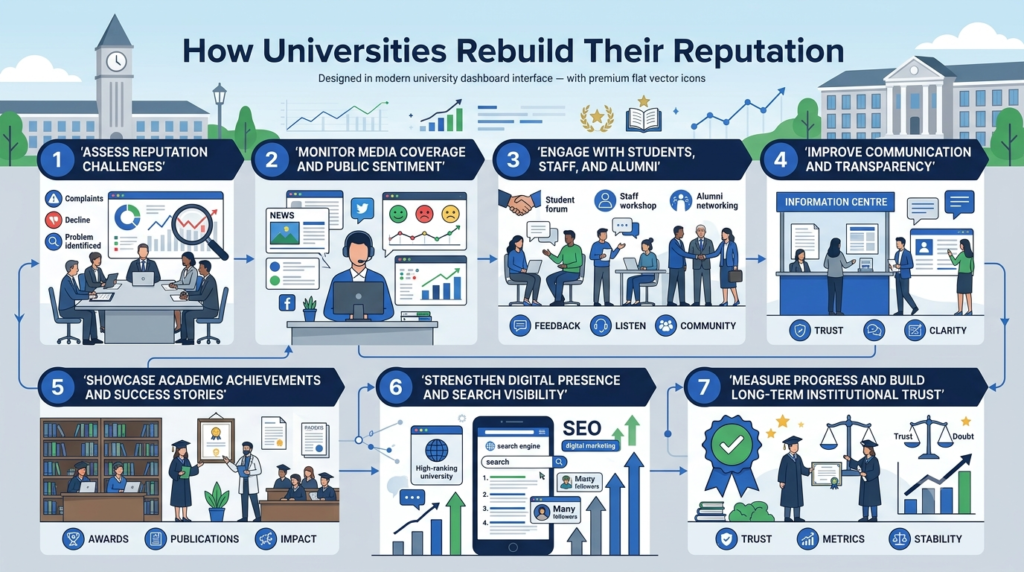
We approach institutional reputation recovery in four connected stages, built specifically around how higher education audiences, prospective students, parents, staff, and the media, actually research and form judgements.
1. Full reputation audit. We map current search visibility, press coverage, social sentiment, and review platform presence for the institution’s name, identifying exactly what’s driving negative perception and separating genuine issues from outdated or disproportionate coverage.
2. Strategic communication support. For universities still working through an active issue, we help build clear, consistent messaging across every channel, ensuring students, staff, and media all receive coordinated, accurate information rather than fragmented or delayed updates.
3. Search visibility rebuilding. We develop authoritative, genuine content, updated institutional profiles, current achievements, and credible third-party coverage, designed to give search engines strong, accurate material to prioritise over outdated or disproportionate negative coverage.
4. Ongoing monitoring and readiness. Once visible recovery is underway, we establish continuous monitoring so future issues are caught early, alongside a documented response plan so the institution never faces the next incident without a clear process already in place.
Why University Reputation Recovery Takes Structured Work, Not Just Time
Institutions rarely improve their standing simply by waiting. Search engines continue surfacing the same negative coverage indefinitely unless it’s actively outweighed by stronger, more current content. Meanwhile, every admissions cycle that passes without active reputation work is another cohort of prospective students forming their impression from an outdated or incomplete picture. Structured university reputation recovery compresses a process that could otherwise take years into a much more manageable, actively managed timeline.
What Makes Higher Education Reputation Work Different
University PR services require a genuinely different approach than standard corporate reputation work, and genuine university reputation recovery reflects that difference throughout. Institutions answer to multiple audiences simultaneously, prospective students choosing where to apply, current students and staff who need consistent internal communication, alumni networks, and media covering higher education specifically. Our guide to reputation damage control in the first 48 hours outlines the response framework we apply to fast-moving campus incidents, adapted specifically to the confidentiality and multi-audience considerations universities face that a generic corporate crisis plan simply doesn’t account for.
Rebuilding Search Visibility the Right Way
We never rely on tactics that risk further damaging an institution’s standing, no manufactured reviews, no attempts to hide legitimate coverage, and no promises of guaranteed removal, since none of that holds up and all of it risks making a difficult situation worse. Instead, our approach to building a positive content strategy focuses on genuine, verifiable content: real achievements, real improvements, and real third-party coverage that search engines have legitimate reason to rank highly, the only approach that produces recovery which actually lasts.
Student Recruitment Impact: Why This Work Pays for Itself
Reputation directly affects application volume, since prospective students and their families research institutions extensively before applying, and negative search results discovered during that research phase can quietly remove an institution from consideration entirely. Institutions that invest in structured recovery typically see this reflected in stronger, more confident applicant engagement well before the next official league table cycle even publishes.
What Working With Us Looks Like
We begin with a confidential audit of your institution’s current search and media presence, at no risk to your public profile during the review itself. From there, we build a recovery plan specific to your actual situation, whether that’s a single recent incident, a longer pattern of declining sentiment, or preparation ahead of an anticipated period of scrutiny. Every engagement is built around realistic timelines and transparent reporting, not vague promises.
Frequently Asked Questions
How quickly can university reputation recovery show results?
Meaningful movement in search visibility typically begins within a few months, while full recovery, reflected in league tables and broader public perception, usually follows the natural NSS and admissions cycle, generally one to two years for a significant turnaround.
Can negative press coverage about a university actually be removed?
Genuine news coverage is rarely removable outright. Our focus is building strong enough current, authoritative content that older or disproportionate coverage no longer dominates search results for the institution’s name.
Do you work with universities during an active crisis, or only after?
Both. We support institutions through active, fast moving situations with structured communication guidance, and we also lead longer term recovery work once the immediate situation has stabilised.
Is this only relevant for universities that already have a serious reputation problem?
No. Institutions increasingly engage us proactively, ahead of a known risk period such as a funding announcement, restructuring, or anticipated league table shift, since prevention is consistently more cost-effective than recovery.
How do you avoid tactics that could create further risk for the institution?
We never use manufactured reviews, content suppression tactics, or guaranteed removal promises. Our approach is built entirely on genuine, verifiable content and transparent communication, the only strategy that holds up under scrutiny and actually protects an institution long term.